
Call Us 📞 800-323-3130
Mon–Fri 8am–6pm CST, Sat–Sun 9am–1pm CST
Free design consultations
Showrooms in Miami & Fort Lauderdale
Call us at 800-323-3130 or email us at info@coolwinecellar.com in case of any questions.
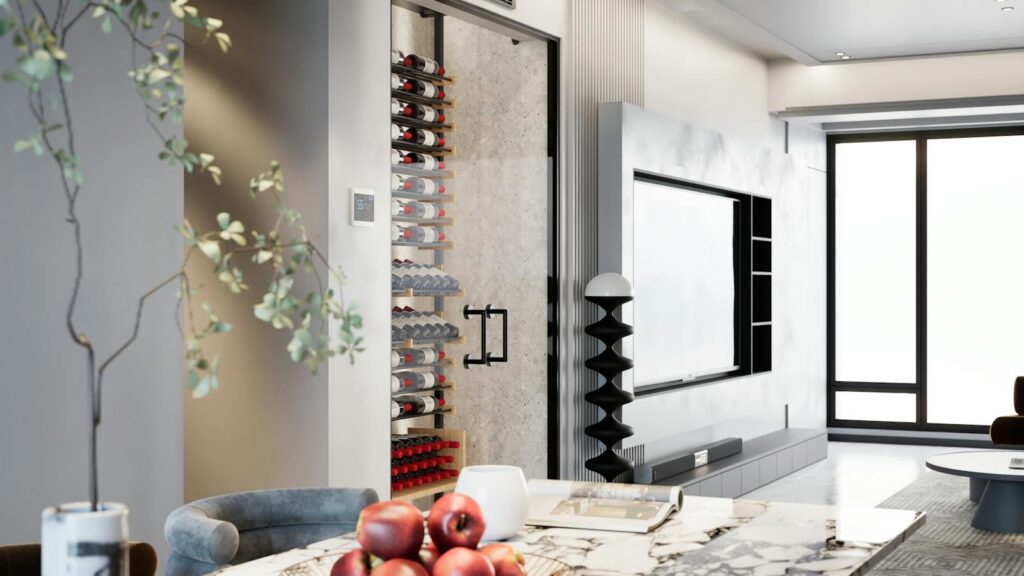
Short answer: a passive wine cellar has no mechanical cooling. It relies on being below ground, on thermal mass and on insulation to stay naturally cool and steady. An active wine cellar uses a dedicated wine cellar cooling unit to hold a set temperature and humidity regardless of the weather. Passive cellars cost almost nothing to run but only work where the ground itself is cool enough; active cellars work in any home and any climate, which is why most cellars built today are active.
| Passive wine cellar | Active wine cellar | |
|---|---|---|
| How it stays cool | Earth contact, thermal mass, insulation | Dedicated cooling unit with thermostat |
| Temperature control | Follows the ground; drifts slowly with the seasons | Held at a set point, typically about 55°F |
| Humidity control | Whatever the site provides | Managed by the cooling system, with a humidifier if needed |
| Where it can go | Below grade, in a suitably cool climate | Any floor, any room, any climate |
| Glass walls and display | Rarely practical | Yes, with insulated glass |
| Energy use and noise | None | Some; depends on system type and room construction |
| Maintenance | Minimal | Periodic service of the cooling unit |
A passive wine cellar is a room, almost always underground, that holds wine-friendly conditions without machinery. A few feet below the surface, soil temperature changes very slowly and stays close to the local average annual air temperature. Surround a room with that soil, add masonry or stone for thermal mass, insulate the ceiling and any above-grade walls, and the room changes temperature by only a few degrees over an entire year.
That slow, gentle drift is acceptable for wine. Rapid day-to-night swings are what do damage, and a true passive cellar does not have them.
When does a passive wine cellar work?
When does it not work?
In warm regions the ground is simply too warm. In South Florida, for example, ground temperatures run in the 70s °F and most homes have no basement, so a passive cellar cannot reach storage temperature. The same is true of any above-grade room, condo, closet or under-stairs space, and of any cellar with large glass walls.
An active wine cellar is a sealed, insulated room with a cooling system designed specifically for wine storage. Unlike household air conditioning, which is built for comfort at around 70°F and strips moisture from the air, a wine cellar cooling unit is designed to hold about 55°F while keeping relative humidity in the 50–70% range.
The main system types are:
We supply and install wine cellar cooling units from WhisperKOOL and Wine Guardian.
What does an active cellar need besides a cooling unit?
The cooling unit is only half of an active cellar. The room has to be built to hold the cold:
Both can age wine well. A genuine passive cellar in the right location has a long track record. An active cellar offers something a passive one cannot: a fixed set point, humidity control and a monitored record of conditions. For valuable bottles that record matters, as explained in designing a cellar for rare and investment-grade wines.
Yes. Many of the most efficient cellars are hybrids: a below-grade room with good insulation and thermal mass, plus a small cooling unit that only runs during the warmest months. The better the passive performance of the room, the smaller and quieter the equipment can be. If you have a basement, start with our page on basement wine cellar design.
What is a passive wine cellar?
A wine cellar with no mechanical cooling. It stays cool because it is below ground and well insulated, so its temperature follows the slow, stable temperature of the surrounding earth.
What is an active wine cellar?
A sealed, insulated room cooled by a dedicated wine cellar cooling unit that holds a set temperature, usually about 55°F, and manages humidity.
Can I build a passive wine cellar in Florida?
Not for proper storage temperatures. Ground temperatures in South Florida are in the 70s °F and most homes lack basements, so wine cellars there need active cooling.
Is a passive wine cellar cheaper?
It is cheaper to run because it uses no energy, but it is only an option if the home already has a suitable below-grade space in a cool climate. Excavating to create one is costly.
Can I use a regular air conditioner for an active wine cellar?
No. Household air conditioners are not designed to hold 55°F and they remove too much humidity. Use a cooling unit made for wine cellars.
Not sure which type your home can support?
Send us the room dimensions and location and we will run a free heat load calculation and recommend the right approach. Request a free design, explore our wine cellar design services, or call 800-323-3130.