
Call Us 📞 800-323-3130
Mon–Fri 8am–6pm CST, Sat–Sun 9am–1pm CST
Free design consultations
Showrooms in Miami & Fort Lauderdale
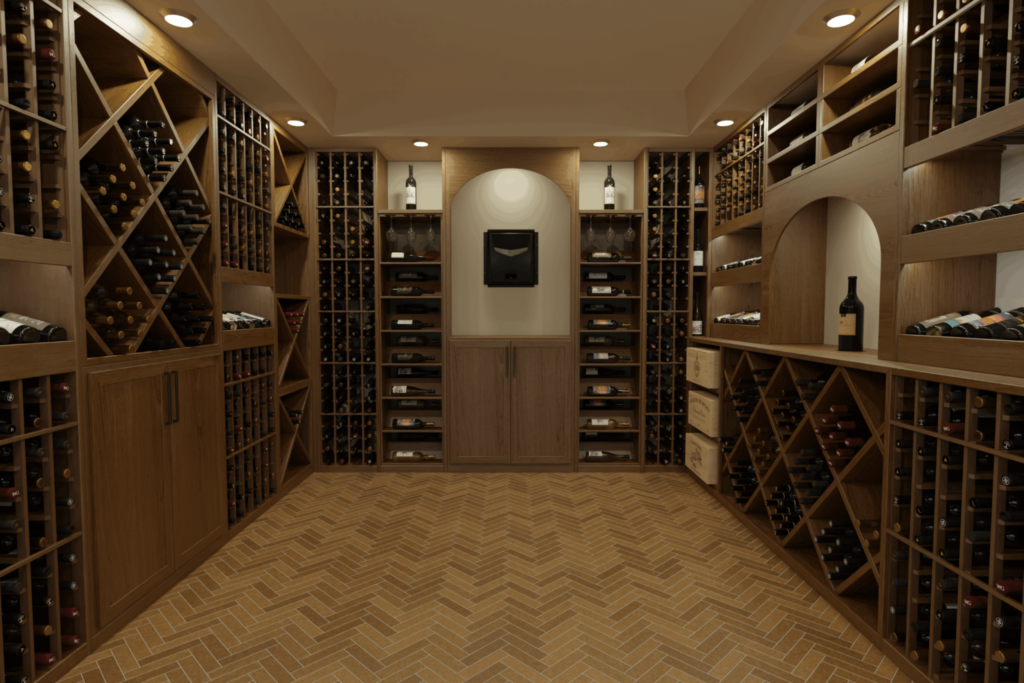
When designing a climate-controlled wine cellar, most homeowners immediately think about temperature. Keeping wine around the proper storage temperature is essential, but humidity is just as important when you’re planning for long-term wine storage.
A wine cellar that is too dry can create problems with corks, while excessive humidity can contribute to mold, condensation, and label damage. This is where a dedicated wine cellar humidifier can become an important part of the climate-control system.
Do you need a humidifier for your wine cellar?
The answer depends on the environment, construction of the cellar, and how effectively your cooling system manages moisture. Wine Guardian recommends maintaining approximately 50%–70% relative humidity (RH), with 60% considered ideal for wine cellars.
In this guide, we’ll explain how humidity affects wine storage, why a cooling unit may not be enough, when you may need a humidifier, and the difference between Wine Guardian integrated and freestanding humidifiers.
Wine bottles may appear completely sealed, but the cork plays an important role in long-term wine aging.
Natural cork is designed to provide a controlled seal while allowing extremely small amounts of oxygen exchange over time. Maintaining the right humidity helps prevent the cork from becoming excessively dry.
According to Wine Guardian, relative humidity between 50% and 70% is appropriate for wine cellars, with 60% RH as the ideal target.
The goal isn’t simply to make the cellar as humid as possible.
Instead, the objective is to maintain a stable, controlled environment.
When relative humidity falls below the recommended range, the environment can become too dry for long-term wine storage.
One concern is cork drying.
A dried cork can lose some of its sealing effectiveness, potentially allowing greater oxygen exposure and contributing to evaporation and wine deterioration over time. Wine Guardian specifically identifies humidity below 50% as a condition that can contribute to dry or cracked corks.
Potential warning signs include:
Relative humidity consistently below 50%
Very dry cellar air
Corks becoming brittle or deteriorating
Increasing ullage in stored bottles
Excessive moisture loss over long storage periods
A cooling system that runs frequently in a dry environment
A digital hygrometer or the humidity sensor associated with your climate-control system can help identify whether the cellar is actually too dry.
More humidity isn’t necessarily better.
When relative humidity stays above approximately 70%, the cellar environment can become increasingly susceptible to mold and other moisture-related problems.
Excessive humidity can contribute to:
Mold growth
Label deterioration
Glue breakdown
Condensation
Damage to wood finishes
Musty odors
Deterioration of the overall wine cellar environment
Wine Guardian recommends keeping wine cellar humidity within the 50%–70% RH range rather than allowing humidity to rise unchecked.
This is particularly important in humid climates such as South Florida, where the challenge may not be adding humidity but controlling excess moisture.
Wine Guardian’s current guidance recommends:
50%–70% RH
with:
60% RH as the ideal target.
A useful way to think about the range is:
| Relative Humidity | General Consideration |
|---|---|
| Below 50% | Environment may be too dry |
| Around 60% | Wine Guardian’s ideal target |
| 50%–70% | Recommended range |
| Above 70% | Increased risk of mold and label/adhesive problems |
The important point is that your wine cellar should maintain a stable environment, rather than constantly moving between very dry and very humid conditions.
No.
In fact, cooling systems can remove some moisture from the air as they operate.
This is one of the most important things homeowners should understand when planning a wine cellar.
A cooling unit’s primary job is to control temperature. A cooling unit alone cannot add moisture to the cellar air. Wine Guardian explicitly notes that a cooling unit cannot add humidity.
This means that a cellar in a dry environment may require both:
Wine Cooling + Humidity Control
rather than relying on the cooling system alone.
Not every wine cellar automatically requires a dedicated humidifier.
The need depends on several factors.
Climate is one of the biggest considerations.
A wine cellar located in a naturally dry climate may lose humidity quickly.
A cellar located in a naturally humid environment may have the opposite problem and require moisture removal rather than additional humidification.
For example, a wine cellar in an arid region may require humidification to maintain the recommended RH range, while a properly constructed cellar in a humid coastal environment may not need additional moisture.
The construction of the wine room has a major effect on environmental stability.
A properly constructed wine cellar should have:
Adequate insulation
A properly positioned vapor barrier
Sealed penetrations
A well-sealed door
Appropriate glass specifications
Properly sealed thresholds
Suitable flooring and wall construction
Wine Guardian emphasizes the importance of a vapor barrier on the warm side of the insulation to help prevent condensation and maintain the desired cellar environment.
Your cooling system also matters.
Different Wine Guardian systems can accommodate different humidification configurations.
Wine Guardian currently offers both integrated and freestanding humidifier options, depending on the cooling system and application.
Don’t install a humidifier simply because you have a wine cellar.
Measure first.
If your cellar consistently stays within the recommended range without additional humidification, adding a humidifier may not be necessary.
If your RH repeatedly falls below the desired range, however, a humidifier may be an important addition.
Wine Guardian offers two primary approaches to humidification:
An integrated humidifier attaches directly to compatible Wine Guardian ducted or ducted split cooling systems.
A freestanding humidifier is installed inside the wine storage space and adds moisture directly to the room.
The choice depends largely on your cooling system, cellar layout, humidity requirements, and installation preferences.
An integrated humidifier is designed to work directly with compatible Wine Guardian ducted or ducted split cooling systems.
Instead of adding moisture directly into the wine room from a standalone appliance, the humidifier adds moisture to the conditioning system’s airstream.
The humidified air is then distributed through the wine cellar’s air circulation system.
Hidden installation
Clean appearance
Works with compatible Wine Guardian systems
Adds moisture to the conditioning airstream
Doesn’t take up valuable wine cellar floor space
Can simplify the overall climate-control installation
Wine Guardian currently describes its integrated humidifiers as attaching directly to compatible ducted or ducted split systems.
This approach can be particularly attractive for high-end wine cellars where homeowners want the climate-control equipment located outside the visible wine storage space.
A freestanding humidifier provides a different approach.
Instead of attaching directly to the cooling system, the humidifier is installed within the wine storage space and introduces moisture directly into the cellar.
Wine Guardian offers freestanding models designed for use with Wine Guardian systems as well as a model that can be used with other wine cellar cooling systems.
This makes a freestanding Wine Guardian humidifier an option even when your existing cooling system isn’t manufactured by Wine Guardian.
Can work with different cooling systems
Adds moisture directly to the wine room
Useful when higher humidity is required
Can be installed independently from the main cooling equipment
Suitable for residential and commercial applications
Wine Guardian recommends freestanding humidification when relative humidity above 60% is desired with certain integrated configurations.
Wine Guardian humidifiers use an evaporative humidification process.
In a typical evaporative system, water saturates a drip pad. Air passes over the wet pad and absorbs moisture before the humidified air is returned to the wine cellar.
The humidistat monitors the room’s relative humidity.
When humidity falls below the programmed set point, the humidifier activates.
Once the desired humidity level is reached, the system shuts off.
Wine Guardian describes this automatic process as a way to maintain the desired humidity without requiring constant manual adjustment.
A humidifier shouldn’t simply run continuously.
The purpose of a wine cellar humidification system is to maintain a controlled humidity level.
That’s why humidity sensing and automatic control are important.
A properly configured system can monitor the cellar environment and activate humidification when the RH falls below the programmed level.
This is much more precise than using a basic household humidifier and manually turning it on and off.
Yes, depending on the model.
Wine Guardian states that its freestanding humidifier can be used regardless of which cooling-unit brand is installed.
This can be useful when upgrading an existing wine cellar.
For example, you may already have a cooling system from another manufacturer but discover that the cellar’s humidity is consistently too low.
Rather than replacing the entire cooling system, a compatible standalone humidifier may provide a way to address the humidity issue.
Always verify compatibility, controls, electrical requirements, and installation requirements before purchasing.
Humidifier capacity matters because a small humidifier may not be appropriate for every wine room.
Wine Guardian’s current product information lists freestanding and integrated humidifier capacities around 0.42 lb/hr at 60°F and up to 1.0 lb/hr at 100°F, depending on the model.
The correct humidifier should be selected based on the actual environmental conditions and application rather than simply choosing a model based on wine cellar square footage.
Factors that can affect humidification requirements include:
Wine cellar volume
Climate
Insulation
Vapor barrier
Door construction
Glass area
Air leakage
Cooling system operation
Desired humidity set point
Frequency of door openings
This question deserves special attention.
Florida is generally humid, but that does not automatically mean a wine cellar will maintain the correct humidity level without dedicated humidity control.
The environment inside a properly cooled wine cellar is different from the outdoor environment.
A cooling system continuously conditions the air, and cooling can remove moisture.
At the same time, a properly constructed wine cellar is designed to be isolated from the surrounding environment.
Therefore, the correct approach is to measure the actual RH inside the wine cellar rather than assuming the outdoor climate tells you what the cellar humidity will be.
For Florida projects, pay particular attention to:
Vapor barrier installation
Insulation
Air sealing
Glass enclosure design
Door sealing
Cooling capacity
Condensation control
Humidity monitoring
Drainage
Mold prevention
In a humid climate, dehumidification and condensation control can be just as important as humidification.
A humidifier cannot compensate for poor wine cellar construction.
Before selecting humidity equipment, the room itself should be properly engineered.
A vapor barrier helps control moisture migration and condensation.
Wine Guardian recommends placing the vapor barrier on the warm side of the insulation and properly sealing the enclosure.
A wine cellar should be treated as a controlled environment rather than simply a room with a wine cooling unit.
The complete system should address:
Insulation + Vapor Barrier + Air Sealing + Cooling + Humidity Control
The first step is measurement.
A digital hygrometer can provide an RH reading, while compatible Wine Guardian systems can use sensors and controls to monitor temperature and humidity.
Instead of relying on how the room “feels,” monitor the actual relative humidity.
Keep an eye on:
Average RH
RH fluctuations
Seasonal changes
Humidity during cooling cycles
Humidity after extended periods with the door closed
Humidity after frequent cellar access
Long-term monitoring provides a much better picture than checking the humidity once.
Humidifiers require routine maintenance.
Wine Guardian recommends checking the humidifier monthly for mineral buildup on the drip pad and looking for vibration, unusual noises, or debris that could affect airflow.
The frequency of cleaning and drip-pad replacement can depend on:
Water quality
Mineral content
Cellar cleanliness
Humidifier operating time
Environmental conditions
Regular maintenance helps keep the humidifier operating effectively.
Yes—if humidity control isn’t properly configured.
The goal isn’t to maximize humidity.
The goal is to maintain the appropriate range.
Excessive humidity can contribute to mold, condensation, label damage, and deterioration of adhesives.
That’s why a properly controlled wine cellar humidifier should operate based on humidity measurements rather than continuously producing moisture.
A household humidifier may seem like an inexpensive solution, but wine cellars have different requirements.
A dedicated wine cellar humidification system is designed around:
Stable humidity
Automatic control
Long-term wine storage
Integration with cooling systems
Controlled moisture distribution
Wine cellar environmental conditions
A basic portable humidifier may add moisture, but it doesn’t necessarily provide the level of environmental control required for a purpose-built wine cellar.
For a valuable wine collection, the entire climate-control system should be designed as a coordinated system.
The right option depends on your cooling system and wine cellar requirements.
You have a compatible Wine Guardian ducted system.
You want the humidifier hidden from view.
You want moisture introduced into the conditioned airstream.
You are building a new wine cellar and planning the climate-control system from the beginning.
You need a standalone humidification solution.
Your cooling unit is from another manufacturer.
Your wine room requires additional humidity.
You want moisture introduced directly into the cellar.
You need a flexible installation option.
Wine Guardian’s product lineup includes specific integrated humidifiers for compatible system families, so model compatibility should be verified before ordering.
Mistake #1: Assuming the Cooling Unit Controls Humidity
A cooling system doesn’t automatically add moisture.
If the cellar becomes too dry, a humidifier may be required.
Mistake #2: Assuming a Humid Climate Doesn’t Need Humidity Monitoring
Outdoor humidity doesn’t necessarily equal wine cellar humidity.
Always measure the environment inside the cellar.
Mistake #3: Ignoring the Vapor Barrier
A humidifier can’t fix condensation problems caused by poor cellar construction.
Mistake #4: Setting the Humidity Too High
More humidity isn’t necessarily better.
Maintaining a controlled range is the objective.
Mistake #5: Choosing a Humidifier Based Only on Cellar Size
Environmental conditions, construction, cooling-system operation, and desired RH should all be considered.
Mistake #6: Forgetting Maintenance
Mineral buildup and debris can affect humidifier performance.
Wine Guardian recommends checking humidifiers monthly.
A humidifier isn’t automatically required for every wine cellar.
But humidity control is an important part of a properly engineered wine storage environment.
Wine Guardian recommends maintaining approximately 50%–70% relative humidity, with 60% RH as the ideal target.
If your cellar consistently stays within that range, additional humidification may not be necessary.
If your wine room repeatedly drops below the desired humidity level—particularly in a dry climate or in a cellar where the cooling system removes significant moisture—a dedicated humidifier can help restore and maintain the desired environment.
Wine Guardian offers both integrated and freestanding humidification solutions, allowing the system to be matched to different wine cellar cooling configurations.
The most important takeaway is simple:
Don’t guess your wine cellar’s humidity—measure it.
Then design the humidity-control solution around the actual conditions of the room.
A properly engineered wine cellar combines insulation, vapor-barrier protection, temperature control, humidity management, and appropriate air sealing to create a stable environment for long-term wine storage.
What humidity should a wine cellar be?
Wine Guardian recommends a relative humidity range of 50% to 70%, with approximately 60% RH considered ideal.
Does a wine cooling unit add humidity?
No. A wine cooling system primarily controls temperature and can remove some moisture from the air. A separate humidifier may be needed if the cellar becomes too dry.
Can low humidity damage wine?
Low humidity can contribute to dry or damaged corks, potentially compromising the seal and increasing the risk of evaporation and wine deterioration over time.
Can high humidity damage wine labels?
Yes. Excessive humidity can contribute to mold and deterioration of labels and adhesives.
What is the difference between an integrated and freestanding Wine Guardian humidifier?
An integrated humidifier attaches to compatible Wine Guardian ducted or ducted split systems and adds moisture to the conditioned airstream. A freestanding humidifier is installed inside the wine space and adds moisture directly to the cellar.
Can I use a Wine Guardian humidifier with another brand of cooling unit?
Wine Guardian states that its freestanding humidifier can be used with cooling systems from other manufacturers. Compatibility and installation requirements should be verified for the specific application.
Do I need a humidifier if I live in Florida?
Not necessarily. Florida’s outdoor humidity does not determine the humidity inside a properly sealed and cooled wine cellar. Monitor the actual RH inside the cellar and address humidity based on measured conditions.
How often should I check my Wine Guardian humidifier?
Wine Guardian recommends checking the humidifier monthly for mineral buildup, vibration, unusual noises, and debris that could affect operation.
Can I install a humidifier without a wine cooling system?
Wine Guardian offers a freestanding humidifier that can operate independently and also offers a model intended for use with other cooling-system brands.
Is 60% humidity better than 70% for a wine cellar?
Wine Guardian identifies 60% RH as the ideal target, while 50%–70% RH is the recommended range. The appropriate set point for an individual cellar should also account for the room’s climate, construction, and environmental conditions.