
Call Us 📞 800-323-3130
Mon–Fri 8am–6pm CST, Sat–Sun 9am–1pm CST
Free design consultations
Showrooms in Miami & Fort Lauderdale
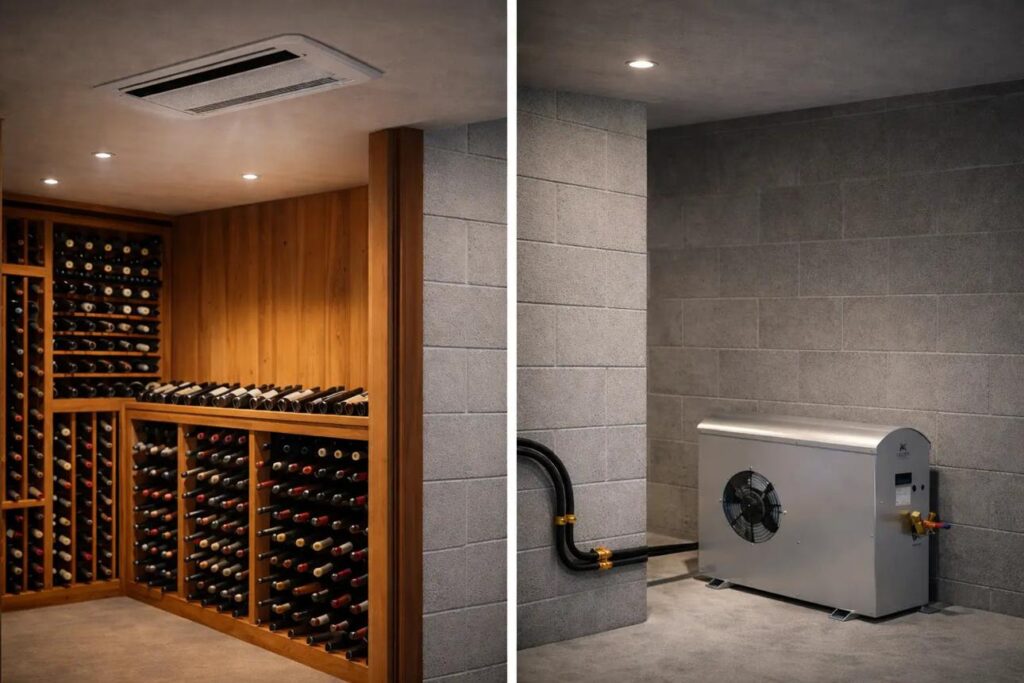
A good wine cooling system should do more than maintain the right temperature. It should protect your collection without making your home feel like a mechanical room. For homeowners planning a custom wine cellar, one of the most important decisions is choosing between a ducted and a ductless wine cooling system.
The biggest differences come down to noise, energy efficiency, installation flexibility, and the size and design of your wine cellar. Ducted systems can keep operating equipment away from the cellar, while ductless systems can offer a simpler installation with fewer ductwork requirements. However, neither system is automatically quieter or more energy-efficient in every situation.
Before comparing performance, it helps to understand how the two configurations work.
A ducted wine cooling system uses insulated ductwork to move cooled air into the wine cellar and return air to the cooling equipment. Depending on the system, the equipment can be installed in an adjacent mechanical room, attic, or another suitable location.
With a fully ducted arrangement, the cellar typically contains only discreet supply and return grilles. This makes ducted cooling especially attractive for luxury residential cellars, glass wine rooms, and installations where visible equipment would detract from the design.
Manufacturers such as Wine Guardian offer ducted configurations designed to provide temperature and humidity control while keeping the equipment out of sight.
A ductless wine cooling system delivers cooled air directly from an evaporator located inside the wine cellar, without requiring air-distribution ducts.
The term commonly refers to a ductless split system, which places the evaporator inside the cellar and the condensing unit elsewhere. This moves the compressor and much of the associated mechanical noise away from the wine collection while avoiding ductwork.
It is important to distinguish a ductless split from a through-the-wall wine cooling unit. A through-the-wall unit also operates without ducts, but its compressor, condenser, and evaporator are housed together in one cabinet, usually mounted in the cellar wall.
This distinction matters because the location of the compressor and fans has a significant impact on noise inside the cellar.
Ducted systems generally have the advantage when minimizing noise inside the cellar is the priority.
Noise consideration | ||
|---|---|---|
Equipment inside cellar | Usually only air grilles | Evaporator and fan |
Compressor noise inside cellar | Typically minimal when equipment is remote | Typically minimal when condenser is remote |
Fan noise | Airflow noise at grilles | Fan noise from the indoor evaporator |
Installation noise considerations | Duct design, airflow velocity, vibration and grille placement | Evaporator location, fan speed and vibration isolation |
Best fit | Quiet luxury cellars and nearby living spaces | Cellars where ductwork is difficult or unnecessary |
Why ducted systems are often quieter
When the cooling equipment is installed outside the cellar, the compressor and fans are separated from the wine storage area. Only the sound of air moving through the ducts and grilles is typically audible inside.
However, ducted systems are not completely silent. Poorly sized ducts, restrictive bends, excessive airflow velocity, loose grilles, or inadequate vibration isolation can create unwanted noise.
For the quietest result, the system must be designed and installed correctly.
Are ductless split systems noisy?
Not necessarily. A ductless split system can also provide a quiet cellar because the compressor is located in a separate condensing unit. The main sound source inside the cellar is the evaporator fan.
For a smaller cellar, a well-selected ductless split may provide an excellent balance between quiet operation, installation simplicity, and cost.
If you are considering a through-the-wall unit, remember that the compressor and condenser are much closer to the wine storage area. These systems can therefore be more noticeable acoustically than remote split or fully ducted configurations.
Manufacturer specifications and noise measurements vary by model and testing conditions, so compare individual units rather than assuming every system of one type will outperform every system of another.
When comparing energy efficiency, it is tempting to assume that ductless systems always use less electricity because they do not require ductwork. In practice, energy consumption depends on the specific unit, its operating conditions, installation quality, and the cellar’s heat load—not simply whether ducts are used.
Both ducted and ductless systems can operate efficiently when properly selected and installed.
How ducted systems affect energy consumption
Ducted systems introduce additional factors that can influence energy use.
Duct insulation: Poorly insulated ducts can gain heat as cooled air travels toward the cellar.
Duct length: Longer runs and excessive bends can increase airflow resistance and the fan power required.
Air leakage: Leaks can reduce the amount of conditioned air reaching the cellar.
Airflow design: Incorrectly sized ducts can restrict airflow, reduce performance, or create noise.
Equipment placement: Installing the unit in an excessively hot attic or another unsuitable location can affect performance, depending on the model’s operating limits.
A properly designed ducted system minimizes these losses through insulated ducts, suitable routing, sealed connections, and correct airflow calculations.
Ducted systems can also provide an important design benefit: the equipment can be located where its operating noise and heat discharge are easier to manage.
How ductless systems affect energy consumption
Ductless systems avoid duct-related heat gain and leakage because cooled air is delivered directly into the cellar.
Their energy consumption still depends on factors such as:
The cooling unit’s efficiency at the actual operating conditions.
The evaporator and condenser fan power.
The temperature difference between the cellar and surrounding environment.
The quality of the cellar’s insulation and vapor barrier.
The cooling capacity required to offset heat entering through glass, walls, doors, and other surfaces.
A ductless system may be an efficient choice when the evaporator can be positioned appropriately and ductwork would be unnecessarily complicated. However, it is not guaranteed to use less electricity than a properly designed ducted system.
What about split systems?
Both ducted and ductless systems can use split configurations.
A ducted split system typically has a remote condenser and an evaporator connected to the cellar through ductwork. A ductless split system has a remote condenser but delivers air directly from the indoor evaporator.
In either case, the condenser location, refrigerant-line design, equipment sizing, and operating conditions influence overall performance.
For this reason, compare manufacturer performance data for the specific models under comparable conditions rather than relying on the system category alone.
Noise and efficiency are important, but installation requirements can determine which system is practical for your project.
Installation factor | Ducted wine cooling | Ductless split wine cooling |
|---|---|---|
Ductwork | Required | Not required |
Refrigerant lines | Required for split configurations; not field-installed for sealed self-contained units | Required for split configurations |
Space for equipment | Mechanical room or another suitable location | Remote location for condenser and space for indoor evaporator |
Best construction stage | Often easiest during new construction or renovation | Can suit new construction or certain retrofit projects |
Design flexibility | High, with flexible supply and return grille placement | High, but evaporator placement must be considered |
Maintenance access | Equipment can often be serviced outside the cellar | Indoor evaporator and remote condenser both require access |
The exact requirements vary by product. Split-system refrigerant work should be performed by a qualified HVAC/R professional, and ducted systems must follow the manufacturer’s duct length, airflow, and installation requirements.
When is a ducted system worth the extra installation work?
A ducted system is worth considering when:
You want a clean, equipment-free appearance inside the cellar.
The wine cellar opens onto a living or entertaining area.
You are building a custom glass-enclosed wine room.
You have a suitable location for the equipment and a practical route for insulated ductwork.
Minimizing noise inside the cellar is a major priority.
When is a ductless system the better choice?
A ductless split system may be the better fit when:
There is limited room for ductwork.
You want to simplify the air-distribution layout.
You can install the evaporator discreetly inside the cellar.
A suitable location is available for the remote condenser.
You are retrofitting an existing wine room where running ducts would be disruptive.
The lowest installation cost will depend on the project. A ductless system avoids duct fabrication and installation, but split-system refrigerant lines, electrical work, equipment access, and other requirements still need to be considered.
Noise and energy efficiency are only part of the comparison. Your cooling system must also maintain stable conditions throughout the wine cellar.
Both ducted and ductless systems can provide suitable temperature control when properly sized and installed.
Air distribution in ducted systems
A ducted system allows supply and return grilles to be positioned strategically. This can help distribute cooled air throughout a large or irregularly shaped cellar.
Correct grille placement and duct design are particularly important in rooms with multiple walls of wine racks, high ceilings, or large glass surfaces. Poor airflow design can leave certain areas warmer than others.
Air distribution in ductless systems
A ductless system delivers air directly from its evaporator. This can work very well in smaller or relatively straightforward spaces, provided the evaporator is positioned to distribute air effectively.
In larger or unusually shaped cellars, the designer must consider the reach and direction of the airflow, possible obstructions, and temperature differences between areas.
Neither system automatically provides better temperature consistency. The result depends on the cellar layout, airflow design, equipment capacity, and installation quality.
Why glass wine cellars need special attention
Glass enclosures can have significantly different heat loads from conventional insulated rooms. Sun exposure, glazing specifications, the number of glass walls, door seals, and surrounding temperatures can all influence cooling requirements.
In warm, humid climates, proper insulation and vapor management are also critical to limiting condensation.
Do not select a cooling unit based on cubic footage alone. A heat-load calculation should be completed before choosing the system and model.
Both system types need periodic maintenance to keep operating effectively.
For ducted systems, maintenance may include cleaning filters and coils, checking airflow, inspecting duct connections, and ensuring that condensate is managed correctly where applicable.
For ductless split systems, maintenance may include cleaning the indoor evaporator filter and coils, inspecting the remote condenser, and checking refrigerant-system performance when needed.
In both cases, ensure the equipment can be accessed without dismantling finished walls, glass panels, or wine racks.
A well-designed installation should account for maintenance access from the beginning. Easy access can reduce future service costs and help avoid disruption to your wine collection.
The best system depends on your priorities, the cellar’s construction, and the available installation space.
You want minimal equipment noise inside the cellar.
A seamless, minimalist appearance is important.
You have room for ductwork and accessible equipment.
You want flexibility in positioning supply and return grilles.
You want to avoid ductwork.
You have a suitable location for a remote condenser.
The cellar layout allows effective direct airflow.
You want a practical solution for an existing space or compact cellar.
If your main concern is noise, a fully ducted system is often the strongest starting point. If installation flexibility is more important and some indoor fan noise is acceptable, a ductless split system can be an excellent alternative.
Neither option should be selected on noise or energy use alone. Cooling capacity, operating conditions, installation requirements, and long-term serviceability matter just as much.
Is a ducted wine cooling system quieter than a ductless system?
Generally, yes. A fully ducted system can locate the cooling equipment outside the cellar, leaving only air grilles inside. A ductless split system keeps its evaporator fan in the cellar, although its compressor is typically located remotely. Actual noise levels depend on the model and installation.
Are ductless wine cooling systems more energy-efficient?
Not necessarily. Ductless systems avoid duct-related heat gain and leakage, but total electricity consumption depends on equipment efficiency, fan power, cellar insulation, ambient conditions, and cooling demand. A properly designed ducted system can also operate efficiently.
Which system is better for a glass wine cellar?
Both can work. Ducted systems are attractive when you want to conceal the equipment and maintain a clean appearance. Ductless split systems can be suitable when there is limited space for ducts. The final selection should be based on a heat-load calculation and the enclosure’s design.
Does a ducted wine cooling system cost more to install?
It can, because ductwork, insulation, grilles, and routing may add labor and materials. However, costs vary depending on the equipment and site conditions. A ductless split avoids ductwork but still requires appropriate equipment placement and refrigerant-line installation.
Can a ductless split system cool a large wine cellar?
Yes, provided the selected system has sufficient cooling capacity and can distribute air effectively. Larger or irregularly shaped cellars may require more careful airflow planning or a different configuration. Proper heat-load calculations are essential.
Which system is best for a wine cellar next to a living room?
A fully ducted system is often a strong choice because it can minimize equipment noise in the cellar and nearby living spaces. A ductless split system can also be quiet when its condenser is positioned appropriately, although the indoor evaporator fan remains audible.
Do ducted wine cooling systems require more maintenance?
Not automatically. Both configurations require regular maintenance. Ducted systems add ducts and grilles that may need inspection, while split systems have indoor and remote outdoor components that require access. Installation quality and accessibility influence long-term maintenance requirements.
What temperature should a wine cellar maintain?
Approximately 55°F is a common target for long-term wine storage. Stable temperature, suitable humidity, and protection from light are also important. The cooling system must be designed to maintain the intended conditions under the cellar’s actual operating environment.
Ducted wine cooling systems generally have the advantage for homeowners prioritizing a quiet, visually clean wine cellar. Ductless split systems offer greater simplicity in air distribution and can be an excellent choice when installing ductwork is impractical.
When comparing energy efficiency, look beyond the system type. Proper sizing, insulation, sealed construction, airflow, and the equipment’s published performance are essential to achieving reliable and economical operation.
At Cool Wine Cellar, we help homeowners compare wine cooling solutions for custom wine cellars, glass wine rooms, and residential wine walls. Explore our wine cooling systems and units to find options for your project.
Planning a new wine cellar? Contact Cool Wine Cellar to discuss your room dimensions, glass enclosure, cooling requirements, and preferred installation layout before choosing a unit.