
Call Us 📞 800-323-3130
Mon–Fri 8am–6pm CST, Sat–Sun 9am–1pm CST
Free design consultations
Showrooms in Miami & Fort Lauderdale
Call us at 800-323-3130 or email us at info@coolwinecellar.com in case of any questions.
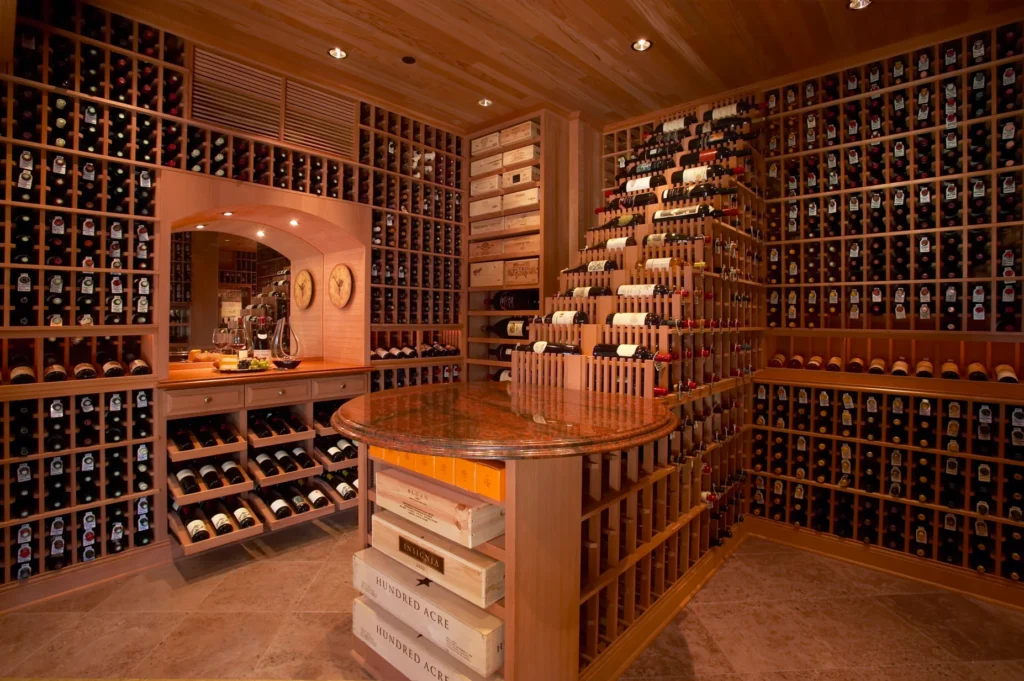
Short answer: the way to add a wine tasting table without giving up bottle capacity is to make the table part of the storage instead of placing it in front of it. The four most effective options are: (1) a tasting countertop built over dense bin or case storage, (2) a tasting island with wine storage in its base, (3) a fold-down or pull-out tasting surface built into the racking, and (4) a counter in a corner that racks cannot use well anyway. Pair any of these with racking that runs to the ceiling and you can often keep, or even increase, your total bottle count.
A freestanding table in the middle of a cellar takes floor space, and the clearance around it pushes racking away from walls or removes a run of racks entirely. In a small cellar, that can mean losing a full section of storage. The fix is to stop treating the table as furniture and design it as part of the racking.
This is the most popular solution in custom cellars. Along one wall, the lower racking is built as diamond bins, rectangular bins or case storage. A countertop sits on top at counter or bar height. Above the counter, individual bottle racking or display rows continue up to the ceiling.
It works because bins and case storage hold bottles stacked together, which typically fits more bottles into the same wall area than single-bottle cubbies. The space under the counter becomes your densest storage, so the counter costs little or no capacity. See what diamond bins, display rows and individual columns each do best.
In a walk-in cellar wide enough for a center island, build the island itself as wine storage. Its base can hold bins, cubbies, case storage or horizontal cradles on two to four sides, with a stone or sealed hardwood top for tasting. The island adds storage to floor space that would otherwise be an empty aisle.
Leave comfortable clearance between the island and the wall racks, roughly 36 inches, so people can move and reach bottles. If the room is too narrow for that, use Option 1 or 3 instead.
For smaller cellars and walk-in closets, a hidden surface does the job:
These give up only a small strip of racking, and in a compact room they are often the only way to add a tasting spot at all. For compact ideas, see turning a closet into wine storage.
Inside corners are hard to rack efficiently because bottles in the two walls collide. A corner counter or a curved tasting ledge turns that dead zone into a feature without touching your main storage. Low spaces, such as under a sloped ceiling or a staircase, also work well for a counter with bins below. See best solutions for corner wine displays.
| Counter over bins | Storage island | Fold-down or pull-out | Corner counter | |
|---|---|---|---|---|
| Capacity impact | Little or none | Adds storage | Small | Little or none |
| Room size needed | Any walk-in | Wide walk-in | Small rooms, closets | Any room with a corner |
| Seating | Stools or standing | Stools on one or more sides | Standing | Standing or one or two stools |
| Work surface | Large | Largest | Small | Medium |
| Visual impact | High with display above | Highest | Hidden when closed | Medium |
Wood wine racks make it easy to integrate counters, bins and islands in one matching finish, and our solid wood cellar kits include bin and counter components. In modern cellars, a stone counter can sit below cable or metal rail displays for a floating look. Unsure which material fits? Read wood vs metal vs cable wine racks.
Planning a cellar that is also for guests? Read how to design a wine cellar that doubles as an entertaining space.
How do I add a tasting table to a small wine cellar?
Use a pull-out shelf, a fold-down table or a narrow counter over bin storage. These need little or no floor space and keep most of the racking.
What height should a wine tasting table be?
About 36 inches for a standing counter, or about 42 inches for bar stools. Seated table height, around 30 inches, works for a lounge but uses more floor space.
Do bins under a counter hold as many bottles as individual racks?
Usually more. Diamond and rectangular bins stack bottles together and typically fit more bottles into the same wall area, though individual bottles are harder to reach.
What is the best countertop for a wine cellar?
Stone such as granite, marble or quartz, or a well-sealed hardwood. These tolerate the cool, humid conditions of a cellar.
Tell us your target bottle count and how you want to taste, and we will design the layout around both. Request a free design, get a free heatload calculation or call 800-323-3130.