
Call Us 📞 800-323-3130
Mon–Fri 8am–6pm CST, Sat–Sun 9am–1pm CST
Free design consultations
Showrooms in Miami & Fort Lauderdale
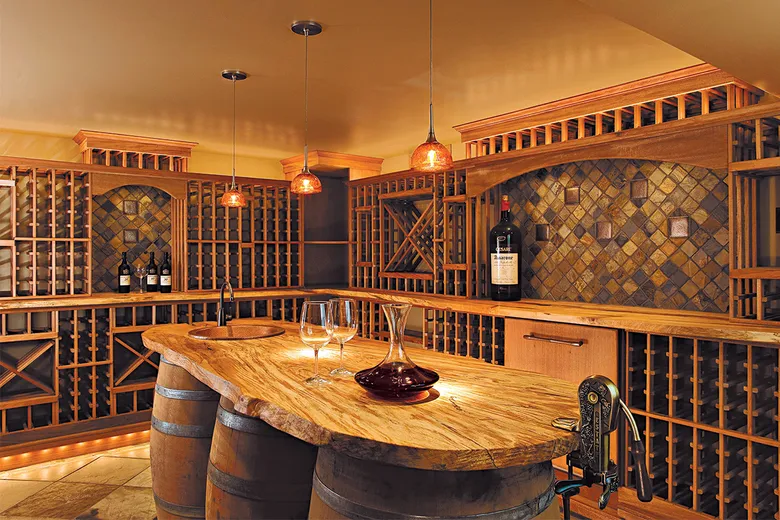
Designing a wine cellar is about more than choosing the right wood or finish. The configuration of the wine racks determines how efficiently you use your space, how easily you can organize your collection, and which bottles become part of the room’s visual design.
A well-planned custom wine cellar often uses several rack styles together. Individual columns are excellent for organized bottle-by-bottle storage, diamond bins provide efficient bulk storage, and wine display rows put special bottles and labels on center stage.
Our custom wood wine racks are designed around this mix-and-match approach, allowing collectors to combine individual columns, diamond bins, display areas, corner racks, extensions, and other components within one cellar.
Here’s what each configuration does best—and when you should consider using it.
Individual columns are one of the most versatile choices for a wine cellar.
Instead of placing several bottles into one open compartment, each bottle has its own dedicated position. This creates a clean, orderly appearance and makes it easier to organize bottles by region, varietal, vintage, producer, or drinking occasion.
CoolWineCellar’s individual-column systems are designed to provide an organized bottle-by-bottle arrangement while creating a clean architectural appearance. They can also be customized for different spaces and collection sizes.
Individual columns are best for:
If you want your wine cellar to feel organized and structured, individual columns are usually the foundation to start with.
Explore: Individual Column Wood Wine Racks
Diamond bins create larger compartments where multiple bottles can be stored together. Their open, geometric design makes them particularly useful when you have a growing collection or want an area for wines stored by case, region, or category.
CoolWineCellar describes its diamond-bin racks as a compact storage solution that allows bottles to be stored horizontally while maximizing available space.
Diamond bins are best for:
For example, instead of giving every bottle its own slot, you could dedicate one or more diamond bins to California Cabernet, Burgundy, Italian wines, or bottles you’re planning to drink over the next few years.
They can also break up a wall of individual bottle storage.
A cellar consisting entirely of identical bottle slots can look repetitive. Adding diamond bins creates visual variation while providing a practical place for bulk storage.
Explore: Diamond Bin Storage Wood Wine Racks
That’s where wine display rows come in.
Rather than storing every bottle in the same orientation, a display row can position selected bottles so their labels are easier to see. This turns part of your wine collection into a visual feature.
CoolWineCellar’s Sommelier wood-rack collection specifically incorporates label-out display rows for collectors who want a more elevated presentation.
Display rows are best for:
Display rows are especially effective when paired with LED lighting. A small number of carefully selected bottles can become the centerpiece of the cellar without requiring every bottle to be displayed.
Here’s the most important part of designing a custom wine cellar:
You don’t have to use the same rack configuration everywhere.
In fact, combining rack types is often the better approach.
CoolWineCellar’s wood-rack system is specifically designed around a mix-and-match concept, allowing individual columns, diamond bins, curved corner racks, extensions, tasting tables, top shelves, and other components to work together.
A typical collector’s cellar might look something like this:
| Rack Type | Primary Purpose |
|---|---|
| Individual Columns | Organized bottle-by-bottle storage |
| Diamond Bins | Bulk and flexible storage |
| Display Rows | Showcasing labels and special bottles |
| Corner Racks | Using difficult corner space |
| Magnum Racks | Large-format bottles |
| Case Storage | Storing unopened cases |
| Tasting Table | Serving and entertaining |
This combination gives you both storage efficiency and visual appeal.
Imagine you’re designing a 500-bottle wine cellar.
You could use:
60–70% Individual Columns
Use these for your primary collection.
Bordeaux, Burgundy, Napa Cabernet, Pinot Noir, Italian wines, and other bottles can be organized into dedicated sections.
20–30% Diamond Bins
Use diamond bins for:
5–10% Display Rows
Reserve these for your best bottles.
You might display:
The exact percentages aren’t rules. The ideal mix depends on your collection and how you use your cellar.
You don’t need hundreds of bottles to benefit from different rack configurations.
A smaller wine room can use the same principle on a smaller scale.
For example:
One wall: Individual bottle columns
One section: Small diamond bin
Center section: Display row
This gives a compact cellar three different functions without making the room feel overcrowded.
Custom wooden wine racks can also be designed around unusual spaces, including under-stair areas, compact alcoves, and other non-standard dimensions.
Large collections require organization just as much as capacity.
Once your collection reaches several hundred bottles, simply putting bottles wherever there is space can make it surprisingly difficult to find something.
That’s when a combination of rack types becomes especially valuable.
For example:
Individual columns → daily and organized storage
Diamond bins → bulk inventory
Display rows → premium bottles
Case storage → unopened cases
Magnum storage → large-format bottles
This approach creates a cellar that functions more like a wine library than a storage room.
Standard wine racks are generally designed around common 750 ml bottles, but collections often include Champagne, Burgundy, magnums, and other larger formats.
CoolWineCellar’s custom wood-rack systems can incorporate specialized Champagne and Magnum storage as part of the overall design. Cool Wine Cellar
If you have large-format bottles, mention them during the design stage.
It’s much easier to plan dedicated storage from the beginning than to discover later that your favorite magnums don’t fit your standard rack openings.
One mistake homeowners sometimes make is trying to turn the entire cellar into a display.
That isn’t always necessary.
Display rows have more impact when they’re used selectively.
A few label-forward bottles surrounded by traditional storage can create a stronger visual effect than hundreds of bottles all competing for attention.
You can also position display rows near:
This turns the display section into an intentional design feature.
The best rack isn’t necessarily the most expensive rack.
It’s the one that matches how you actually use your wine collection.
If you prioritize capacity:
Choose diamond bins + individual columns.
If you prioritize organization:
Choose individual columns.
If you want your wine to become part of the décor:
Add display rows.
If you entertain frequently:
Use display rows near a tasting or serving area.
If you have a large collection:
Combine all three.
If you have an unusual room:
Use custom columns, corners, extensions, and specialty storage to work around the architecture.
A beautiful wine cellar doesn’t have to sacrifice capacity for presentation.
The strongest designs often use different rack configurations for different jobs.
Individual columns provide structure.
Diamond bins provide flexibility and bulk storage.
Display rows provide visual impact.
Together, they can create a wine cellar that is easier to organize, easier to use, and much more interesting to look at.
And because custom wood wine racks can be configured around the room’s dimensions, collection size, bottle types, and design preferences, you’re not limited to a one-style-fits-all solution.
If you’re planning a new wine cellar—or upgrading an existing one—start by thinking about what each part of your collection needs, rather than simply counting bottles.
CoolWineCellar offers custom wooden wine-rack solutions with individual columns, diamond bins, display rows, corner configurations, extensions, tasting tables, top shelves, and other components that can be combined into a personalized cellar design.
Explore the complete collection:
Custom Wooden Wine Racks at CoolWineCellar
Whether you’re building a compact wine room or a large collector’s cellar, the right combination of diamond bins, display rows, and individual columns can make every bottle easier to store—and the entire collection more beautiful to experience.
Ready for a custom layout? CoolWineCellar offers free personalized wine cellar design assistance and heat-load calculations to help coordinate your racking and climate-control requirements.