
Call Us 📞 800-323-3130
Mon–Fri 8am–6pm CST, Sat–Sun 9am–1pm CST
Free design consultations
Showrooms in Miami & Fort Lauderdale
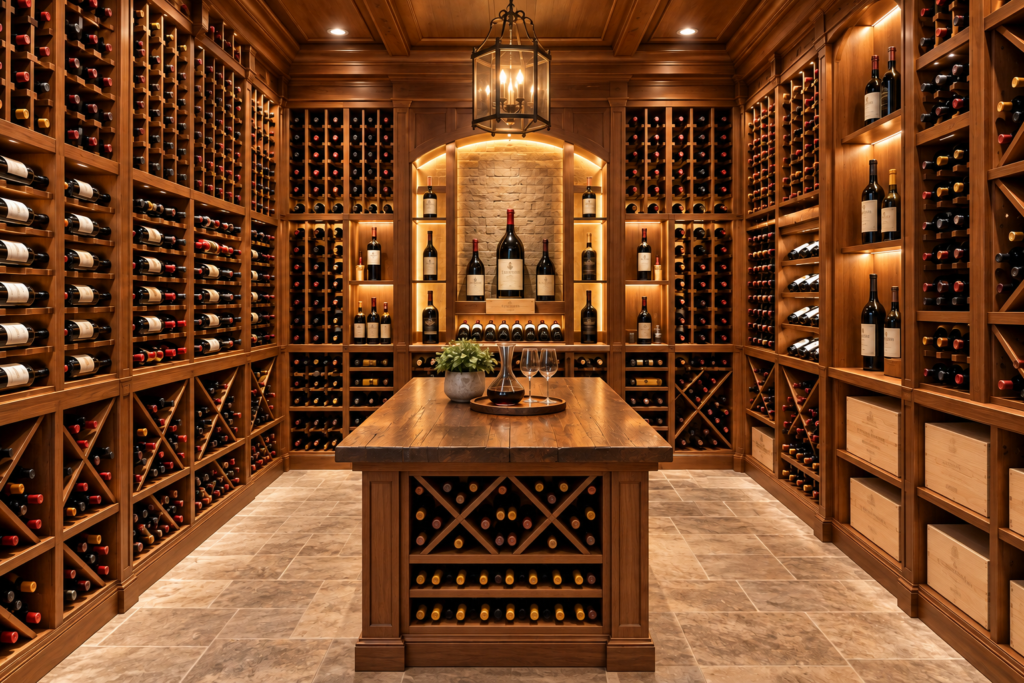
A well-designed wine cellar should do more than simply store bottles. For serious wine collectors, the ideal cellar combines efficient bulk storage with beautiful showpiece displays that turn prized bottles into part of the room’s design.
The challenge is finding the right balance. Bulk storage needs to maximize capacity and make bottles easy to organize, while display areas should create visual impact and highlight special bottles, collections, or architectural features.
With thoughtful planning, you can create a wine cellar that stores hundreds of bottles efficiently while still looking sophisticated, intentional, and highly customized.
Before designing your cellar, it helps to separate your storage needs into two categories.
Bulk storage is designed primarily for capacity, organization, and accessibility. It is ideal for:
Large wine collections
Cases of similar wines
Everyday bottles
Long-term aging collections
Maximizing available wall space
Organizing bottles by region, varietal, vintage, or producer
Traditional individual bottle racks, diamond bins, horizontal bottle storage, and custom wood cubbies can all be incorporated into a bulk-storage section.
Showpiece displays are designed to make selected bottles the focal point of the cellar. These areas may feature:
Rare or collectible wines
Large-format bottles
Special vintages
Decorative bottle arrangements
Backlit displays
Archways or focal walls
Custom wood architectural details
Sculptural or presentation-style wine racks
The goal is not necessarily to maximize bottle capacity. Instead, the goal is to create visual impact.
A successful cellar uses both approaches rather than forcing the entire room to follow one storage style.
The first step is to understand what you are actually storing.
Ask yourself:
How many bottles do I currently own?
How large will my collection become?
How many bottles need long-term aging?
Which wines should be prominently displayed?
Do I collect specific regions or producers?
Do I need storage for Champagne or large-format bottles?
Will I regularly access the cellar for entertaining?
Do I need room for future expansion?
For example, a collector with 500 bottles may want most of the cellar dedicated to practical storage while reserving one wall or central section for 30–50 visually important bottles.
Planning for future growth is particularly important. A cellar designed exactly around today’s collection can become overcrowded surprisingly quickly.
One of the easiest ways to combine bulk storage and showpiece displays is to create distinct functional zones.
A typical cellar might include:
Zone 1 – Bulk Storage
High-capacity wood wine racks along the main walls.
Zone 2 – Feature Display
A focal wall featuring custom wine racks and architectural detailing.
Zone 3 – Rare Wine Collection
A smaller section dedicated to collectible or premium bottles.
Zone 4 – Tasting or Entertainment Area
A table, counter, island, or seating area positioned near the display.
This zoning approach allows the cellar to remain practical without making every wall look identical.
Wood remains one of the most versatile materials for a traditional or contemporary wine cellar.
For bulk storage, custom wood wine racks can be designed around the exact dimensions of the room. This allows you to take advantage of areas that might otherwise be wasted, including corners, narrow walls, columns, and spaces beneath stairs.
A custom system can incorporate several storage styles within the same design, such as:
This makes it possible to create a high-capacity storage system without sacrificing the appearance of the room.
For collectors looking specifically for exclusive wood wine racks for both bulk storage and display, CoolWineCellar.com offers custom and specialty wood wine rack solutions designed to combine functionality with presentation.
Your showpiece display should have a clear visual purpose.
Rather than scattering premium bottles throughout the cellar, consider creating one dominant focal point.
A feature wall might include:
A contrasting wood finish
Decorative arches
A large diamond-bin section
A center display rack
Backlighting
Custom bottle presentation shelves
A logo or engraved detail
A tasting counter
Glass doors or an architectural opening
The focal wall becomes the visual anchor of the cellar.
For example, the majority of the cellar could feature natural wood individual bottle storage, while the center wall uses a darker finish and illuminated display shelves for collectible wines.
Not every bottle needs to be displayed in exactly the same way.
A combination of horizontal and presentation-oriented storage can create a more dynamic design.
Consider using:
Horizontal bottle storage for the majority of your collection.
Diagonal displays for selected bottles.
Label-forward presentation for wines you want guests to notice.
Diamond bins for bulk storage and larger visual groupings.
Display shelves for special bottles or decorative arrangements.
This combination creates visual rhythm while still maintaining practical storage capacity.
Showpiece displays work best when they are positioned where people naturally look.
Potential locations include:
Directly opposite the entrance
Behind a tasting table
At the end of a hallway
Around a central architectural feature
Behind glass doors
On a prominent back wall
Around a wine cellar entrance
Think of the display area almost like artwork.
The purpose is not simply to hold bottles. It should communicate something about the collection and the owner’s personality.
Lighting can dramatically change how a wine cellar feels.
Bulk storage generally benefits from subtle, even illumination that makes labels easy to read.
Showpiece displays can use more focused lighting to create depth and attention.
Popular options include:
LED strip lighting
Recessed lighting
Under-shelf lighting
Backlighting
Toe-kick lighting
Spotlights
Architectural accent lighting
LED lighting is commonly preferred because it can provide attractive illumination while minimizing heat compared with traditional lighting sources.
Avoid excessive lighting or fixtures that introduce unnecessary heat into the wine storage environment. The cellar’s cooling and environmental-control system should remain the priority.
The wood finish can help visually distinguish bulk storage from premium displays.
For example, you might use a consistent natural finish throughout the cellar and introduce a darker or richer finish on the feature wall.
Popular wood options for wine racks can include:
Premium Redwood
Mahogany
Knotty Alder
Pine
White Oak
Walnut
Sapele
The best choice depends on your desired appearance, budget, room design, and overall architectural style.
A traditional cellar might use rich mahogany or redwood, while a contemporary design could pair natural white oak with modern lighting and glass.
One of the biggest design mistakes is dedicating too much of the cellar to decorative display.
A beautiful feature wall is valuable, but the majority of the room should still perform its primary function: protecting and organizing the wine collection.
A useful strategy is to reserve approximately 70–85% of the available rack capacity for practical storage and use the remaining area for presentation.
The exact ratio depends on the collector.
Someone with a large aging collection may prioritize capacity, while someone who primarily entertains may want a larger presentation area.
Wine rack design is only one part of creating a successful cellar.
Wine needs a stable environment, so the room should be properly designed for temperature and humidity control.
Factors to consider include:
Proper insulation
Vapor-barrier requirements
Appropriate wine cellar cooling
Door construction
Glass enclosure design
Room size
Exterior climate
Heat-producing equipment
Number and size of glass walls
This is especially important in warm or humid climates, where a wine cellar may require more careful environmental planning.
The cooling system should be sized according to the actual heat load of the room rather than simply relying on the room’s cubic footage.
If your wine cellar is visible from another room, a glass enclosure can turn the collection into a major architectural feature.
Glass allows guests to see the bottles without entering the cellar and works particularly well when combined with:
Custom wood wine racks
LED lighting
Feature walls
Label-forward bottle displays
Modern architectural finishes
However, glass can significantly affect the thermal load of a wine cellar. The amount of glass, its orientation, exposure to sunlight, and type of glazing should be considered when selecting the cooling system.
High capacity doesn’t have to mean poor organization.
You can divide bulk storage according to:
Red wines
White wines
Sparkling wines
Rosé
Region
Producer
Vintage
Drinking window
Investment collection
Custom labels or small identification plaques can make large collections easier to navigate.
You can also place frequently accessed bottles closer to the entrance while keeping long-term aging collections deeper within the cellar.
A great wine cellar should reflect the collector.
Your display area might highlight:
A favorite producer
Create a dedicated presentation section for a winery you collect extensively.
A special vintage
Display bottles from an important year.
Large-format bottles
Use specially designed storage for magnums and larger formats.
Travel and regional collections
Create sections representing Bordeaux, Burgundy, Napa, Tuscany, Champagne, or other wine regions.
Family collection
Use a custom display to showcase wines associated with important occasions.
This transforms the cellar from simple storage into a personal wine experience.
One of the advantages of custom wood wine racks is flexibility.
Instead of designing the room around prefabricated rack dimensions, the rack system can be designed around the architecture.
Custom wine racks can accommodate:
Uneven walls
Corners
Columns
Arched openings
Low ceilings
Tall ceilings
Staircases
Glass walls
Built-in cabinetry
Tasting areas
For collectors who want both high-capacity storage and premium bottle presentation, a custom wood rack system can provide a cohesive look throughout the entire cellar.
At CoolWineCellar.com, you can explore exclusive wood wine rack options for creating both bulk storage sections and elegant showpiece displays.
The best wine cellars don’t treat racks, lighting, glass, doors, cooling, and finishes as separate decisions.
Everything should work together.
For example:
Wood racks provide storage and warmth.
Glass creates visibility.
Lighting highlights the collection.
Cooling protects the wine.
Insulation improves environmental performance.
A focal display creates visual interest.
A tasting area makes the cellar more functional for entertaining.
When these elements are designed together, the result feels intentional rather than simply assembled.
Imagine a 500-bottle cellar with three usable walls.
A possible layout could include:
Main Wall
Approximately 250–300 bottles of individual bottle storage.
Side Wall
Approximately 100–150 bottles using a combination of individual racks and diamond bins.
Feature Wall
Approximately 50–75 premium bottles displayed in a visually prominent custom wood wine rack.
Center
A compact tasting table or island with enough clearance for comfortable movement.
Lighting
Subtle LED illumination throughout the storage area with accent lighting focused on the feature wall.
This approach gives the collector substantial storage capacity while creating a dedicated presentation area.
The exact layout should be adjusted based on room dimensions, bottle inventory, architectural features, and future collection growth.
Designing for Today’s Collection Only
If your collection is growing, build additional capacity into the design.
Making Every Wall a Display Wall
Too many display areas can reduce useful storage capacity and make the cellar visually cluttered.
Ignoring the Cooling Load
Glass, lighting, doors, insulation, and the surrounding environment can all affect the cooling requirements.
Forgetting Large Bottles
If you collect magnums or other large formats, include dedicated storage from the beginning.
Poor Lighting Placement
Lighting should highlight the bottles without creating unnecessary heat or glare.
Treating the Wine Rack as an Afterthought
The rack system should be planned together with the room’s architecture rather than added after the walls and other features are finalized.
Designing a wine cellar with both bulk storage and showpiece displays is ultimately about balance.
Bulk storage gives you capacity and organization. Showpiece displays give the cellar personality and visual impact. Custom wood wine racks can bridge the two by providing practical bottle storage while also creating beautiful architectural features.
Whether you’re designing a compact residential cellar or a large collector’s room, start with your bottle inventory, divide the space into functional zones, reserve a prominent area for special bottles, and design the wine racks around the room rather than forcing the room around standard dimensions.
For collectors looking for distinctive wood wine rack solutions, CoolWineCellar offers exclusive wood wine racks designed for both efficient bulk storage and elegant showpiece wine displays. Explore the available options and create a cellar that protects your collection while making it part of the home’s design.