
Call Us 📞 800-323-3130
Mon–Fri 8am–6pm CST, Sat–Sun 9am–1pm CST
Free design consultations
Showrooms in Miami & Fort Lauderdale
Call us at 800-323-3130 or email us at info@coolwinecellar.com in case of any questions.
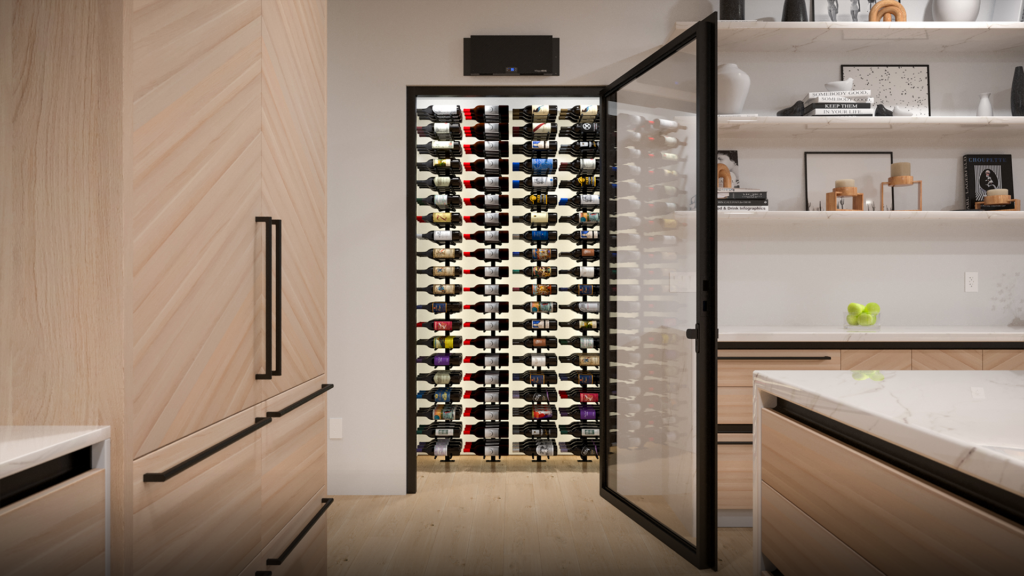
Short answer: wine cellar cooling systems are refrigeration units designed to hold a wine room at about 55°F with 50–70% relative humidity. There are four main types: self-contained through-the-wall units, split systems, ducted systems and ceiling-mounted systems. The right one depends on your cellar’s heat load, where the unit’s exhaust heat can go, how quiet the room must be and how visible the equipment can be. Size is always set by a BTU heat load calculation, not by bottle count.
A household air conditioner is built to keep people comfortable at around 70–75°F, and it dries the air as it cools. Wine wants the opposite: a cooler, steady temperature and enough humidity to keep corks from drying out. Run a standard AC down to 55°F and it will short-cycle, ice up and strip moisture from the room.
Wine cellar cooling systems are designed to run at cellar temperatures for long periods, manage humidity and recover smoothly after the door opens. Learn more in how wine cellar cooling units work.
Everything is in one box mounted through a wall. The cold side faces the cellar and the warm side exhausts into an adjacent room. They are the simplest and most affordable to install, ideal for small to mid-size cellars, closets and wine walls.
Watch for: the exhaust room must be large and ventilated enough to absorb the heat, and you will hear the unit inside the cellar. See through-the-wall cooling units and the Wine Guardian self-contained unit.
The evaporator sits in or near the cellar and the condenser sits outdoors or in a remote space, connected by refrigerant lines. Heat and most of the noise leave the house. Split systems suit larger cellars and rooms with no suitable space to exhaust heat.
Watch for: refrigerant lines need a licensed HVAC installer. See WhisperKOOL split systems and Wine Guardian split systems.
The whole unit sits outside the cellar, in a closet, attic or mechanical room, and connects with short supply and return ducts. Only two grilles show in the cellar, so ducted systems are the quietest and least visible option inside the room.
Watch for: you need a nearby space for the unit and a route for ducts. See ducted wine cellar cooling units and why ducted systems are the quietest option.
The evaporator mounts flush in the ceiling, freeing every wall for racking. Ceiling units can be self-contained or split. They are popular in modern glass wine rooms where wall space is precious. See WhisperKOOL ceiling mount systems and Wine Guardian ceiling mount systems.
| Through-the-wall | Split | Ducted | Ceiling-mount | |
|---|---|---|---|---|
| Equipment location | In the wall | Evaporator in cellar, condenser remote | Outside the cellar | In the ceiling |
| Noise in the cellar | Highest | Low | Lowest | Low to medium |
| Visibility | Visible grille | Visible evaporator | Two grilles only | Flush ceiling panel |
| Installation | Simplest | HVAC contractor | Ducting required | Ceiling access required |
| Relative cost | Lowest | Medium to high | Medium to high | Medium to high |
| Best for | Small cellars, closets | Large cellars, no exhaust space | Quiet, hidden installs | Glass rooms, full-wall racking |
For a deeper side-by-side, read ducted vs split wine cellar cooling.
Undersized units run constantly and wear out. Oversized units short-cycle and fail to manage humidity. Correct sizing comes from a heat load calculation in BTU per hour that accounts for:
We run a free heatload calculation for every project. For the method, see how to calculate heat load for a wine cooling unit.
No cooling system can hold temperature in a poorly built room. Before choosing equipment, make sure the cellar has:
We design, supply and install systems from WhisperKOOL and Wine Guardian, from compact through-the-wall units to the Wine Guardian Pro line with smart monitoring, and commercial wine cellar cooling units for restaurants and hotels. Browse all wine cellar cooling units, see our wine cellar cooling systems page or read our WhisperKOOL review.
With correct sizing and regular service, a quality wine cellar cooling system typically lasts many years. Clean condenser coils, keep drain lines clear and check refrigerant and controls annually. See annual maintenance for wine cooling systems. If noise is a concern, read how to reduce wine cooling unit noise.
What is the best wine cellar cooling system?
There is no single best system. Through-the-wall units are best for small, simple cellars; ducted systems for quiet, hidden installs; split systems for large cellars or where heat cannot be exhausted nearby.
What temperature should a wine cellar cooling system be set to?
About 55°F for long-term storage, with relative humidity between 50% and 70%.
Can I use a mini-split air conditioner for a wine cellar?
A standard comfort mini-split is not designed to run at 55°F and will remove too much humidity. Use a split system built for wine cellars.
How much does a wine cellar cooling system cost?
Cost depends on system type, capacity and installation. Through-the-wall units are the most affordable; split and ducted systems cost more because of remote equipment and installation work. A heat load calculation is the first step to an accurate quote.
Do you install wine cellar cooling systems?
Yes. We install across Miami, Fort Lauderdale and South Florida with our HVAC partners, and ship nationwide. See wine cellar cooling installation in Miami.
Send us your room dimensions and construction details, and we will size the right system for free. Get a free heatload calculation, request a free design or call 800-323-3130.