
Call Us 📞 800-323-3130
Mon–Fri 8am–6pm CST, Sat–Sun 9am–1pm CST
Free design consultations
Showrooms in Miami & Fort Lauderdale
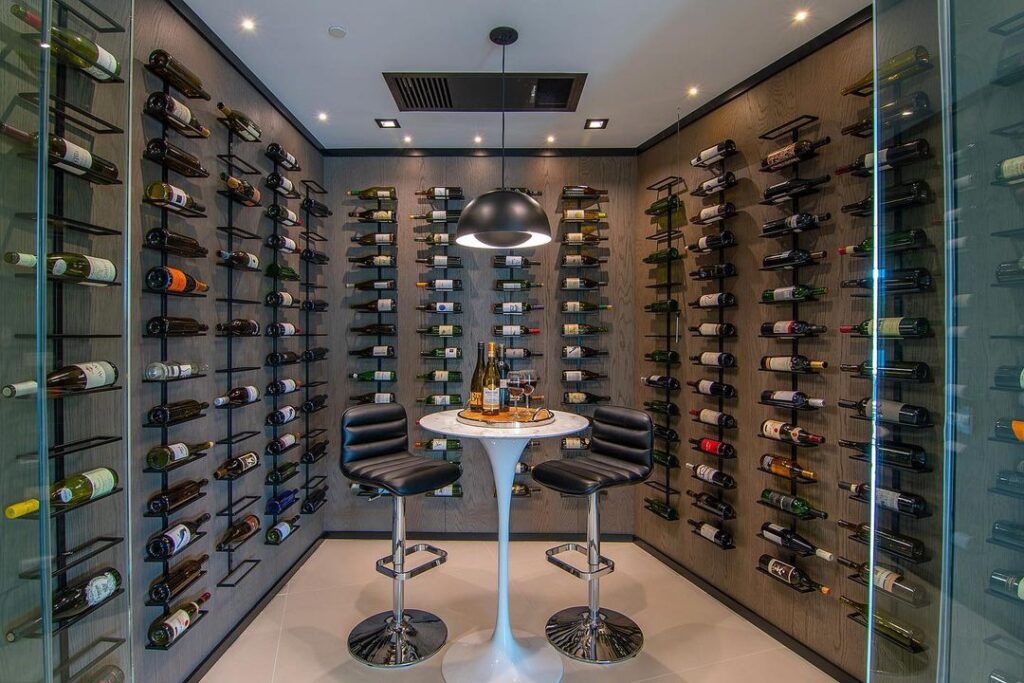
In the world of modern wine cellar design, glass is king. It transforms a storage space into a stunning visual centerpiece. However, from a thermal perspective, glass is a “thermal hole” compared to a traditional insulated wall.
If you are planning a glass-enclosed cellar, understanding how it affects your insulation and cooling requirements is the difference between a collection that ages gracefully and a cooling unit that burns out in a year.
In a standard wine cellar, walls are typically insulated to an R-value of 13 to 20. Glass, even high-quality versions, has a significantly lower R-value.
Single-Pane Glass: Provides almost no insulation (R−1). It is prone to heavy condensation and is generally not recommended for climate-controlled environments.
Double-Pane (Thermopane) Glass: Consists of two layers of glass with an argon gas fill in between. This significantly improves insulation (R−3 to R−4) and prevents “sweating” on the exterior.
Because glass allows more heat transfer than a stud wall, your cooling unit has to work harder. When professionals calculate the BTU (British Thermal Units) needed for your cellar, they apply a “glass factor.”
Get a free heatload calculation today & get the best wine cooling units for your favorite vintages.
Pro Tip: A cellar with three glass walls may require a cooling unit twice as powerful as a fully enclosed room of the same size.
While aesthetics are the goal, sunlight is the enemy of wine. UV rays can degrade organic compounds in wine (causing “light struck” flavors), and the infrared spectrum adds “radiant heat” to the room.
The Solution: Always opt for UV-rated coatings on your glass panels to protect your labels and the liquid inside.
The glass itself is only half the battle; the gaskets and seals are where most insulation failures occur. Frameless glass doors look beautiful but often have small gaps.
The Solution: Use high-quality polycarbonate seals or magnetic gaskets to ensure that your cooled air stays inside and humid room air stays out.
To have a glass wine cellar that is both beautiful and functional, follow these best practices:
Use 1/2″ or 1″ Insulated Units: Never settle for single-pane glass.
Over-spec the Cooling Unit: Ensure your system (like a Wine Guardian or WhisperKOOL) is rated for the extra heat load.
Thermally Broken Frames: If using metal frames, ensure they are “thermally broken” so the metal doesn’t conduct heat from the outside to the inside.
Designing a glass enclosure requires precision. A gap of even a few millimeters can lead to condensation issues and mold.
If you are looking to balance high-end aesthetics with technical reliability, visit CoolWineCellar. They offer custom glass enclosure quotes at affordable prices, specializing in seamless integration with climate control systems to ensure your “floating” wine display stays at a perfect 55∘F.