Call Us 📞 800-323-3130
Mon–Fri 8am–6pm CST, Sat–Sun 9am–1pm CST
Free design consultations
Showrooms in Miami & Fort Lauderdale
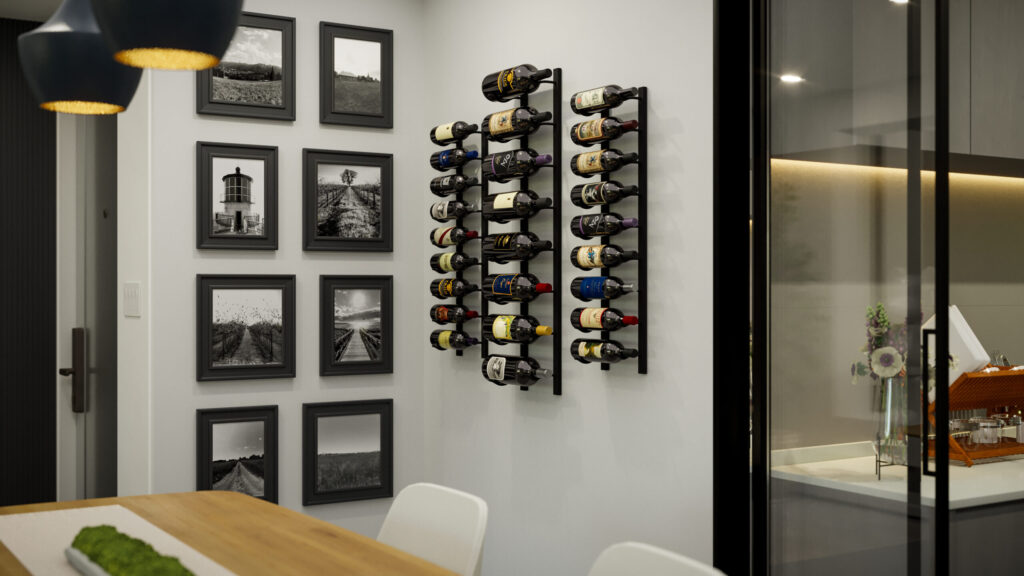
Short answer: treat large-format bottles as the centerpiece rather than squeezing them into standard racks. The most effective ideas give magnums and larger bottles their own space: a lit feature niche, oversized wall rails or pegs, a cradle at eye level, or a dedicated section of a wine wall. Because these bottles are heavier and taller, the display also has to be sized and mounted for them.
Here are the approaches we use most when designing a large-format wine bottle display in a contemporary cellar.
Standard wine racks are sized for 750 ml bottles. A magnum (1.5 L) is noticeably wider and taller, and a double magnum (3 L) is larger still. Push them into a standard slot and they either won’t fit or will sit awkwardly. Large-format bottles also tend to be special: celebration Champagne, a vintage you want to age, or a gift you want guests to see. A dedicated display solves the fit problem and turns these bottles into a design feature.
1. A lit feature niche
Build a recessed niche into a wine wall and give it its own lighting. A single double magnum or a row of magnums in a backlit niche becomes the focal point of the cellar. Lining the niche in a contrasting material, such as dark wood against a metal wall, makes it stand out even more.
2. Magnum-sized wall rails
Metal wall rails come in versions sized for larger bottles, so magnums can sit in the same clean rows as the rest of the collection. Our E-Series Wall Rails include a magnum option, and the 1.5 L wine bottle racks are built specifically for magnums. Browse all metal wine racks for more sizes.
3. Floating cable displays
Cable wine systems make large bottles look like they are suspended in mid-air, which suits a minimal contemporary space. The cables and holders need to be rated for the extra size and weight. Read can cable wine racks hold magnums and large-format bottles? and see our magnum cable wine racks.
4. Oversized wine pegs and panels
Peg systems let you place large bottles exactly where you want them, in patterns or as accents among standard bottles. Larger pegs, such as our 3-liter wine bottle holder pegs, are sized for double magnums. Explore the full pegs and panels collection, or add LED lighting with the V Bar (Glow) Mounting System.
Many large-format bottles are sparkling wine. A dedicated Champagne wall groups them together for entertaining, with room for magnums alongside standard bottles. See our ideas for building a Champagne wall and our Champagne storage racks.
For a warmer look, solid wood racks with oversized cubbies hold magnums securely and pair well with contemporary metal elsewhere in the cellar. See our solid wood magnum and Champagne racks and the wider range of wood wine racks.
When you want large bottles on show in a living area, a glass-front cabinet protects them while keeping them visible. A Champagne cabinet or one of our luxury wine cabinets can be configured with larger shelves for magnums.
The most striking contemporary cellars mix bottle sizes deliberately. A common approach is a grid of standard bottles in label-forward rails with a band or column of magnums running through it. The change in scale creates rhythm, and the larger bottles draw the eye. Modular wall systems such as the Evolution Series can be planned around a mix of bottle sizes from the start. Keep the hardware hidden so the bottles carry the design; our guide to hiding wine wall hardware shows how.
What counts as a large-format wine bottle?
Any bottle larger than the standard 750 ml. The most common are the magnum (1.5 L) and the double magnum (3 L), with even larger sizes available for some wines.
Can standard wine racks hold magnums?
Usually not well. Magnums are wider and taller than standard bottles, so they need racks, rails, pegs or cubbies sized for them.
Should magnums be stored horizontally?
Cork-sealed bottles that you plan to keep for a while should be stored on their side or at a slight angle so the cork stays in contact with the wine.
Where should large-format bottles go in a wine wall?
At or slightly below eye level works best for display, and the heaviest bottles should sit lower on the wall. A dedicated, well-lit section helps them stand out.
Can I display large-format bottles outside a wine cellar?
Yes, for bottles you plan to open soon. For aging, keep them in a climate-controlled cellar or a cooled wine cabinet.
Design your large-format wine bottle display
We design contemporary wine walls and cellars with dedicated space for magnums and larger formats, and you can see many of these systems at our Miami and Fort Lauderdale showrooms. Request a free design, explore our wine cellar design services, or call 800-323-3130.