
Call Us 📞 800-323-3130
Mon–Fri 8am–6pm CST, Sat–Sun 9am–1pm CST
Free design consultations
Showrooms in Miami & Fort Lauderdale
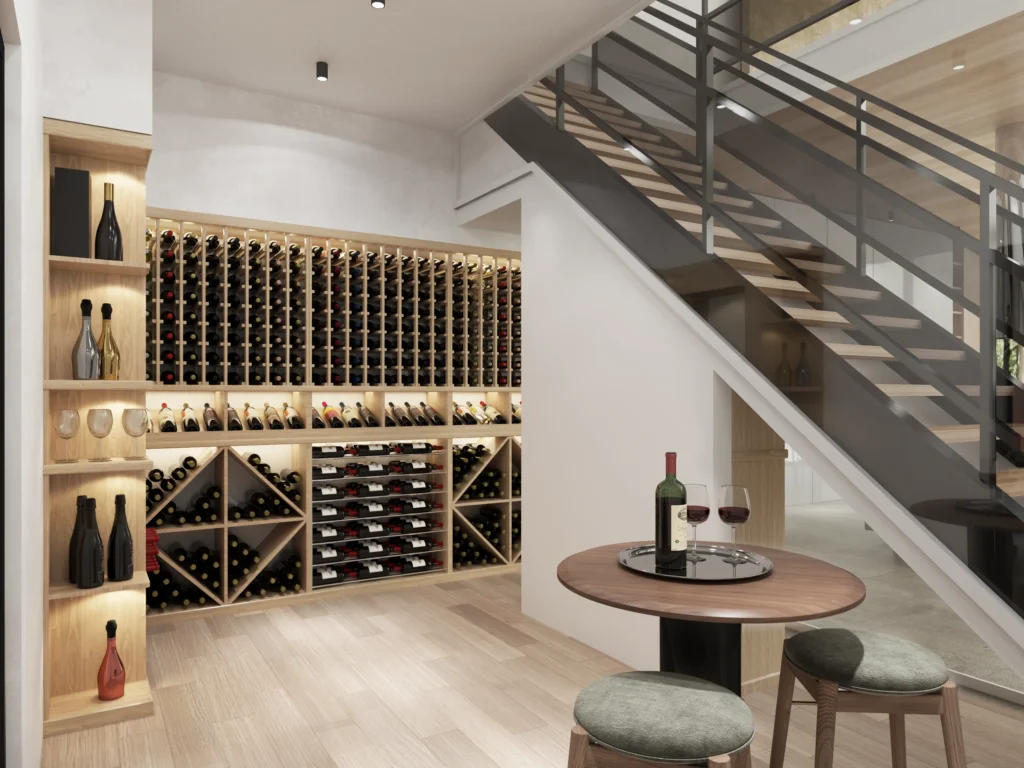
Creating a dedicated wine room is one of the best ways to turn a wine collection into a beautiful feature of your home. But before choosing wine racks, glass walls, or a cooling system, an important question needs to be answered:
How much space do you actually need for a properly climate-controlled wine room?
The good news is that you don’t need a huge room to create a functional wine cellar. A small closet-sized space can store hundreds of bottles when efficiently designed, while a larger room can accommodate tasting areas, display walls, glass enclosures, and custom cabinetry.
The key is to plan the storage capacity, insulation, cooling system, access, and circulation space together.
There is no universal minimum size for a wine room. A practical dedicated wine room can start at approximately 25–30 square feet, depending on the desired bottle capacity and layout.
For example, a compact room measuring approximately 5 feet × 6 feet can provide meaningful wine storage when vertical space is used efficiently.
However, a very small room leaves limited space for:
Walking inside the room
Displaying bottles
Accessing individual bottles
Installing a cooling system
Creating specialty storage
Adding tasting or serving areas
If your goal is simply to store wine, a small room may be enough. If you want a comfortable wine experience, a larger footprint is usually preferable.
Bottle capacity is often the best starting point for determining the required room size.
A rough planning guide might look like this:
| Wine Collection | Approximate Room Size |
|---|---|
| 50–150 bottles | 20–30 sq. ft. |
| 150–300 bottles | 30–50 sq. ft. |
| 300–500 bottles | 50–80 sq. ft. |
| 500–1,000 bottles | 80–150+ sq. ft. |
| 1,000+ bottles | 150+ sq. ft. |
These are general planning ranges rather than fixed rules. Actual capacity depends heavily on the rack style, ceiling height, bottle sizes, and amount of display space.
A highly efficient wine rack configuration can hold substantially more bottles than a decorative display-oriented design.
One of the biggest mistakes homeowners make is designing a wine room around the number of bottles they own today.
Wine collections tend to grow.
If you currently have 250 bottles but expect to reach 500 bottles over the next several years, designing a room for exactly 250 bottles could force you into an expensive redesign later.
A better approach is to ask:
“How large will my collection realistically become?”
Then design the racking around that future capacity.
Leaving some room for growth is usually much easier than expanding the wine room later.
Floor space isn’t the only measurement that matters.
Ceiling height can significantly affect wine storage capacity.
A room with a standard 8-foot ceiling can provide substantial storage, but a room with a 9-, 10-, or 12-foot ceiling creates additional opportunities for vertical racking.
Tall rooms can accommodate:
Floor-to-ceiling cable wine racks
Tall wood wine racks
Vertical metal displays
Ladder-accessible storage
High display rows
Architectural bottle walls
However, higher ceilings can also increase the volume of the room and therefore potentially increase the cooling requirement.
This is why room dimensions should be considered during the cooling design process rather than treating ceiling height as an afterthought.
A wine room needs enough space to access the collection comfortably.
If the room is designed only for storage, racks can occupy a large percentage of the available wall space.
But if you want to walk into the room and browse your collection, you need a practical aisle.
A narrow single-wall wine room can work well for compact spaces.
A larger room can incorporate:
Central aisles
Multiple rack walls
Corner racks
Display sections
Seating
Tasting tables
Cabinets
The more comfortable you want the room to feel, the more floor area you should dedicate to circulation rather than bottle storage.
One of the most important differences between a regular wine storage room and a properly climate-controlled wine room is the wine cooling system.
A wine cellar cooling unit is designed to maintain the stable environmental conditions needed for wine storage.
Depending on the room and installation, you may use:
Through-the-wall cooling
Self-contained cooling
Ducted cooling
Split systems
Ceiling-mounted systems
Remote condenser systems
The cooling equipment should be selected based on the room’s heat load, not simply its cubic footage.
Two wine rooms with exactly the same dimensions can require completely different cooling capacities.
Consider two 8-foot × 8-foot rooms.
Interior location
Properly insulated
No exterior glass
Minimal lighting
Little heat exposure
Exterior-facing walls
Large glass enclosure
Glass door
Direct sunlight
Warm surrounding temperatures
Room B may require substantially more cooling capacity even though both rooms have identical dimensions.
Factors that influence wine cellar heat load include:
Room dimensions
Insulation
Exterior walls
Glass walls
Door type
Ambient temperature
Sun exposure
Lighting
Adjacent rooms
Ceiling exposure
Number of occupants and heat-producing equipment
This is particularly important in warm climates such as Miami, Fort Lauderdale, Palm Beach, and other areas of South Florida.
Proper climate control begins with the room envelope.
A wine cooling unit can only perform effectively when the room is properly constructed.
A dedicated wine room generally needs appropriate:
Wall insulation
Ceiling insulation
Vapor barrier
Door sealing
Glass enclosure sealing
Penetration sealing
In hot and humid climates, vapor control becomes especially important.
Without adequate insulation and vapor management, warm humid air can migrate into the wine room, increasing the cooling load and potentially contributing to condensation.
This is why the wine room should be treated as a controlled environment rather than simply a room containing a refrigeration unit.
The cooling unit itself needs to be included in the design.
Different systems have different installation requirements.
A through-the-wall unit may occupy part of a wall and require appropriate airflow around the equipment.
A ducted system can place the evaporator away from the visible wine room, allowing the room to maintain a cleaner appearance.
A split system can separate the evaporator and condenser, providing additional installation flexibility.
A ceiling-mounted system can be particularly useful when wall space is limited.
The important point is to determine the cooling method before finalizing the room layout.
A dedicated wine room does not have to be large to be impressive.
A compact wine room can use the available vertical and wall space efficiently.
For example, a small room might feature:
Floor-to-ceiling racking
One glass door
A compact cooling system
Minimal aisle space
High-capacity bottle storage
This can provide substantial storage while taking up very little floor space.
A small wine room can also be placed in locations that would otherwise be difficult to use, such as:
Under stairs
Behind a dining room
Beside a kitchen
Under a staircase landing
Inside a pantry
In an unused closet
Beneath a stairwell
Adjacent to an entertainment room
A larger dedicated wine room makes sense when you want the cellar to function as more than storage.
You may want additional space for:
Wine Tasting
A tasting table or small bar can transform the room into an entertaining area.
Large Display Walls
A larger footprint allows you to incorporate dramatic feature walls, custom arches, and architectural displays.
Large glass walls can turn the wine collection into a visible design element.
Multiple Rack Styles
You can combine standard bottle storage with:
Seating
A larger room can accommodate chairs or a tasting counter without sacrificing access to the collection.
Wine racks can be surprisingly space-efficient.
A standard bottle is relatively compact, and properly designed racking can use the full height and width of a wall.
However, decorative features can increase the footprint.
For example:
Maximum storage design:
Uses most available wall space for bottles.
Display-oriented design:
Uses more space for presentation, lighting, architectural details, and bottle visibility.
Luxury tasting room:
Allocates additional floor area for seating, counters, tables, and entertaining.
Your preferred experience should therefore influence the size of the room.
The wine cellar door can affect usable space more than many homeowners realize.
A hinged door requires swing clearance, while a properly planned pivot or sliding configuration may offer different layout possibilities.
Glass doors are particularly popular because they allow the wine collection to remain visible.
But the door also needs to provide an appropriate seal to help maintain the controlled environment.
For climate-controlled wine rooms, aesthetics and environmental performance should be considered together.
Glass wine rooms can make a relatively small wine collection feel much more impressive.
A glass enclosure allows the wine to become part of the surrounding room rather than hiding it behind a traditional wall.
However, glass can also increase the cooling load.
Large glass walls—especially single-pane glass—can transfer significantly more heat than properly insulated opaque walls.
If you’re planning a glass wine room, the glass specification should be included in the heat-load calculation.
This is one reason why frameless glass wine rooms require careful climate-control planning, particularly in South Florida.
If your available space is limited, consider these strategies:
Use Full-Height Racking
Use the vertical space instead of stopping the racks well below the ceiling.
Combine Storage and Display
Reserve a small section for premium display bottles while using the rest of the room for high-capacity storage.
Use Corner Space
Custom corner racks can turn otherwise wasted space into valuable bottle storage.
Consider Cable or Metal Racks
Modern systems can create high-capacity displays without making the room feel visually crowded.
Use Specialty Storage Selectively
Diamond bins and bulk storage can be useful, but they should be incorporated according to your collection rather than simply added everywhere.
Plan the Cooling System Early
A ducted or split system may provide more flexibility than placing a large cooling unit directly inside a small room.
The ideal wine room isn’t necessarily the largest room you can build.
A successful wine cellar balances:
Bottle capacity + accessibility + insulation + climate control + aesthetics + future growth.
A 30-square-foot wine room can be highly functional if it is intelligently designed.
A 150-square-foot wine room can also be poorly designed if the racking, cooling, insulation, and circulation aren’t properly coordinated.
The design matters more than the raw square footage.
Can I create a wine room in a small closet?
Yes. A small closet can be converted into a climate-controlled wine storage room if it can be properly insulated, sealed, and cooled.
Is 50 square feet enough for a wine cellar?
Yes. A 50-square-foot room can provide substantial wine storage, particularly when floor-to-ceiling racking is used efficiently.
How many bottles can a small wine room hold?
Capacity varies by room dimensions and rack design, but a compact dedicated wine room can hold hundreds of bottles when efficiently configured.
Does a bigger wine room require a bigger cooling unit?
Not necessarily. Cooling requirements depend on heat load rather than size alone. A small room with extensive glass and high heat exposure can require more cooling than a larger, well-insulated room.
Can I use a regular air conditioner for a wine room?
A standard residential air conditioner is generally not designed specifically for the temperature stability and operating conditions required for long-term wine storage. A dedicated wine cellar cooling system is usually a better solution.
Does a glass wine room need more cooling?
It can. The amount depends on the type and area of glass, surrounding temperatures, sun exposure, insulation, and other heat-load factors.
If you’re unsure how much space you need, the best approach is to start with your collection and design goals.
At CoolWineCellar.com, you can get a free custom wine cellar design consultation to discuss your available space, bottle capacity, wine rack preferences, glass enclosure, cooling requirements, and overall design.
Whether you’re converting a small closet into a wine room or planning a large luxury wine cellar, a professional design can help you determine how to use every available inch effectively.
You don’t need a massive room to create a dedicated wine cellar.
A compact space can become an impressive wine room when it is properly insulated, climate controlled, and intelligently designed. The ideal size depends on how many bottles you want to store, how much display space you want, whether you need a tasting area, and what type of cooling system the room requires.
Before construction begins, consider the entire wine cellar system—racking, insulation, vapor control, glass, doors, lighting, cooling, and circulation.
With the right design, even a small unused space can become a beautiful, temperature-controlled home for your wine collection.
Ready to explore your wine room options? Visit CoolWineCellar.com for a free custom wine cellar design consultation.