
Call Us 📞 800-323-3130
Mon–Fri 8am–6pm CST, Sat–Sun 9am–1pm CST
Free design consultations
Showrooms in Miami & Fort Lauderdale
A fully sealed wine enclosure can create a stunning centerpiece in a modern home, restaurant, or luxury hospitality space. Frameless glass panels, sleek metal frames, and custom wine racks allow the collection to become part of the interior design while maintaining a dedicated environment for wine storage.
However, sealing an enclosure introduces an important design question: How should you manage air movement, heat rejection, humidity, and pressure without compromising the wine cellar’s temperature control?
The answer begins with understanding that mechanical ventilation and wine cellar cooling serve different purposes. A cooling system maintains the desired temperature inside the enclosure, while ventilation manages air exchange or removes heat from a designated space when the system design requires it. Simply adding an exhaust fan to a sealed wine cellar can introduce warm, humid air and make temperature control more difficult.
In this guide, we explain how to plan ventilation for a fully sealed wine enclosure, coordinate it with the cooling system, prevent condensation, and avoid common installation mistakes.
Before specifying fans, ducts, or air grilles, determine what the enclosure actually needs.
Wine cellar cooling
A dedicated wine cellar cooling system removes heat from the enclosure to maintain the required storage temperature. Depending on the design, it may use a self-contained unit, a split system, or a ducted configuration.
The cooling system must be sized for the enclosure’s actual heat load, including heat entering through glass, walls, doors, lighting, and other sources.
Mechanical ventilation
Mechanical ventilation introduces outdoor or adjacent-space air and/or exhausts air from a designated area. It may be required to ventilate a separate equipment room, manage heat accumulation, or satisfy applicable building and mechanical codes.
Ventilation is not automatically required inside every wine enclosure. A properly designed, sealed wine cellar generally relies on its dedicated cooling system and controlled construction details rather than continuous uncontrolled exchange with the surrounding room.
Heat rejection
Every refrigeration system must reject the heat it removes from the wine cellar, along with the heat generated by its own operation.
Where that heat goes depends on the equipment configuration:
A self-contained unit typically discharges heat into the space where its condenser is located.
A split system places the condenser remotely, allowing heat to be rejected elsewhere.
A ducted system can distribute cooled air through ducts while locating the equipment remotely, depending on its configuration.
These are different functions. Ducting cooled air into a cellar does not, by itself, provide ventilation for the cellar or guarantee that the cooling equipment’s heat is being discharged appropriately.
Design principle: Determine where heat enters the wine enclosure, where the cooling system removes it, and where the equipment releases that heat before deciding whether mechanical ventilation is necessary.
A fully sealed wine enclosure does not automatically need a dedicated outdoor-air ventilation system. The correct approach depends on the enclosure’s use, occupancy, cooling configuration, and applicable building requirements.
For a residential wine display that is rarely occupied, the priority is usually stable temperature, appropriate humidity, and controlled air leakage. A commercial wine room that employees or customers enter regularly may have additional indoor-air-quality and code requirements.
Consider three possible scenarios.
Scenario A: Residential wine enclosure
A dedicated cooling system circulates and conditions cellar air. Uncontrolled outdoor-air ventilation is generally undesirable because it can introduce heat and moisture.
Scenario B: Sealed enclosure with remote cooling equipment
The wine cellar may need no separate ventilation fan, but the equipment room must have adequate airflow or a properly designed heat-rejection arrangement.
Scenario C: Commercial wine room
Assess occupancy, indoor-air-quality requirements, building codes, and equipment heat loads. Any required ventilation should be coordinated with the cellar’s cooling and humidity-control design.
The distinction is important: ventilating a mechanical room to remove heat is not the same as supplying fresh air to the wine enclosure.
One of the most common problems with fully sealed wine enclosures is overlooking the space where the cooling equipment releases heat.
A refrigeration system transfers heat out of the wine cellar and rejects it at the condenser. If that heat accumulates in a small, enclosed mechanical room, the surrounding temperature can rise and reduce the system’s cooling performance.
The solution depends on the equipment configuration.
Self-contained cooling systems
A self-contained unit houses the refrigeration components in one assembly. Depending on its design, it may discharge warm condenser air into an adjacent room or through an approved exhaust duct.
If the unit is installed in a closet or enclosed mechanical space, determine whether that space can handle the rejected heat. If additional ventilation is needed, plan both the exhaust route and the required replacement-air supply.
Simply installing an exhaust fan without providing a suitable air inlet can restrict airflow and undermine performance.
A split system places the condenser away from the indoor evaporator. This can simplify heat management inside the wine cellar because the condenser rejects heat at a separate location.
However, the remote condenser still requires the clearances and operating conditions specified by the manufacturer. An outdoor condenser also needs an installation location suitable for the model and local weather conditions.
Ducted systems can keep the main equipment away from the wine enclosure and deliver conditioned air through supply and return ducts.
The installation must account for both sides of the system: airflow between the cellar and evaporator, and heat rejection at the condenser. Some units allow condenser air to be ducted; others have specific limitations on duct length, pressure, or installation location.
For example, Wine Guardian’s installation resources provide model-specific manuals and specifications that should be consulted before designing ductwork or ventilation.
Important: Never assume that a wine cooling unit can be placed inside a sealed cabinet or closet without checking its installation requirements.
In warm, humid climates, condensation can become a major challenge for fully sealed wine enclosures.
When warm, moisture-laden air contacts a surface colder than its dew point, water can form on the glass, metal framing, or surrounding construction. Repeated condensation can damage finishes, promote mold growth, and affect nearby building materials.
Adding more ventilation is not necessarily the solution. In a hot, humid environment, bringing uncontrolled outdoor air into a cold wine enclosure can increase the moisture load.
Instead, coordinate the enclosure’s construction with the cooling system.
Key considerations include:
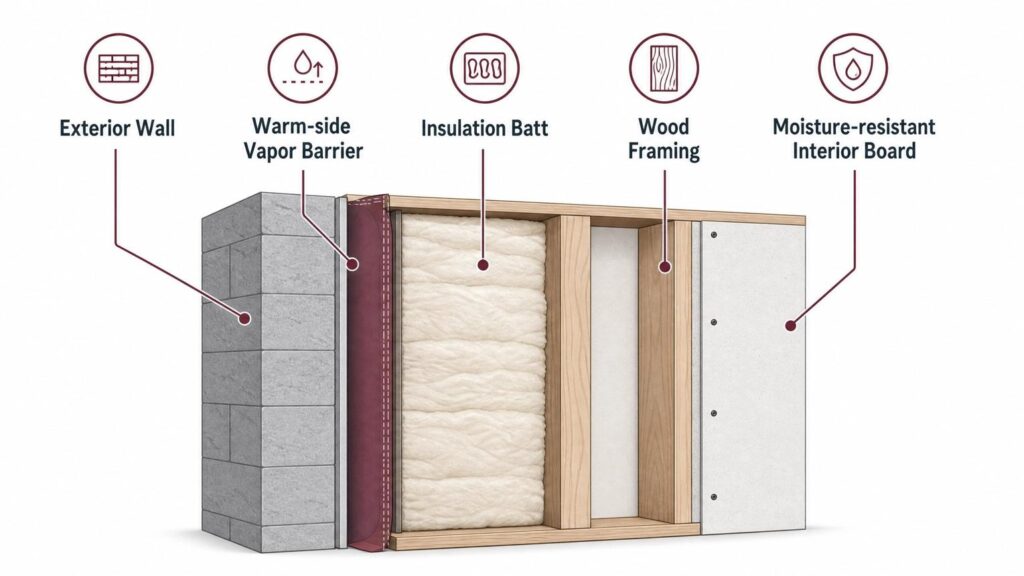
Insulation: Select insulation appropriate for the enclosure’s construction and temperature difference.
Vapor control: Design vapor-retarding layers and air barriers according to the climate, assembly, and building-science requirements.
Air sealing: Reduce unintended infiltration through door seals, panel joints, penetrations, and framing connections.
Glass specifications: Consider glazing performance, frame construction, and surface temperatures.
Humidity monitoring: Monitor cellar conditions and investigate persistent moisture or condensation rather than assuming a ventilation fan will solve the problem.
Condensate management: Provide the cooling unit with the drain or condensate-removal arrangement specified by the manufacturer.
The correct vapor-control strategy depends on the wall and ceiling assembly and the surrounding climate. Avoid specifying a vapor barrier location solely from a generic rule; coordinate it with the full enclosure design.
If the mechanical room needs ventilation, the airflow requirement should be calculated rather than estimated by choosing a convenient fan size.
The design must consider the amount of heat released by the cooling equipment, the acceptable temperature rise in the mechanical space, the air’s entering temperature, and the restrictions imposed by ducts, grilles, and filters.
A simplified sensible-heat calculation for air is:
Where:
\(Q\) = heat to be removed, in BTU per hour.
\(\Delta T\) = allowable air-temperature rise, in °F.
CFM = approximate airflow in cubic feet per minute.
For example, if a mechanical room needs to remove 3,000 BTU/h of sensible heat while limiting the air-temperature rise to 10°F:
This gives a theoretical airflow estimate of approximately 278 CFM under the stated assumptions. It is not a recommended fan size for every wine cooling installation.
The actual requirement must be based on the equipment manufacturer’s heat-rejection data, the mechanical room’s heat gains, available replacement air, duct resistance, and local design conditions. A qualified HVAC professional should verify the final selection.
A sealed wine enclosure can be affected by pressure differences between the cellar and adjacent spaces.
If an exhaust fan removes air from the enclosure without an appropriate replacement-air path, it may create negative pressure. Air can then enter through door seals, small gaps, and other unintended openings.
In a wine cellar, this can introduce warm, humid air, increase the cooling load, and contribute to condensation.
To avoid these problems:
Do not install an exhaust fan inside the wine enclosure without a defined engineering purpose.
If ventilation is required by code or occupancy, have the air supply and exhaust designed together.
Keep the enclosure’s door seals and penetrations properly detailed.
Avoid using the wine cellar as a return-air or exhaust-air path for unrelated building systems.
Have the HVAC designer evaluate pressure relationships between the enclosure and adjoining rooms.
A balanced ventilation strategy may be appropriate in certain occupied or specialized wine cellars, but the airflow rate and controls should be established by the design professional. There is no universal ventilation rate that applies to every residential wine enclosure.
Mechanical ventilation, cooling, and humidity control should be treated as coordinated systems rather than separate decisions.
A cooling system may remove moisture as air passes over its evaporator coil. How much moisture it removes depends on operating conditions, coil temperature, airflow, and system design.
Meanwhile, outdoor-air ventilation can introduce additional moisture. In hot, humid climates, that added latent load can make the cooling system work harder and may create conditions that lead to condensation.
For a fully sealed wine enclosure, consider the following controls and measurements:
Design element | What to establish |
|---|---|
Temperature control | Target cellar temperature and sensor location |
Humidity monitoring | Expected humidity range and a response plan for persistent high or low readings |
Condensate management | Manufacturer-approved drainage or condensate removal |
Mechanical-room temperature | Acceptable operating temperature around the condenser |
Ventilation controls | Required airflow, fan operation, and replacement-air path |
Air distribution | Supply and return locations that promote even temperature |
Service access | Space to inspect filters, coils, drains, and other components |
Temperature and humidity targets should be selected for the intended wine-storage application. Approximately 55°F is a common long-term storage target, while humidity management must account for cork condition, labels, enclosure construction, and condensation risk.
Several mistakes can undermine an otherwise well-designed wine enclosure.
Mistake 1: Installing an exhaust fan inside the cellar without a heat or air-quality assessment. This can pull humid air into the enclosure and increase the cooling load.
Mistake 2: Enclosing the cooling equipment without accounting for condenser heat. A mechanical room can overheat even when the wine cellar itself is properly insulated.
Mistake 3: Using the same airflow strategy for the cellar and the equipment room. These spaces have different purposes and often require different airflow arrangements.
Mistake 4: Selecting a fan based only on room volume. Heat rejection, temperature rise, static pressure, and the manufacturer’s requirements determine the appropriate airflow.
Mistake 5: Ignoring humidity and vapor management. A sealed enclosure still requires proper construction details to control moisture movement and condensation.
Mistake 6: Hiding equipment without preserving service access. Fans, filters, coils, drains, and other components must remain accessible for maintenance.
Mistake 7: Assuming every wine cooling system can be ducted the same way. Follow the specific model’s installation instructions, including duct limits, clearances, and condenser-air requirements.
Before construction or installation, review the following items with your wine cellar designer and HVAC contractor.
Installation planning checklist
0 of 10
Does a fully sealed wine cellar need mechanical ventilation?
Not always. A residential wine enclosure may rely on its dedicated cooling system without separate outdoor-air ventilation. However, ventilation may be necessary for an occupied commercial space, a mechanical room, or a specific equipment installation. Applicable codes and manufacturer requirements take precedence.
Should I install an exhaust fan inside a glass wine cellar?
Generally, not unless the design specifically calls for it. An exhaust fan can depressurize the enclosure and pull warm, humid air through gaps. First determine whether ventilation is required and whether it should serve the cellar or the equipment space.
How do I ventilate a wine cooling unit installed in a closet?
Follow the unit’s installation manual. Depending on the model, the closet may need sufficient free air volume, an exhaust path, a replacement-air inlet, or ducted condenser air. Do not assume a louvered door or a small exhaust fan will provide sufficient airflow without checking the requirements.
Can I duct the hot air from a wine cooling unit outside?
Some models permit condenser exhaust to be ducted outdoors or into another suitable space. Others have limitations on duct length, static pressure, or permitted installation locations. Confirm that the manufacturer approves the arrangement and that replacement air and local weather conditions are accounted for.
How do I prevent condensation in a sealed wine enclosure?
Proper insulation, air sealing, vapor management, suitable glazing, and controlled temperature and humidity are essential. Avoid uncontrolled humid-air infiltration, and make sure the cooling system’s condensate is properly managed.
Does ventilation affect wine cellar energy efficiency?
Yes. Uncontrolled ventilation can introduce additional sensible and latent heat, increasing cooling demand. Conversely, inadequate ventilation around a condenser can raise its operating temperature and reduce cooling performance. The goal is controlled airflow appropriate to each part of the system.
How often should a wine cellar’s ventilation system operate?
There is no universal schedule. Fan operation should be based on the equipment’s requirements, heat load, room conditions, and any applicable ventilation standards. A qualified designer should determine whether continuous, demand-controlled, or intermittent operation is appropriate.
Planning mechanical ventilation for a fully sealed wine enclosure starts with understanding the difference between conditioning the wine cellar and managing heat around its cooling equipment.
For many residential wine cellars, the priority is to maintain a well-sealed enclosure, size the cooling system correctly, and ensure that the condenser can reject heat effectively. Separate ventilation should be added only where the equipment design, indoor-air-quality needs, or building requirements justify it.
At Cool Wine Cellar, we help homeowners plan custom wine cellars, glass wine enclosures, wine racks, and cooling solutions. Coordinating the enclosure, cooling system, and mechanical requirements early can help prevent condensation problems, improve reliability, and preserve the clean architectural appearance of your wine room.