
Call Us 📞 800-323-3130
Mon–Fri 8am–6pm CST, Sat–Sun 9am–1pm CST
Free design consultations
Showrooms in Miami & Fort Lauderdale
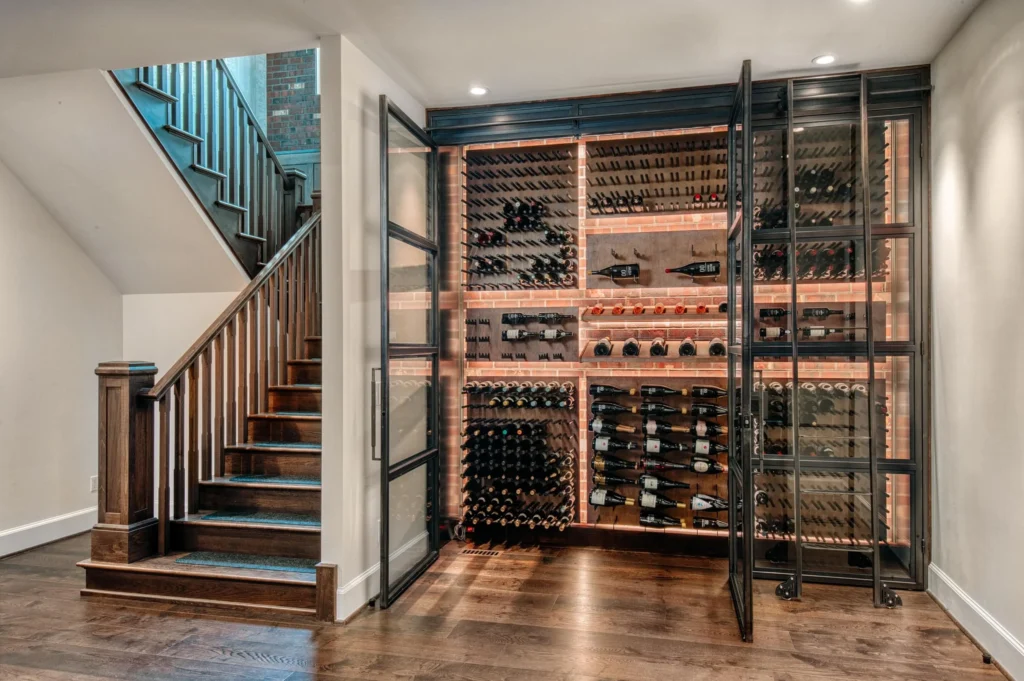
A tall wine wall can transform an ordinary room into a striking wine display. Floor-to-ceiling wine racks, glass enclosures, and dramatic vertical bottle arrangements create a sophisticated focal point while maximizing storage capacity.
However, the taller the wine wall becomes, the more important temperature management becomes.
Wine needs a stable environment for proper storage and aging. In a tall wine display, warm air naturally rises while cooler air settles lower in the space. Without proper cooling, airflow, insulation, and rack design, the top of a tall wine wall can become warmer than the bottom.
So, how do you ensure even temperature distribution within a tall wine wall?
The answer involves designing the entire wine storage environment as a system rather than simply installing a cooling unit.
A wine cellar should maintain a relatively stable temperature throughout the storage area. Temperature fluctuations and hot spots can expose bottles at different levels to different storage conditions.
This becomes particularly important when the wine wall is:
8–10 feet or taller
Enclosed behind glass
Located against an exterior wall
Exposed to sunlight
Installed in a warm or humid climate
Built with a large number of bottles
Designed with limited airflow around the racks
A cooling system may maintain the desired temperature at its thermostat while other parts of the wine wall remain warmer.
That is why cooling capacity alone does not guarantee uniform temperature distribution.
The first step toward maintaining an even temperature is creating a properly insulated wine storage environment.
A cooling unit continuously removes heat from the wine room. If heat is constantly entering through poorly insulated walls, ceilings, doors, or glass, the cooling system will have to work harder and temperature differences can become more pronounced.
A properly constructed wine room should consider:
Wall insulation
Ceiling insulation
Floor conditions
Vapor-barrier requirements
Door sealing
Glass enclosure construction
Exterior-wall exposure
Sunlight and solar heat gain
In warm climates such as Florida, insulation and vapor management become especially important because of high outdoor temperatures and humidity.
Why the ceiling matters
Heat naturally accumulates near the ceiling. In a tall wine wall, the upper section may therefore experience greater heat exposure than the lower portion.
A properly insulated ceiling helps reduce heat transfer and allows the cooling system to maintain a more stable environment.
One of the most common mistakes is choosing a wine cooling unit based solely on the cubic footage of the wine room.
A better approach is to calculate the actual heat load.
Heat-load calculations can consider:
Room dimensions
Ambient temperature
Insulation level
Glass area
Number of exterior walls
Ceiling exposure
Door construction
Lighting
Location
Desired wine-room temperature
Heat generated by equipment
Expected environmental conditions
A tall glass wine wall can have substantially different cooling requirements from a small, enclosed room of the same volume.
For this reason, a professional wine cellar designer should evaluate the complete construction before selecting the cooling system.
Where the cooling unit is installed can have a major impact on temperature distribution.
The goal is not simply to introduce cold air into the room. The goal is to create a continuous circulation pattern that allows cooled air to reach all areas of the wine wall.
Depending on the design, cooling systems may be:
For a particularly tall wine wall, ducted systems can provide greater flexibility because supply and return air locations can be designed around the architecture of the wine room.
Instead of concentrating cold air in one location, ductwork can help distribute conditioned air more strategically.
Air distribution is one of the most important considerations for a tall wine wall.
Cold air tends to move downward while warm air rises. If supply and return locations are poorly positioned, the room can develop temperature layers.
A properly designed system should establish a consistent air circulation pattern.
For example, depending on the specific room configuration, supply air may be introduced toward the upper portion of the room while return air is positioned to help draw warmer air through the circulation path.
However, there is no single supply-and-return arrangement that works for every wine wall.
The location of:
Racks
Glass
Doors
Ceiling
Cooling equipment
Architectural obstructions
should all be considered.
Beautiful wine racks should not completely block airflow.
A tall wine wall may use wood racks, metal wine racks, cable systems, floating racks, or a combination of different storage styles.
Regardless of the rack style, the design should allow conditioned air to circulate throughout the wine storage area.
Avoid creating large sealed-off cavities behind the racks unless the system has specifically been engineered for that configuration.
Proper airflow helps reduce temperature differences between:
Top → Middle → Bottom
and
Front → Back
of the wine wall.
The upper section of a tall wine wall deserves particular attention because warm air naturally rises.
This is especially important when the wine wall extends from floor to ceiling.
If the upper portion of the enclosure is exposed to:
An attic
A hot roof
Direct sunlight
An exterior wall
Poorly insulated construction
the top of the wine wall may experience additional heat gain.
Proper ceiling insulation and strategic air circulation can help minimize this problem.
For very tall installations, temperature sensors can also be positioned at different heights during commissioning to verify that the system is performing consistently.
Glass creates an impressive visual effect, but it can introduce additional thermal challenges.
Large glass panels can allow solar radiation and ambient heat to enter the wine storage environment, particularly when the enclosure is exposed to direct sunlight.
When designing a glass wine wall, consider:
Glass type
Panel size
Frame construction
Door seals
Sun exposure
Window orientation
Exterior shading
Air circulation
A wine cellar with extensive glass should be treated differently from a traditional insulated room.
Avoid direct sunlight
Direct sunlight is particularly undesirable for wine storage because it can add heat to the enclosure and expose wine to UV radiation.
Where possible, position the wine wall away from direct solar exposure or incorporate appropriate shading and glazing strategies.
Wine rack selection is not only an aesthetic decision.
The configuration of the racks can influence airflow, accessibility, bottle orientation, and how efficiently the cooling system can condition the space.
For tall wine walls, designers may use:
Floor-to-ceiling wood wine racks
Metal display racks
Cable wine racks
Floating wine racks
Wall-mounted bottle displays
Mixed-material wine walls
Open rack designs can be particularly useful when creating a visually open display because they allow air to move more freely around the bottles.
The rack design should ultimately complement the HVAC strategy rather than work against it.
A densely packed wine wall can restrict airflow.
Although maximizing bottle capacity may be important, every wine wall should balance storage density with accessibility and environmental performance.
Consider leaving appropriate space around:
Cooling supply outlets
Return air locations
Corners
Ceiling areas
Equipment
Structural components
Your designer can determine the appropriate clearances based on the cooling system and rack configuration.
One thermostat does not necessarily tell you what is happening throughout a tall wine wall.
For a large or unusually tall installation, temperature measurements can be taken at several heights.
For example:
Upper zone: near the ceiling
Middle zone: center of the wine wall
Lower zone: near the floor
These measurements can reveal whether temperature stratification is occurring.
If the upper area is consistently warmer, the solution may involve adjustments to airflow, insulation, duct placement, or cooling capacity rather than simply lowering the thermostat.
If the bottom of the wine wall is cold while the top is warm, installing a substantially larger cooling unit may not solve the underlying problem.
The issue could be air distribution rather than cooling capacity.
Oversizing a cooling unit can introduce other problems, including shorter cycling periods and inefficient operation.
Before increasing cooling capacity, evaluate:
Insulation
Heat gain
Supply-air location
Return-air location
Airflow restrictions
Rack configuration
Glass exposure
Door sealing
Cooling-unit sizing
A properly balanced system is usually more effective than simply installing a larger unit.
A door that does not seal properly can introduce warm, humid air every time the cooling system operates.
For a tall wine wall enclosed behind glass, the door is often one of the most frequently used components of the enclosure.
A quality wine cellar door should provide:
A reliable seal
Proper weatherstripping
Appropriate insulation
Correct installation
Minimal air leakage
The door should also be compatible with the overall glass-enclosure design.
Temperature is only one part of wine cellar climate control.
Humidity also matters, particularly in warm and humid environments.
Excessive humidity can contribute to condensation, mold, and damage to finishes, while excessively dry conditions can affect natural corks over time.
A properly designed wine cellar should therefore consider both:
Temperature + Humidity
Insulation and vapor-barrier design are especially important when constructing wine cellars in humid climates.
Lighting can add heat to a wine display.
LED lighting is commonly used in modern wine cellars because it provides attractive illumination while generating relatively little heat compared with some traditional lighting technologies.
For a tall wine wall, strategically placed LED lighting can highlight bottles and architectural details without unnecessarily increasing the thermal load.
Lighting should still be included when evaluating the overall heat load.
One of the biggest advantages of working with a professional wine cellar designer is that the cooling system, insulation, glass, lighting, and wine racks can be coordinated before construction is completed.
Ideally, the design process should consider:
Wine Wall → Enclosure → Insulation → Glass → Airflow → Cooling System → Controls
rather than treating each component as an independent purchase.
This approach helps prevent expensive modifications after the wine wall has already been installed.
Several design mistakes can contribute to temperature stratification in tall wine walls.
Possible causes:
Heat accumulation near the ceiling
Poor ceiling insulation
Insufficient air circulation
Incorrect supply/return placement
Solar heat gain
Possible causes:
Cold air settling near the floor
Poor return-air design
Insufficient circulation
Cooling unit location
Possible causes:
Uneven glass exposure
Exterior-wall heat gain
Poor airflow distribution
Architectural obstructions
Possible causes:
Frequent door opening
Poor door sealing
Insufficient insulation
Excessive infiltration of warm humid air
There isn’t a universal cooling configuration for every tall wine wall.
The correct approach depends on the room’s dimensions, construction, glass exposure, insulation, climate, rack design, and desired temperature.
For a typical tall wine display, a well-engineered solution may include:
Properly insulated walls and ceiling
An appropriate vapor-barrier strategy
A cooling system sized according to heat load
Strategically positioned supply and return air
Adequate airflow around the racks
Properly sealed wine cellar doors
Low-heat LED lighting
Temperature monitoring at multiple heights
Protection from direct sunlight
Professional commissioning after installation
A tall wine wall can be both a beautiful architectural feature and a reliable wine-storage solution, but maintaining consistent conditions requires more than selecting a powerful cooling unit.
Even temperature distribution comes from the interaction of insulation, airflow, cooling capacity, rack configuration, glass construction, and climate control.
If you’re designing a floor-to-ceiling wine wall, consider the cooling strategy at the beginning of the project—not after the wine racks and glass enclosure have already been installed.
At CoolWineCellar, we help homeowners, designers, contractors, and trade professionals develop wine cellar solutions that combine wine storage, cooling technology, glass enclosures, and custom wine rack design. A properly planned system can help protect the wine collection while allowing the wine wall to remain the visual centerpiece of the space.