
Call Us 📞 800-323-3130
Mon–Fri 8am–6pm CST, Sat–Sun 9am–1pm CST
Free design consultations
Showrooms in Miami & Fort Lauderdale
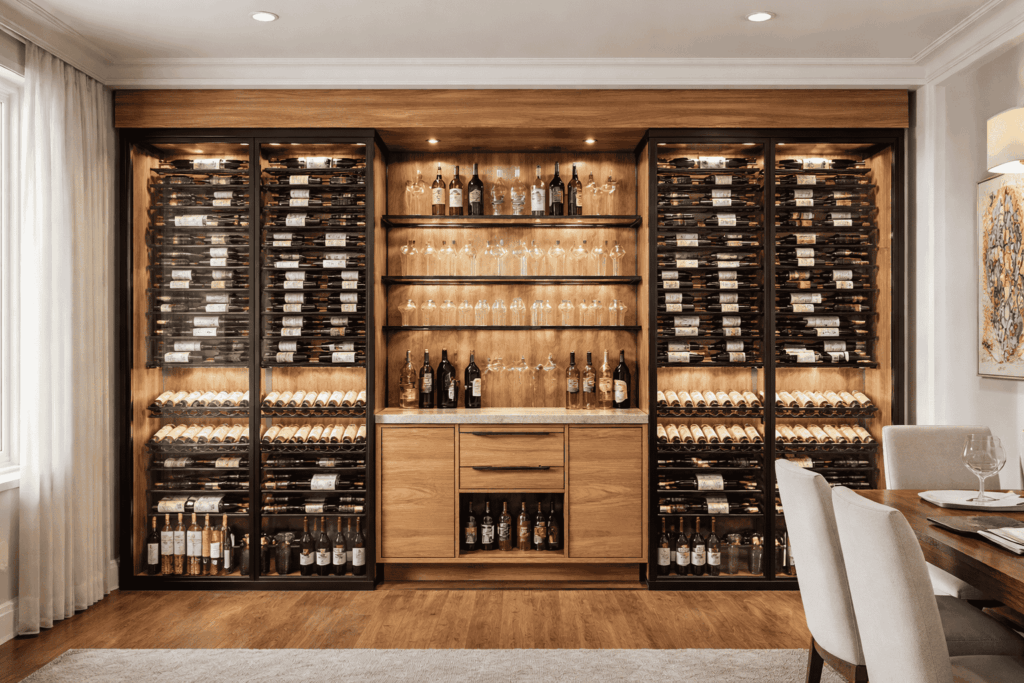
A beautifully designed wine cellar should do more than store bottles. It should tell a story about your collection, complement your home’s architecture, and make every bottle feel like part of a carefully curated display. When you collect both red and white wines, the challenge is to create a space that showcases their variety while maintaining the right storage conditions.
From illuminated glass wine walls to floor-to-ceiling wood wine racks and contemporary metal displays, there are countless ways to create a wine cellar that balances visual impact with practical storage. The secret is to combine thoughtful organization, complementary materials, strategic lighting, and an appropriate cooling system.
Whether you are designing a compact residential wine room or a statement-making cellar in an open-concept living space, these ideas will help you showcase reds and whites in a way that feels cohesive, sophisticated, and distinctly yours.
One of the easiest ways to make a mixed wine collection look intentional is to organize it into distinct display zones. Rather than placing bottles randomly throughout the cellar, use the layout to establish a visual rhythm.
For example, you could dedicate one side of the wine room to red wines and the opposite side to white wines. Alternatively, arrange the bottles in horizontal bands, with reds occupying the lower sections and whites displayed at eye level.
The best arrangement depends on your collection size, bottle dimensions, and preferred aesthetic.
Design ideas to consider:
Side-by-side displays: Create two complementary sections using matching wine racks, with each section dedicated to a different wine category.
Vertical zoning: Use floor-to-ceiling wine columns to create distinct areas while maintaining a consistent architectural appearance.
Central feature wall: Position your most visually striking bottles in a central display, with additional storage arranged around it.
Color-coordinated layouts: Arrange labels and bottle colors to create a subtle visual gradient across the room.
Keep in mind that red and white wines do not necessarily require separate storage rooms. Many collections can be stored together in one properly designed cellar, provided the temperature and humidity conditions suit the wines being stored.
<AsyncImageGroup query={[“luxury modern glass enclosed wine cellar black metal frame illuminated wine bottle display residential interior”,”frameless glass wine room contemporary living room floor to ceiling wine display”,”luxury glass wine cellar red white wine bottles architectural lighting modern home”]} aspectRatio=”5:4″ layout=”bento” size=”lg”/>
A glass-enclosed wine cellar is an excellent option when you want to showcase both reds and whites without making the room feel closed off.
Glass creates visual continuity between the wine room and its surroundings, making it particularly effective in open-concept kitchens, dining rooms, and entertainment spaces.
For a balanced design, consider combining a black metal wine rack system with a frameless glass enclosure. The dark framework creates a defined architectural outline, while the bottles provide color and texture.
To make the collection stand out:
Use symmetrical or repeating rack arrangements for a clean, contemporary appearance.
Combine bottle storage with a few display shelves for large-format bottles or special selections.
Use carefully positioned lighting to highlight the collection without creating excessive heat.
Coordinate the glass framing, door hardware, and surrounding finishes with the rest of the interior.
Important: Glass enclosures can create a significant cooling load, especially when they have large glazed surfaces. Include the glass specifications, room dimensions, insulation, and surrounding temperatures in the wine cellar cooling calculation before finalizing the design.
The wine rack system determines how the bottles are displayed and how the cellar feels visually. When designing for reds and whites, choose a system that accommodates your collection while maintaining a consistent design language.
<AsyncImageGroup query={[“modern matte black metal wall mounted wine racks luxury wine cellar”,”contemporary floor to ceiling metal wine bottle display gold accents”,”minimalist metal wine racks individual bottle display glass wine room”]} aspectRatio=”5:4″ layout=”carousel” size=”lg”/>
Metal wine racks work particularly well in contemporary spaces. Their slim profiles allow bottle labels to remain visible, making it easier to showcase different wines without creating a visually heavy wall.
Black metal provides contrast against light-colored walls, while brushed brass or gold finishes can introduce warmth and a luxurious accent.
These systems are especially useful when the collection includes bottles with varied label designs and colors.
<AsyncImageGroup query={[“luxury mahogany wood wine racks traditional wine cellar bottle storage”,”modern white oak wine cellar shelving warm wood wine bottle display”,”premium redwood wine cellar racks floor to ceiling residential cellar”]} aspectRatio=”5:4″ layout=”carousel” size=”lg”/>
Wood wine racks create a warmer, more traditional atmosphere. Mahogany, redwood, white oak, walnut, and other wood options can complement both classic and contemporary interiors.
For a mixed collection, wood racks can provide a consistent backdrop that allows red and white wine labels to stand out without overwhelming the room.
Consider darker woods for a dramatic, intimate cellar or lighter finishes for a bright, modern wine room.
<AsyncImageGroup query={[“floating cable wine racks modern glass wine cellar individual bottles”,”minimalist floating wine bottle display wall luxury interior”,”vertical cable wine rack floor to ceiling contemporary wine room”]} aspectRatio=”5:4″ layout=”carousel” size=”lg”/>
Cable and floating wine racks create a lighter visual effect, making them attractive choices for compact rooms and feature walls.
Because the bottles appear to float against the wall, these systems can create an impressive display without making the space feel crowded.
They are particularly effective when you want the bottles and labels to become the primary visual feature rather than the storage structure.
Always verify bottle compatibility, mounting requirements, and the system’s rated capacity before installation.
Lighting can transform an ordinary storage room into a sophisticated wine display. It helps distinguish different sections, highlights architectural features, and makes the collection more inviting.
However, wine cellar lighting must be planned carefully because excessive light and heat can negatively affect wine quality.
<AsyncImageGroup query={[“luxury wine cellar warm LED lighting illuminated metal wine racks”,”modern wine wall backlit bottle display luxury residential interior”,”wine cellar vertical LED strip lighting black metal wine racks”]} aspectRatio=”5:4″ layout=”carousel” size=”lg”/>
Consider these lighting strategies:
Warm LED strip lighting: Install appropriately specified LED strips along rack edges, vertical columns, or architectural recesses to create a soft, elegant glow.
Integrated rack lighting: Highlight individual bottles or sections while keeping the light source discreet.
Accent lighting: Use controlled lighting to draw attention to special bottles, limited editions, or a central display.
Dimmable lighting: Adjust the atmosphere for everyday access, entertaining, or special occasions.
Motion-activated lighting: Reduce unnecessary illumination when the cellar is not in use.
Avoid placing bright light sources directly against bottles or using lighting that introduces unnecessary heat. UV exposure should also be minimized, particularly for wines stored over extended periods.
For a cellar that showcases both reds and whites, consistent lighting across the two sections usually creates a more cohesive appearance than using dramatically different lighting colors for each category.
Red and white wine bottles offer different visual characteristics. Many red wines come in dark green, brown, or nearly opaque bottles, while white wines may feature lighter green, clear, or amber glass.
You can use these differences to create a visually engaging display.
For example, dark bottles against a light stone or white oak backdrop create strong contrast. Clear and pale-green bottles can look particularly striking against dark metal racks or charcoal-colored walls.
Consider these combinations:
| Design style | Materials and finishes | Visual effect |
|---|---|---|
| Contemporary luxury | Black metal, clear glass, dark stone | Bold contrast and clean lines |
| Warm modern | White oak, bronze accents, warm LEDs | Natural texture with refined details |
| Classic cellar | Mahogany, traditional cabinetry, subdued lighting | Timeless and intimate |
| Minimalist | Frameless glass, floating racks, neutral walls | Light, open, architectural |
| Dramatic statement | Dark walls, metallic finishes, accent lighting | Strong visual focus |
Rather than assigning a different material to every wine category, use the same overall palette throughout the cellar. Subtle differences in rack placement, bottle orientation, or label arrangement can distinguish reds from whites without making the room feel fragmented.
A visually attractive cellar should also make it easy to find the bottle you want.
Separating reds and whites is a useful starting point, but you can take the organization further by arranging bottles according to grape variety, region, producer, vintage, or drinking occasion.
For example, a residential cellar might include:
A dedicated red wine section for Cabernet Sauvignon, Merlot, Pinot Noir, and other favorites.
A white wine section for Chardonnay, Sauvignon Blanc, Riesling, and similar selections.
A feature area for Champagne, sparkling wines, and special bottles.
A separate display for large-format bottles or collectible vintages.
Discreet bulk storage for everyday wines that do not need prominent display.
For a large collection, consider a digital inventory that records bottle location, vintage, quantity, and drinking window. You can use small, unobtrusive labels or a digital cellar map to make retrieval easier.
The goal is to make organization part of the design rather than an afterthought.
Bottle orientation significantly affects how the collection looks.
Traditional wine racks often store bottles horizontally, which is space-efficient and suitable for many wines sealed with natural cork. Display racks can instead angle bottles forward or position labels toward the viewer to create a more retail-inspired presentation.
A combination of storage and display styles can work especially well for mixed red and white collections.
Horizontal storage: Provides a clean, consistent pattern and makes efficient use of wall space.
Label-forward display: Makes bottle identification easy and turns labels into part of the design.
Angled display shelves: Create a more dynamic presentation for selected bottles, depending on the rack’s intended use and the closure type.
Individual bottle columns: Give each bottle its own visual space and create an orderly, gallery-like effect.
For long-term storage, follow the storage recommendations appropriate to each wine and closure. Traditional cork-sealed bottles are commonly stored horizontally or at an appropriate angle, while screw-cap and other closure types do not require the same cork-moisture considerations.
Ensure that the selected racks support the actual bottle shapes and sizes in your collection, including wider sparkling wine bottles where applicable.
A common misconception is that red and white wines must be stored at different temperatures.
In most cases, red and white wines can share the same properly controlled cellar. Long-term storage generally benefits from a stable temperature, with approximately 55°F often used as a practical target for a mixed collection.
Serving temperatures are different from storage temperatures. Many white wines and sparkling wines are served cooler than reds, but this does not mean the entire cellar must be divided into separate temperature zones.
For example, you can store Cabernet Sauvignon, Pinot Noir, Chardonnay, Sauvignon Blanc, and sparkling wines in one cellar at a suitable storage temperature. When you are ready to serve them, chill or temper each bottle to its appropriate serving temperature.
If you want separate temperature zones, consider whether you need them for long-term storage or immediate serving. A dual-zone wine cabinet may be useful when you want reds and whites ready to serve at different temperatures. A conventional wine room, however, generally works best when designed around stable storage conditions.
The wine cooling system must be sized for the actual room conditions, not just the number of bottles.
Factors that affect cooling requirements include:
Room dimensions and ceiling height.
Insulation and vapor-control construction.
Glass walls, doors, and framing.
Heat from nearby kitchens, living spaces, or direct sunlight.
Lighting and equipment heat loads.
Outdoor climate and the location of the cooling system’s condenser.
A cooling system that is too small may run continuously and struggle to maintain the desired temperature. Professional heat-load calculations can help determine the appropriate system before installation.
The cooling equipment should support the visual concept without compromising performance.
Depending on the cellar layout, several approaches may be suitable.
Ducted wine cooling systems: These allow the cooling equipment to be located away from the main display area, helping preserve a clean, uncluttered appearance.
Split wine cooling systems: These separate the evaporator and condenser, providing flexibility in equipment placement when the design and installation conditions permit.
Through-the-wall cooling systems: These can be appropriate for certain smaller cellars when there is a suitable location for equipment and heat rejection.
Ceiling-mounted systems: These may work well when wall space is limited and the equipment can be installed with the required clearances and service access.
For glass wine rooms and high-end feature walls, ducted or split systems are often worth evaluating because they can keep visible mechanical equipment to a minimum. The correct choice depends on the cooling load, installation constraints, and manufacturer specifications.
A discreet installation is only successful if the equipment can still receive adequate airflow, reject heat properly, and be serviced when necessary.
A mixed wine collection often includes bottles that deserve more attention than everyday storage provides.
Limited releases, anniversary wines, collectible vintages, and large-format bottles can become focal points within the cellar.
You might create a dedicated feature section with:
A central display shelf for selected bottles.
A contrasting rack finish or material.
A discreet plaque identifying a vintage or collection.
A small area for large-format bottles, provided the rack is designed for their dimensions and weight.
A digital inventory or cellar-management system for tracking special selections.
Keep decorative displays restrained. A few carefully selected bottles often create a stronger visual effect than filling every available surface with competing features.
If you use decorative lighting, ensure that the display does not expose valuable bottles to excessive light or heat.
A beautiful cellar should be easy to use, particularly when it is connected to a kitchen, dining room, or entertaining area.
Consider how guests will move through the space, where bottles will be retrieved, and whether the door and racks allow comfortable access.
Helpful design features include:
Clear pathways and accessible bottle storage.
A convenient location for frequently served wines.
A small preparation or serving surface outside the temperature-controlled enclosure.
Adequate clearance around doors and cooling equipment.
Easy-to-clean flooring and finishes.
A discreet inventory system for larger collections.
Avoid using the wine room as a general storage area for glassware, kitchen supplies, or unrelated items. Keeping the cellar focused on wine makes the display feel more deliberate and preserves usable bottle capacity.
Even an expensive wine cellar can lose its impact when key planning decisions are overlooked.
Watch out for these common mistakes:
Mixing display styles without a unifying design. Combine different rack types only when the materials, finishes, and proportions work together.
Using excessive lighting. Bright illumination can create heat and expose bottles to unnecessary light.
Ignoring bottle dimensions. Sparkling wine and large-format bottles may not fit standard storage positions.
Separating reds and whites without a practical reason. Visual zoning can be useful, but separate temperature zones are not automatically necessary for storage.
Undersizing the cooling system. Glass, sunlight, and inadequate insulation can substantially increase the cooling load.
Choosing racks based on appearance alone. Verify load capacity, mounting requirements, bottle compatibility, and accessibility.
Neglecting humidity and insulation. Poor enclosure construction can lead to condensation and material damage.
Failing to plan for maintenance. Cooling equipment needs suitable access even when concealed.
Addressing these issues during the design stage can prevent expensive modifications later.
Should red and white wines be stored in separate wine cellars?
No. Red and white wines can generally be stored together in one properly designed cellar at a stable temperature suitable for long-term storage. Separate zones are more relevant when wines need to be kept at different serving temperatures.
What is the best way to display red and white wine bottles together?
Side-by-side rack sections, vertical bottle columns, and label-forward displays are all effective options. Choose an arrangement that complements the room’s architecture and makes the collection easy to navigate.
What color wine racks work best for a mixed collection?
Black metal racks create strong contrast and suit contemporary interiors, while natural wood provides warmth and a timeless appearance. The best choice depends on the room’s materials, lighting, and overall design.
Is a glass wine cellar suitable for storing both reds and whites?
Yes, provided the enclosure is properly insulated and sealed and the cooling system is sized for the glass-related heat load. Glass creates an attractive display but requires more careful thermal planning than many solid-wall designs.
Do red and white wines need different humidity levels?
Not generally. A mixed collection can usually share the same controlled environment. Maintaining suitable relative humidity and avoiding condensation are more important than creating separate humidity zones solely for red and white wines.
What lighting is best for a wine cellar display?
Low-heat LED lighting with controlled brightness is a popular choice. Limit unnecessary illumination and avoid direct sunlight to help protect wine quality.
Designing a wine cellar that showcases both reds and whites is about finding the right balance between visual presentation, practical organization, and reliable environmental control.
Use distinct display zones to give each part of your collection its own identity. Select wine racks that complement your interior, introduce lighting carefully, and consider glass enclosures when you want the bottles to become a focal point. Most importantly, plan the insulation and cooling system around the room’s actual conditions rather than its appearance alone.
Whether your style is contemporary and minimalist or warm and traditional, a well-designed wine cellar can make every bottle part of the experience.
Ready to design your own wine cellar? CoolWineCellar offers wine cellar design solutions, custom wine racks, glass wine enclosures, and wine cooling systems to help bring your vision to life. Explore your options and create a wine display that combines beauty, organization, and dependable storage conditions.