
Call Us 📞 800-323-3130
Mon–Fri 8am–6pm CST, Sat–Sun 9am–1pm CST
Free design consultations
Showrooms in Miami & Fort Lauderdale
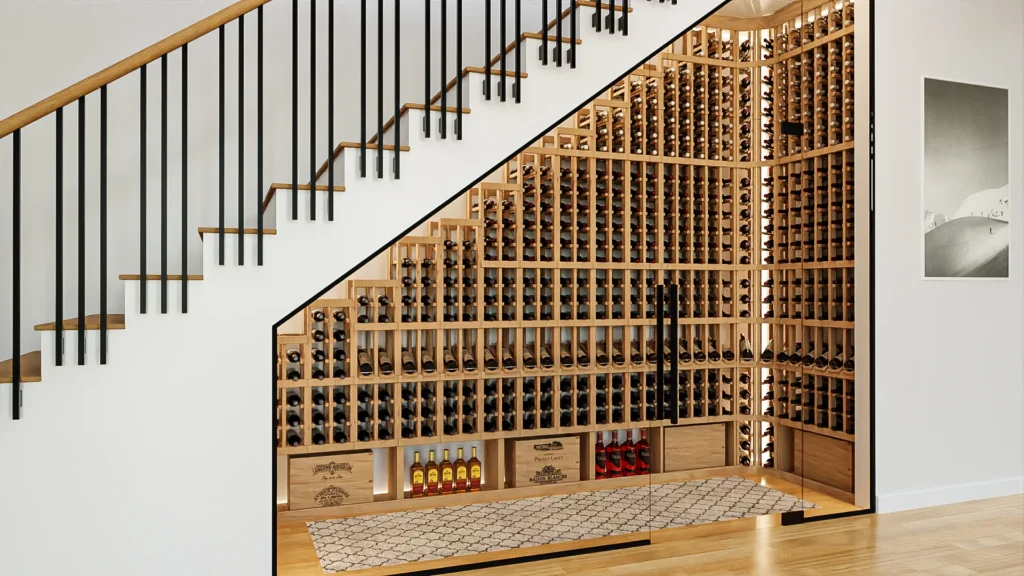
The space beneath a staircase is often overlooked. It can become a storage closet, an awkward empty area, or simply unused square footage. But with thoughtful planning, that same space can become a luxurious under-stairs wine display that combines architectural beauty, efficient bottle storage, and proper wine preservation.
An under-stairs wine cellar is especially appealing because it allows homeowners to turn an otherwise underutilized part of the home into a highly visible design feature.
The secret is to approach the project as more than a wine rack installation. A successful under-stairs wine display should integrate racking, insulation, climate control, lighting, glass, and custom millwork into one cohesive design.
Under-stair spaces can be ideal for wine storage because they are often naturally separated from the main living areas while remaining close to dining and entertaining spaces.
Depending on the staircase and available dimensions, the area can accommodate:
The sloped ceiling created by the staircase can actually become a design advantage, allowing the wine display to follow the architecture of the home.
Before choosing the rack style, determine what you want the space to accomplish.
Ask yourself:
How many bottles do I want to store?
How many bottles do I want on display?
Do I collect large-format bottles?
Do I want everyday bottles to be easily accessible?
Will the collection grow?
These questions influence the size and configuration of the racking.
For example, a homeowner might use the tallest portion of the under-stair space for full-height bottle storage while reserving the lower or more visible section for label-forward display.
The biggest difference between an ordinary under-stair wine rack and a luxury wine display is often the level of integration.
Instead of simply placing a rack beneath the stairs, consider designing the entire area as custom millwork.
This can include:
Wood panels
Custom shelving
Integrated wine pegs
Decorative trim
Back panels
Display niches
Cabinetry
Live-edge shelves
Matching architectural finishes
The goal is for the wine area to look like it was designed with the house rather than added afterward.
A custom wine display can even incorporate details from nearby architectural elements, such as a fireplace mantel, kitchen cabinetry, flooring, or staircase materials.
The rack is the centerpiece of the display, and different systems create very different visual effects.
Floating wine racks are ideal for homeowners who want a minimalist, contemporary appearance.
They reduce visible hardware and allow the bottles to become the primary visual feature.
Behind glass, a floating wine rack can create an almost invisible display.
Cable systems are another excellent option for modern under-stair wine displays.
Thin vertical cables can create a lightweight appearance while allowing bottles to be displayed at different heights.
They work particularly well when the under-stair area is visible from a dining room, kitchen, or living space.
Metal wine racks provide a more architectural appearance.
Matte black metal, for example, can complement modern stair railings, lighting fixtures, window frames, and other architectural details.
Wooden racking provides warmth and texture.
Popular woods include:
Redwood
Mahogany
White Oak
Walnut
Knotty Alder
Pine
Sapele
Wood can be stained or finished to coordinate with the surrounding interior.
Wine pegs are useful when you want bottles to project directly from a wall or custom millwork panel.
They can provide an efficient combination of storage and display while maintaining a clean appearance.
If the under-stair wine display is located in a prominent part of the home, glass can turn it into a dramatic focal point.
A frameless glass enclosure provides excellent visibility while preserving the open feeling of the surrounding space.
Glass can be used for:
Full-height doors
Feature walls
Partial enclosures
Corner panels
Custom wine room fronts
A glass enclosure also makes the wine collection visible without requiring the homeowner to enter the storage area every time they want to admire it.
However, glass introduces an important consideration:
Heat load.
Large areas of glass can transfer more heat into a climate-controlled wine room than insulated opaque walls. The type, area, orientation, and surrounding conditions of the glass should therefore be included in the cooling calculation.
A beautiful wine display is only part of the equation.
If the space is intended for long-term wine storage, it needs a properly designed climate-control system.
Wine requires relatively stable environmental conditions. Temperature fluctuations, excessive heat, and unsuitable humidity can negatively affect a wine collection over time.
An under-stair wine room should therefore be treated as a temperature-controlled enclosure, not simply a decorative cabinet.
A standard residential HVAC system isn’t necessarily designed to maintain the stable conditions required for wine storage.
A dedicated wine cellar cooling system is designed specifically for wine rooms and can operate differently from conventional comfort cooling.
Depending on the size and configuration of the under-stair wine room, options may include:
Through-the-wall systems
Self-contained systems
Ducted systems
Split systems
Ceiling-mounted systems
The right choice depends on the room’s heat load and the available installation space.
One of the most important steps is determining the actual cooling requirement.
Do not select the cooling system solely based on the cubic footage of the under-stair space.
The heat load can be affected by:
Room size
Ceiling height
Staircase construction
Exterior walls
Glass doors
Glass panels
Insulation
Surrounding room temperature
Sun exposure
Lighting
Door openings
A compact under-stair wine room with a large glass enclosure may require more cooling than a larger, fully insulated interior cellar.
This is especially important in warm climates such as Miami, Fort Lauderdale, and South Florida, where high ambient temperatures and humidity can increase the cooling demand.
The cooling unit should be considered early in the design.
An under-stair space may have limited room for mechanical equipment, making equipment placement particularly important.
A through-the-wall system may be appropriate when there is a suitable adjacent space where condenser heat can be discharged.
A ducted system can provide greater flexibility by allowing the cooling equipment to be located away from the visible wine display.
A split system can separate the evaporator and condenser, which may be advantageous when the available mechanical space is limited.
The best system is the one that provides the required cooling while fitting naturally into the home’s architecture.
Climate control begins with the construction of the wine room.
The walls, ceiling, and other boundaries should be properly insulated and sealed.
A wine cellar may require:
Insulated walls
Insulated ceiling
Vapor barrier
Sealed penetrations
Properly weatherstripped door
Appropriate glass specifications
This is particularly important in humid climates.
Without adequate insulation and vapor control, warm humid air can enter the wine room, increasing the cooling load and potentially creating condensation issues.
A powerful cooling unit cannot compensate indefinitely for an improperly constructed wine room.
Lighting can transform an under-stair wine display from simple storage into a luxury feature.
Popular lighting options include:
LED strips can be installed beneath shelves or along rack sections to illuminate individual bottles.
Backlit bottles can create a dramatic effect, particularly when the wine room is visible through glass.
Focused lighting can highlight special bottles, artwork, or architectural details.
Small recessed fixtures can provide general illumination without overwhelming the display.
LED lighting is generally preferred because it produces relatively little heat compared with older lighting technologies.
An under-stair wine display doesn’t have to be limited to bottles.
A custom shelf can provide space for:
Wine glasses
Decanters
Corkscrews
Decorative objects
Books
Wine accessories
Special bottles
A natural wood or live-edge shelf can introduce warmth into a modern glass-and-metal wine display.
For an especially cohesive design, consider matching the shelf material to an existing fireplace mantel, kitchen island, staircase, or other architectural feature.
A luxury wine display shouldn’t be beautiful but inconvenient.
Consider separating your collection into:
Display bottles — special vintages and visually attractive labels.
Everyday bottles — wines you access frequently.
Bulk storage — bottles that don’t need to be prominently displayed.
This allows the most visible part of the wine room to remain elegant while making everyday access practical.
If you collect Magnums or other large-format bottles, mention this during the design stage.
Standard bottle racks are not always designed for larger bottle dimensions.
A custom under-stair wine display can incorporate dedicated storage for:
Magnums
Champagne
Burgundy bottles
Oversized bottles
Decorative bottles
Planning for these bottles from the beginning prevents awkward modifications later.
The sloped underside of a staircase naturally creates different ceiling heights.
Rather than trying to hide this, use the slope as part of the design.
For example:
Tall racks can occupy the highest section.
Shorter bottle storage can follow the slope.
Display shelves can be positioned beneath the highest point.
Cable wine racks can emphasize vertical height.
Custom millwork can follow the exact staircase profile.
This creates a wine display that feels architectural rather than improvised.
If your home has a contemporary style, consider combining:
Frameless glass + matte black metal + floating wine racks + LED lighting.
This combination creates a clean, minimalist appearance.
For a warmer contemporary look, consider:
White Oak + black metal + glass + warm LED lighting.
For a traditional luxury home:
Mahogany or Redwood + custom millwork + decorative molding + glass door.
The materials should complement the surrounding architecture rather than compete with it.
There isn’t a universal price because the scope can range from a simple wine rack installation to a fully climate-controlled custom wine room.
The cost can be influenced by:
Wine rack material
Bottle capacity
Custom millwork
Glass enclosure
Door type
Cooling system
Insulation
Vapor barrier
Lighting
Electrical work
Flooring
Wood finish
Installation labor
A basic wine display can be relatively simple, while a fully enclosed and climate-controlled luxury wine room can involve multiple trades and custom fabrication.
The best way to establish a realistic budget is to design the space first and then price each component.
The cooling system and racking should be coordinated from the beginning.
A climate-controlled wine room needs appropriate insulation and vapor control.
Large glass surfaces can significantly affect the cooling requirement.
Cubic footage is only one part of the calculation.
Leave room for the collection to expand.
The most beautiful wine display is still a storage system. Make sure you can comfortably reach the bottles.
Cooling equipment should remain accessible for maintenance and service.
The most successful projects bring multiple elements together:
Custom racking for bottle storage.
Glass for visibility.
Lighting for presentation.
Insulation and vapor control for environmental stability.
Dedicated cooling for wine preservation.
Millwork for architectural integration.
Specialty storage for large-format and display bottles.
When these elements are designed together, the result can look less like a storage area and more like a custom piece of architecture.
If you have an unused area beneath your staircase, don’t assume it’s too small or awkward for a wine cellar.
At CoolWineCellar.com, you can request a free custom wine cellar design consultation to explore how your available space can be transformed into a beautiful, climate-controlled wine display.
The design process can take into account:
Available dimensions
Bottle capacity
Wine rack style
Glass enclosure
Cooling requirements
Lighting
Wood finishes
Custom millwork
Overall home design
Whether you want a minimalist glass wine display or a warm, traditional wooden cellar, the space beneath your stairs may offer much more potential than you realize.
An under-stairs wine display can be one of the most creative ways to incorporate wine storage into a home.
But luxury isn’t simply about choosing expensive racks or adding glass.
True luxury comes from integrating storage, climate control, architecture, lighting, and craftsmanship into one seamless design.
Start with the structure and cooling requirements, then build the aesthetics around them. With the right planning, an otherwise overlooked space beneath the stairs can become a sophisticated wine showcase that protects your collection and adds character to the entire home.
Ready to transform your under-stair space? Visit CoolWineCellar.com for a free custom wine cellar design consultation.