
Call Us 📞 800-323-3130
Mon–Fri 8am–6pm CST, Sat–Sun 9am–1pm CST
Free design consultations
Showrooms in Miami & Fort Lauderdale
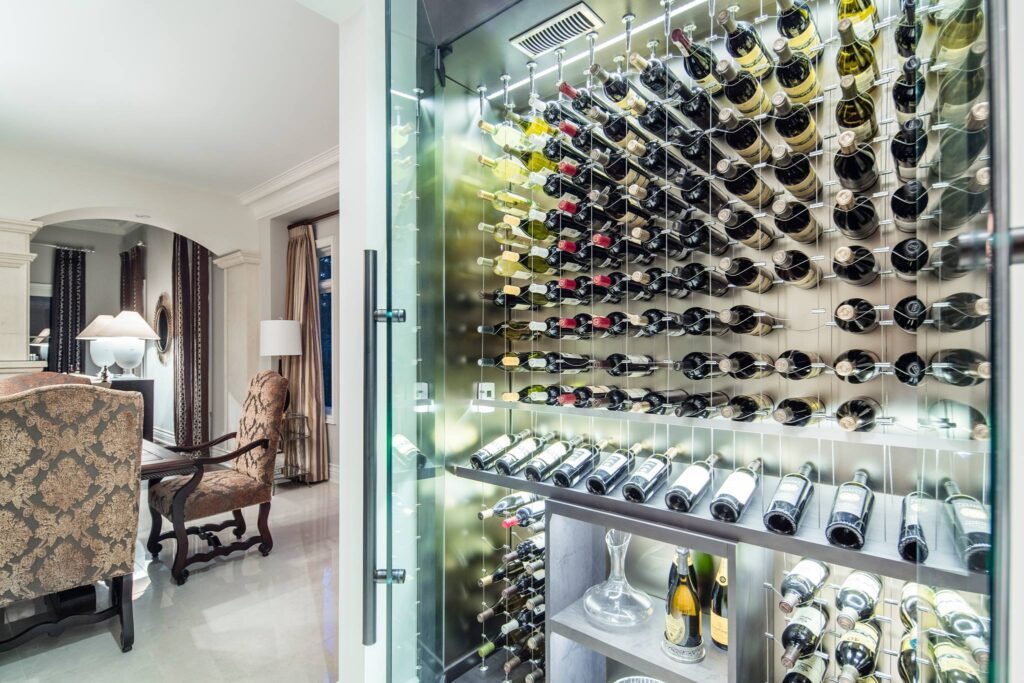
Choosing the right wine rack is about more than deciding how many bottles you want to store. The way bottles are positioned can dramatically change the appearance, accessibility, and functionality of your wine cellar.
Two popular approaches are horizontal wine racking and label-forward wine racking. Horizontal storage is often chosen for efficient bottle storage and traditional cellar design, while label-forward racking puts the wine label on display and makes it easier to identify individual bottles.
So, which style is right for your collection?
The answer depends on how you use your cellar, how much space you have, whether presentation matters to you, and how quickly you want to identify and access your wine.
Horizontal wine racking stores bottles on their sides, typically with the bottle resting securely in a cradle, cubby, shelf, or individual slot.
This is one of the most familiar wine-storage configurations.
The primary advantage is efficient storage.
By keeping bottles horizontally arranged across the wall, a wine cellar can accommodate a large collection without requiring excessive floor space.
Horizontal racking works particularly well for:
Large wine collections
Traditional wine cellars
High-capacity storage
Wall-to-wall wine racks
Custom wood wine cellars
Bulk bottle storage
Collectors prioritizing capacity
Horizontal bottle storage has long been associated with traditional wine storage because keeping a corked bottle on its side helps keep the cork from drying out.
Modern wine closures vary, and storage recommendations can depend on the type of closure, but horizontal positioning remains a popular and practical configuration for many collectors.
It also makes excellent use of vertical wall space.
A properly designed horizontal wine rack can turn an entire wall into organized bottle storage.
Label-forward racking is designed to position bottles so the front label faces outward toward the viewer.
Instead of looking at the end or side of the bottle, you can see the wine’s label immediately.
This makes label-forward storage especially attractive for collectors who want their wine collection to function as part of the room’s visual design.
It can be particularly effective for:
Feature walls
Glass wine rooms
Luxury wine cellars
Display bottles
Wine tasting areas
Wine collections organized by producer or vintage
Contemporary interiors
Label-forward racking turns bottles into a form of visual artwork.
The biggest difference is the balance between storage efficiency and presentation.
| Feature | Horizontal Racking | Label-Forward Racking |
|---|---|---|
| Primary purpose | Efficient storage | Display and identification |
| Bottle visibility | Moderate | Excellent |
| Label visibility | Limited depending on configuration | Excellent |
| Storage capacity | Generally high | Can be lower |
| Best for | Large collections | Display-oriented collections |
| Accessibility | Good | Excellent for identifying bottles |
| Visual impact | Traditional | Contemporary/luxury |
| Glass wine rooms | Very good | Excellent |
| Cost | Varies by material/design | Often higher for specialized display |
| Ideal use | Main storage | Feature/display sections |
Neither style is universally better.
In many custom wine cellars, the best solution is to combine both.
Horizontal racking is a strong choice if your main priority is maximizing bottle capacity.
For example, if you have 500 bottles and want to store as much wine as possible within a limited footprint, traditional horizontal racks can make efficient use of the available walls.
This approach is especially useful when:
You have a growing collection.
You need maximum storage density.
Most bottles don’t need to be prominently displayed.
The cellar is primarily for long-term storage.
You want a classic wine cellar appearance.
A large collection can be divided into logical sections using horizontal racks while reserving a smaller portion of the cellar for special displays.
Label-forward racking is ideal when your wine collection is also part of the room’s design.
Instead of opening a cabinet or searching through a rack, you can immediately see what is available.
This can be especially useful for collectors who organize their wines by:
Region
Winery
Vintage
Varietal
Drinking preference
Special occasions
If you regularly entertain guests, label-forward racking can also make it easier to select bottles during a tasting or dinner.
Imagine walking into your wine cellar and immediately seeing the labels of every bottle on display.
You don’t need to pull out bottles or remember exactly where a particular vintage is located.
This is one of the biggest practical advantages of label-forward storage.
It turns the wine cellar into something closer to a wine library.
You can scan the collection visually and quickly identify what you want.
The main drawback of label-forward racking is that presentation can require more space.
Traditional horizontal racking can pack bottles tightly into a wall.
Label-forward systems often require additional clearance or specialized bottle supports to position labels toward the viewer.
That means a label-forward wall may store fewer bottles per square foot than a high-density traditional rack.
For this reason, label-forward racking is often best used strategically rather than throughout the entire cellar.
A hybrid wine rack design can provide the best of both worlds.
For example:
Use traditional horizontal wine racks for high-capacity bottle storage.
Use label-forward racking to highlight your best wines.
Reserve a small area for special vintages, rare bottles, or collector’s editions.
Add dedicated sections for Magnums and other oversized bottles.
This creates a wine cellar that is both practical and visually impressive.
Label-forward racks are especially effective in a glass-enclosed wine room.
Because the entire collection can be viewed from outside the cellar, positioning the labels toward the glass maximizes the visual impact.
A modern glass wine room might combine:
Frameless glass + label-forward racks + LED lighting + dark metal hardware.
The result is an architectural wine display that can become a focal point of the dining room, kitchen, or living area.
Label-forward displays don’t have to be made from metal.
Custom wooden racking can also be designed to showcase bottle labels.
Popular wood species include:
Redwood
Mahogany
White Oak
Walnut
Knotty Alder
Sapele
Wood adds warmth and craftsmanship to the display and can coordinate with cabinetry, flooring, doors, or other millwork in the home.
For a traditional luxury cellar, mahogany or premium redwood can create a classic appearance.
For a contemporary interior, white oak or walnut can provide a more modern aesthetic.
Contemporary wine cellars often use metal, cable, and floating wine racks for label-forward presentation.
These systems can create a minimalist appearance where the bottles appear to float against the wall.
Popular approaches include:
These systems work particularly well when the homeowner wants the wine collection to feel like part of the architecture.
When selecting a label-forward system, consider how the bottle is actually supported.
The rack needs to securely hold the bottle while maintaining the desired display angle.
Some systems position the bottle horizontally, while others may use an angled presentation.
The correct configuration depends on the rack system and the type of bottle being stored.
Special attention should be given to:
Bottle diameter
Bottle length
Bottle weight
Closure type
Large-format bottles
Champagne bottles
Burgundy bottles
Not every bottle will fit identically into every rack.
A common mistake is designing a beautiful label-forward display without considering bottle variety.
Wine collections often include bottles that are larger or differently shaped than standard 750 ml bottles.
If you collect:
Magnums
Double Magnums
Champagne
Burgundy
Oversized bottles
tell your wine rack designer before the layout is finalized.
Specialty storage can be incorporated into the design rather than forcing oversized bottles into standard spaces.
The right rack configuration depends on your lifestyle.
If You Mostly Store Wine:
Prioritize horizontal, high-capacity storage.
If You Frequently Entertain:
Add more label-forward display so guests can easily browse the collection.
If You Collect Rare Wines:
Create a dedicated display area for special bottles.
If You Have a Large Collection:
Use a hybrid design that balances high-density storage with presentation.
If Your Wine Room Is Visible From Outside:
Consider making the most visible wall label-forward.
Wine rack pricing varies based on the material, design, capacity, finish, and level of customization.
Standard horizontal wood racks can provide an efficient way to control costs while still creating an elegant cellar.
Specialized label-forward systems may require more hardware and custom fabrication.
You don’t have to make every section of the cellar equally expensive.
A smart design can use:
Standard storage + premium display + custom specialty sections.
This puts your budget where it will have the greatest visual and functional impact.
If you’re investing in label-forward storage, don’t overlook lighting.
A well-designed lighting system can make labels easier to read and transform the wine collection into a dramatic display.
Consider:
LED strip lighting
Backlighting
Recessed lighting
Under-shelf lighting
Accent lighting
Lighting should be selected carefully for a wine environment, with LED solutions commonly preferred because they generate relatively little heat.
The most attractive wine rack is still only one part of a successful wine cellar.
If you’re creating a dedicated wine room, the space should also be properly insulated, sealed, and climate controlled.
The cooling system should be sized according to the room’s actual heat load, considering factors such as:
Room dimensions
Insulation
Exterior walls
Glass walls
Door construction
Ambient temperature
Sun exposure
This is especially important in warm and humid climates such as South Florida. Shop the top wine cooling units today.
A balanced luxury cellar might look like this:
Back Wall
High-capacity horizontal racking for everyday storage.
Main Feature Wall
Label-forward display for premium bottles and special vintages.
Side Wall
Specialty storage for Magnums and Champagne.
Lower Sections
Bulk storage or diamond bins.
Glass Front
Clear visibility of the collection from outside the room.
Lighting
Subtle LED illumination highlighting labels and architectural features.
This approach provides both efficient storage and a high-end visual presentation.
Is label-forward wine storage better than horizontal storage?
Not necessarily. Label-forward storage is better for visibility and presentation, while traditional horizontal racking can provide greater storage density. Many wine cellars benefit from combining both.
Does label-forward racking store fewer bottles?
It can. Because the system prioritizes bottle presentation and accessibility, it may use more space per bottle than high-density horizontal storage.
Yes. Custom wooden racks can be designed to present labels toward the viewer.
Yes. Metal, cable, floating, and wine peg systems are especially effective for contemporary label-forward displays.
Usually, there is no need to make every bottle a display bottle. A combination of efficient storage and strategically placed display sections often provides better value.
Some specialized systems can, but the rack must be specifically designed or configured for large-format bottles.
The best wine cellar design starts with understanding how you want to store and experience your collection.
At CoolWineCellar.com, you can explore custom wood, metal, cable, floating, and contemporary wine rack solutions designed for different collection sizes and interior styles.
If you’re unsure whether horizontal or label-forward storage is right for your project, a free custom wine cellar design consultation can help you determine the ideal combination based on your bottle count, available space, architecture, and budget.
Choosing between horizontal and label-forward wine racking isn’t simply a matter of aesthetics.
It’s about deciding how you want your wine collection to function.
Horizontal racking prioritizes efficient storage. Label-forward racking prioritizes visibility, accessibility, and presentation.
For many collectors, the smartest solution is to combine the two: use horizontal racks for the majority of the collection and label-forward displays for the bottles you want to showcase.
That approach gives you the best of both worlds—a wine cellar that stores efficiently, looks exceptional, and makes it easy to enjoy your collection.