
Call Us 📞 800-323-3130
Mon–Fri 8am–6pm CST, Sat–Sun 9am–1pm CST
Free design consultations
Showrooms in Miami & Fort Lauderdale
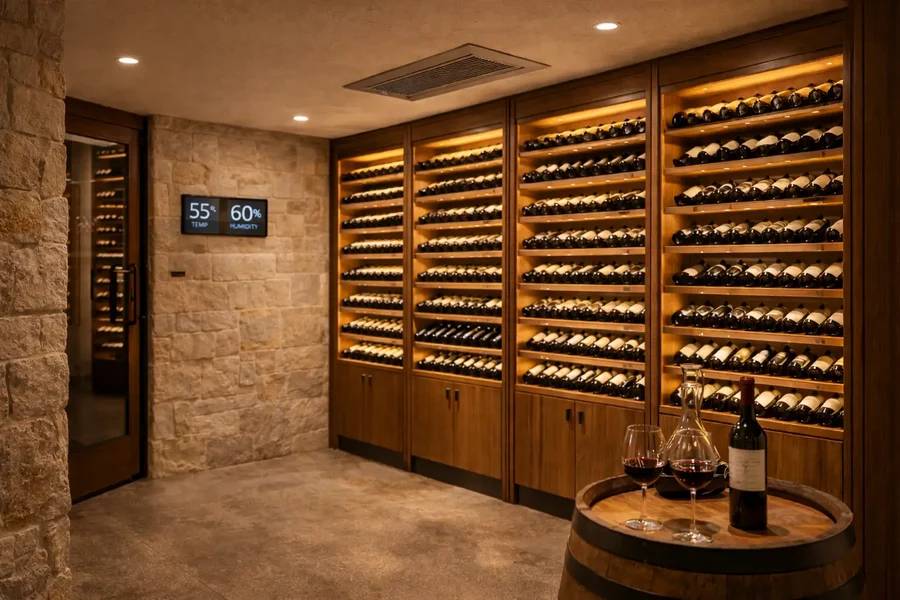
A wine cellar is more than a beautiful place to display your collection. It is a carefully controlled environment where temperature, humidity, and air circulation help protect your wine as it ages. Whether you have a compact residential wine room, a glass-enclosed wine wall, or a large commercial cellar, maintaining consistent conditions is essential.
Smart controls make managing these conditions easier by allowing you to monitor temperature and humidity remotely, receive alerts when readings move outside your preferred range, and identify potential problems before they threaten your collection.
From Wi-Fi-enabled sensors to integrated wine cooling systems, today’s technology offers several ways to make wine storage more convenient and reliable. The key is choosing a solution that works with your existing cooling equipment and provides the right level of monitoring for your cellar.
Before installing smart controls, establish the environmental conditions you want to maintain. Monitoring technology is only useful when you understand which readings matter and when action is needed.
For long-term storage, approximately 55°F is a commonly used wine cellar temperature target. Stability is generally more important than achieving an exact number at every moment.
Relative humidity is also important, particularly for bottles sealed with natural cork. A range of approximately 50%–70% is often used as a general guideline, although the ideal level depends on the cellar’s design, storage duration, and construction materials.
Here are practical starting points for configuring your monitoring system:
| Parameter | General target | What to monitor |
|---|---|---|
| Temperature | Around 55°F | Sustained temperature changes and unexpected fluctuations |
| Relative humidity | Approximately 50%–70% | Persistent dryness, excessive moisture, and condensation risks |
| Cooling performance | Consistent operation | Unusual runtime, alarms, or failure to reach the setpoint |
| Sensor connectivity | Reliable communication | Offline sensors and missing readings |
These values are general guidelines rather than universal requirements. Follow the recommendations for your particular collection and cooling equipment.
The foundation of any smart wine cellar is an accurate temperature and humidity sensor. These devices measure environmental conditions and send readings to a connected application, monitoring hub, or building automation system.
Depending on the product, you may be able to review current readings, view historical trends, and receive notifications when conditions move outside configured limits.
Common options include:
Wi-Fi sensors: These connect directly to your wireless network and typically provide remote monitoring through a smartphone app. They can be convenient for residential cellars where reliable Wi-Fi coverage is available.
Bluetooth sensors: These are suitable for local monitoring, although remote access may require a compatible gateway or hub.
Hub-based wireless sensors: These communicate with a central hub that sends readings to the internet. They can be useful when several sensors are installed throughout a home or commercial property.
Wired environmental sensors: These can integrate with compatible building automation systems or dedicated monitoring controllers. They are worth considering for larger cellars or commercial installations that require centralized oversight.
When choosing a sensor, look for temperature and humidity accuracy, adjustable alert thresholds, reliable data logging, and a clear indication when the device loses connectivity.
For a typical residential cellar, one well-positioned sensor may be sufficient. Larger wine rooms or multi-zone cellars may benefit from multiple sensors to identify differences between areas.
Smart monitoring and smart cooling are not necessarily the same thing.
A monitoring sensor measures conditions and reports them to you. A cooling controller regulates the equipment that changes those conditions. Some products combine both functions, while others require separate devices.
Before purchasing smart controls, determine which capabilities your existing wine cooling system supports.
Option A: Use an independent monitoring system
This is often the simplest way to add smart functionality to an existing cellar.
Install a compatible temperature and humidity sensor inside the wine room and connect it to a mobile application. You can then review readings remotely and receive alerts if the temperature becomes too high or humidity falls outside your preferred range.
This approach is especially useful when your cooling unit does not offer built-in Wi-Fi or remote monitoring.
However, an independent sensor generally cannot adjust the cooling system unless the products are specifically designed to communicate with each other.
Option B: Use a compatible smart thermostat or cooling controller
Some wine cooling systems support dedicated thermostats or controllers that regulate the equipment and display operating conditions.
Depending on the model, these controllers may provide features such as temperature adjustment, operating-status information, alarm notifications, or remote access.
Before integrating a third-party controller, confirm compatibility with the cooling unit’s electrical requirements, control interface, and operating logic. A general-purpose smart thermostat should not be assumed to work with a specialized wine cellar cooling system.
Option C: Integrate the cellar with a building automation system
For luxury homes, hospitality venues, restaurants, and commercial wine rooms, a building automation system may provide centralized monitoring.
Compatible temperature and humidity sensors can feed data into a common interface alongside other building systems. Depending on the installation, the system may support remote alarms, trend analysis, and authorized control of compatible equipment.
This approach is particularly useful when several wine rooms or storage zones need to be monitored from one location.
One of the most useful benefits of smart monitoring is receiving an alert when something goes wrong.
Without notifications, a cooling failure may remain unnoticed for hours or days, especially when the cellar is located in a vacation home, basement, or commercial property that is not monitored continuously.
Smart sensors can notify you when readings exceed your configured limits, although available alert types vary by product.
Consider configuring the following alerts:
High-temperature alert: Notifies you when the cellar becomes warmer than your selected threshold.
Low-temperature alert: Helps identify unexpectedly cold conditions.
High-humidity alert: Flags prolonged moisture conditions that may contribute to condensation or mold.
Low-humidity alert: Warns when conditions remain unusually dry.
Sensor-offline alert: Indicates that the monitoring device has stopped communicating, where supported.
Cooling-system alarm: Provides notification when supported equipment reports a fault.
Avoid setting every alert to trigger immediately for minor fluctuations. A brief door opening may cause a temporary change that does not threaten the collection.
Where the system supports it, use adjustable thresholds and time delays to distinguish short-lived changes from sustained problems.
For example, you might configure a high-temperature notification if the cellar remains above 58°F for a specified period. This is an illustrative setting, not a universal alarm threshold; the appropriate value depends on your cooling system, normal operating range, and tolerance for temperature excursions.
A single sensor does not always tell the whole story.
In a large wine cellar, a glass enclosure, or a room with unusual airflow patterns, conditions can vary between the upper and lower racks or between areas near the cooling supply and return.
Placing sensors strategically can help you understand these differences.
For example:
Position one sensor in a representative area of the cellar, away from direct supply airflow.
Add another sensor in a different part of a large room if temperature distribution is a concern.
Monitor areas where condensation has occurred previously.
Avoid placing sensors directly beside lights, exterior glass exposed to sunlight, or other heat sources that could distort readings.
Follow the sensor manufacturer’s placement recommendations and avoid assuming that readings taken directly in a cold supply-air stream represent the temperature experienced by the entire wine collection.
For glass-enclosed wine rooms, monitoring near vulnerable areas may also help identify temperature or humidity conditions that contribute to condensation. A sensor alone cannot determine whether a surface will condense, because surface temperature and local dew point also matter.
Real-time readings tell you what is happening now. Historical data helps explain what has been happening over time.
Many smart monitoring systems record readings in charts or logs, allowing you to review temperature changes throughout the day and compare performance across different periods.
This information can be particularly valuable when troubleshooting a cellar that struggles to maintain its setpoint.
For example, historical data may reveal that:
Temperatures rise consistently during the hottest part of the afternoon.
The cellar becomes warmer after frequent door openings.
Humidity increases after cooking or during periods of high outdoor humidity.
Temperature recovery takes longer than usual after the door is opened.
A sensor repeatedly records unusual readings in one area.
These patterns can help narrow down potential causes, such as inadequate insulation, excessive heat gain through glass, poor air distribution, or a cooling system that is undersized for the actual heat load.
However, monitoring data cannot independently establish the cause of a problem. A qualified wine cellar technician may need to inspect the enclosure, airflow, refrigeration components, and equipment installation.
If you are building a custom wine cellar, planning smart controls during the design stage can be easier than adding them after installation.
Early planning allows you to coordinate sensors, wiring, network access, cooling equipment, and service requirements before walls and ceilings are finished.
Consider the following design elements.
Sensor locations: Identify suitable monitoring points before installing wine racks and decorative panels.
Network coverage: Verify that Wi-Fi or the chosen wireless communication method works inside the enclosed room, especially when glass, metal framing, or dense construction materials affect signal quality.
Power and wiring: Provide the necessary electrical connections and low-voltage wiring for compatible controllers, gateways, and sensors.
Cooling-system compatibility: Select equipment with the control and monitoring features your project requires.
Equipment access: Ensure that controllers and connected components remain accessible for maintenance and troubleshooting.
Future expansion: If you expect to add more storage zones, choose a monitoring platform that can support additional sensors without requiring a complete replacement.
For luxury projects, integrating smart monitoring into the overall wine cellar design can preserve the clean appearance of a glass enclosure while providing useful information behind the scenes.
One of the most important decisions is determining whether you simply want to monitor the cellar or have the system automatically respond to changing conditions.
Monitoring systems measure conditions and notify you when intervention may be necessary. Automatic control systems use compatible controllers to operate equipment according to programmed settings.
For example, a monitoring-only system may send a high-temperature alert while leaving you responsible for checking the cooling unit. An integrated control system may adjust compatible equipment to maintain its setpoint.
Humidity control requires additional consideration. Not every wine cooling system actively regulates humidity, and a temperature controller may not be capable of operating a humidifier or dehumidifier.
Before connecting devices, confirm that the complete system supports the intended functions and includes appropriate safety protections.
Avoid using unsupported electrical relays or improvised controls to switch refrigeration equipment. Incorrect control methods can damage equipment, interfere with compressor protection, or create electrical hazards.
Smart monitoring depends on more than the sensor itself. Power interruptions, wireless connectivity problems, depleted batteries, and cloud-service outages can all affect your ability to receive timely notifications.
A dependable setup should account for these possibilities.
Consider these safeguards:
Choose sensors with a low-battery notification or a clear battery-status indicator.
Enable offline alerts when the platform supports them.
Confirm that the monitoring device reconnects automatically after a network interruption.
Keep the cooling system’s essential temperature control independent of internet access whenever the equipment is designed to operate that way.
Consider backup power for appropriate monitoring components if power interruptions are a concern.
Test notifications periodically to verify that they reach the intended recipient.
For commercial wine storage, restaurants, and high-value collections, a monitoring platform with reliable alert delivery and documented operating history may be worth the additional investment.
Remember that a smartphone notification is not a substitute for a properly sized cooling system, regular maintenance, or an emergency response plan.
Even a well-designed smart monitoring system needs periodic attention.
Sensor readings can drift over time, batteries can weaken, and software settings may change. A faulty sensor can create false alarms or provide misleading reassurance when conditions are outside the desired range.
To maintain dependable monitoring:
Review temperature and humidity readings regularly.
Inspect sensors for damage, moisture exposure, or loose mounting.
Replace batteries according to the manufacturer’s recommendations.
Compare readings with a suitable reference instrument periodically.
Follow the manufacturer’s calibration or replacement instructions.
Test notification settings after major configuration changes.
Review historical data after servicing the cooling system.
If two sensors consistently show different readings, investigate their placement and accuracy before assuming that the cellar has a genuine environmental imbalance.
For commercial installations, documenting sensor checks and maintenance activities can also support consistent operational procedures.
The ideal setup depends on your cellar’s size, the value of your collection, and the amount of automation you need.
| Wine cellar type | Suggested starting point | Key consideration |
|---|---|---|
| Small residential wine room | Connected temperature and humidity sensor | Reliable remote alerts |
| Glass-enclosed wine wall | Sensor monitoring plus compatible cooling controls | Heat gain, sensor placement, and condensation risks |
| Large custom wine cellar | Multiple sensors and an integrated controller | Temperature distribution and equipment compatibility |
| Vacation home cellar | Remote monitoring with offline alerts | Reliable notifications when the property is unattended |
| Restaurant or commercial cellar | Centralized monitoring with historical data | Operational reliability and maintenance records |
| Multi-zone wine storage | Separate sensors for each relevant zone | Independent readings and appropriate control for each zone |
These are starting points rather than fixed requirements. The right configuration should be selected according to the actual enclosure, cooling equipment, and monitoring objectives.
Can I monitor my wine cellar temperature from my phone?
Yes. A compatible Wi-Fi sensor, wireless gateway, or integrated cooling controller can let you view cellar temperature through a smartphone application. Remote access requires the appropriate network connection and product support.
Can smart sensors control my wine cellar cooling unit?
Some systems can, but many sensors are designed only for monitoring. Automatic control requires a compatible thermostat or controller that supports the specific cooling equipment.
How many sensors does a wine cellar need?
A small, well-designed cellar may need only one sensor. Larger rooms, multiple zones, and enclosures with uneven airflow may benefit from additional sensors to identify environmental differences.
Do smart temperature sensors also measure humidity?
Many products measure both temperature and relative humidity, but not all do. Check the specifications before purchasing and confirm that the device provides the data you need.
Will smart controls prevent wine spoilage?
Smart controls can help identify temperature excursions, equipment problems, and humidity changes sooner. However, they cannot guarantee wine preservation. Proper insulation, cooling capacity, enclosure sealing, maintenance, and timely responses to alerts remain essential.
Can I add smart monitoring to an existing wine cellar?
In many cases, yes. An independent temperature and humidity sensor is often the easiest starting point. More advanced automation may require compatible controls, wiring, or upgrades to the existing cooling system.
Smart controls can make wine cellar management more convenient by giving you visibility into temperature, humidity, and environmental trends without requiring constant visits to the room. With the right sensors, notifications, and compatible cooling controls, you can identify potential problems earlier and make more informed decisions about maintaining your collection.
The most effective approach begins with reliable environmental monitoring and expands to automatic control when the cooling equipment supports it. For larger or more complex cellars, professional planning can help coordinate sensors, refrigeration equipment, insulation, and building automation into one dependable system.
Planning a smart wine cellar? CoolWineCellar can help you explore custom wine cellar designs, glass wine enclosures, wine racks, and wine cooling solutions tailored to your space. Start with the right environmental design, then add monitoring technology that supports the long-term protection of your collection.