
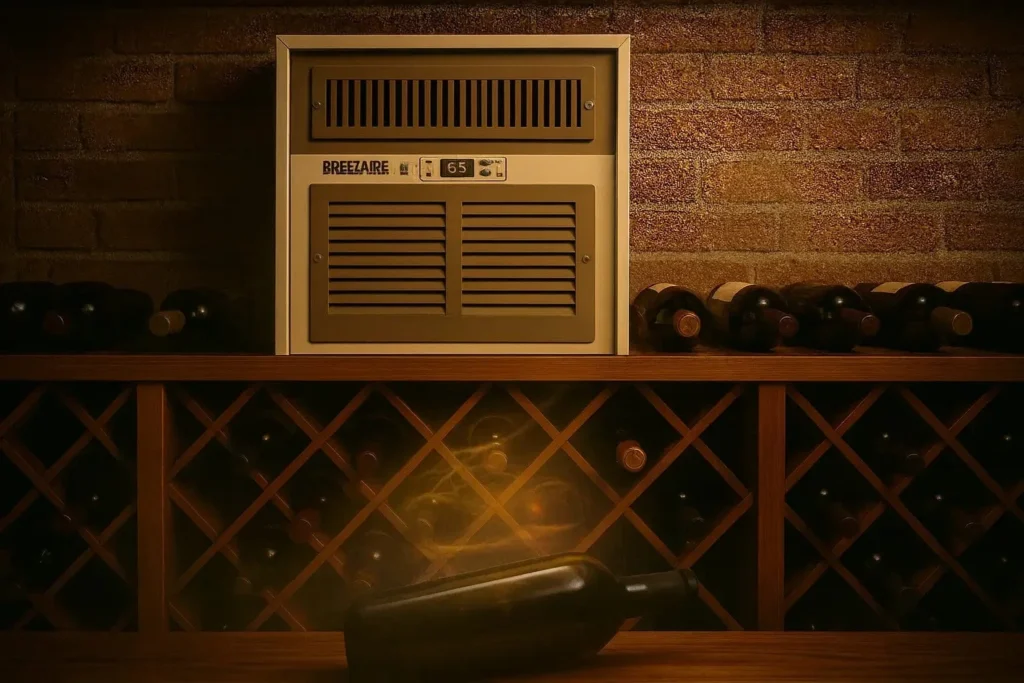
When choosing a wine cellar cooling system, the Breezaire WKL and WKE series can be confusing because they are closely related. Both were designed for wine cellar applications, and many homeowners searching for a replacement may encounter older WKE units alongside newer WKL models.
The most important thing to know is that the WKE series has been discontinued and replaced by the WKL series. Breezaire currently lists the WKL 1060, 2200, 3000, 4000, 6000, and 8000 models as replacements for the older WK and WKE series.
So, if you’re building a new wine cellar or replacing an older WKE unit, the WKL is generally the model family to consider.
What Is the Breezaire WKE Series?
The Breezaire WKE was an older generation of self-contained wine cellar cooling systems. Breezaire’s documentation identifies the WKE series as a discontinued product line, with production ending in December 2016. The manufacturer now identifies the WKL series as its replacement.
The WKE was designed to maintain wine-cellar conditions rather than operate like a standard refrigerator or air conditioner. Breezaire’s WKE documentation specifies a selectable temperature range of approximately 48°F to 62°F and a target relative humidity range of approximately 50% to 75%, assuming the wine enclosure is properly constructed.
Like other Breezaire wine cellar systems, the WKE was designed to cool the enclosure gently while removing excess moisture rather than aggressively drying the air.
What Is the Breezaire WKL Series?
The WKL is the newer generation of Breezaire’s self-contained wine cellar cooling equipment.
Breezaire currently offers the WKL series in several capacities, including:
- WKL 1060
- WKL 2200
- WKL 3000
- WKL 4000
- WKL 6000
- WKL 8000
Depending on the model, the manufacturer’s published sizing guide ranges from approximately 140 cubic feet to 2,000 cubic feet under specified enclosure construction conditions.
The WKL uses Breezaire’s Sentry III digital control system, which provides a large LED display, adjustable temperature settings, power-outage protection, and blocked-airflow protection.
The Biggest Difference Between WKE and WKL
The easiest way to understand the difference is:
WKE = older, discontinued generation
WKL = newer replacement generation
Breezaire’s own service documentation specifically states that the WKE series was discontinued and that the WKL series replaced it.
There is also a significant difference in the control system.
According to Breezaire’s service FAQ, the WKL has a built-in controller with a large digital display, while the WKE used an LCD display that could be wired up to approximately 75 feet away. Breezaire notes that there are additional differences in the control systems between the two generations.
WKL vs. WKE at a Glance
| Feature | Breezaire WKE | Breezaire WKL |
|---|---|---|
| Product status | Discontinued | Current replacement series |
| Generation | Older | Newer |
| Controller | Older LCD/control system | Sentry III digital controller |
| Display | Remote-capable LCD | Built-in LED display |
| Wine cellar application | Yes | Yes |
| Temperature control | Approximately 48–62°F | Approximately 48–63°F |
| Humidity range | Approximately 50–75% | Approximately 50–75% |
| Current availability | Replacement/service situations | Current product line |
| Best for new installations | No | Yes |
The exact specifications vary by model, and the published temperature range should not be interpreted as a guarantee that every installation will perform identically. Proper cellar construction and heatload are critical.
Does the WKL Cool Better Than the WKE?
It’s tempting to think of the WKL simply as a more powerful version of the WKE, but that’s not really the best way to look at the upgrade.
The major change is generation, controls, availability, and serviceability, rather than simply temperature performance.
Both systems were designed specifically for wine storage environments. Breezaire emphasizes gentle cooling, humidity management, vibration control, and quiet operation across its wine cooling systems.
For a new installation, the advantage of the WKL is that you’re buying into the current Breezaire product family rather than installing an obsolete model.
Why Was the WKE Replaced?
Breezaire has continued updating its product lines while maintaining compatibility and service support for many older units.
The manufacturer’s current website states that the company has worked to improve and update its products while maintaining the ability to repair production units dating back to 1985.
However, there is an important distinction between being serviceable and being the best choice for a new installation.
An older WKE may still be repairable, but that doesn’t necessarily make purchasing an older WKE the best decision when a current WKL replacement is available.
Which Breezaire Should You Buy?
Choose the WKL if you’re building a new wine cellar
For a new wine cellar, the WKL is the clear choice between the two.
The reasons are straightforward:
- It is the current replacement for the WKE.
- It uses the newer Sentry III control system.
- It is currently offered by Breezaire.
- Replacement parts and service are supported through the current product ecosystem.
- It is available in multiple capacities.
- It provides modern control and protection features.
Breezaire’s current product page specifically identifies the WKL models as replacements for the older WK and WKE series.
Consider a WKE only when replacing an existing unit
If you already have a WKE installed and need to repair or replace it, the situation is different.
Before buying another older WKE, determine:
- The exact WKE model.
- The serial number.
- The cooling capacity.
- The physical dimensions.
- The existing electrical requirements.
- The configuration of the wine cellar.
- Whether the current installation meets Breezaire’s construction requirements.
Breezaire recommends contacting its service department with the model and serial number when assistance is required.
In many cases, replacing an older WKE with the appropriate WKL equivalent may make more sense than trying to source another discontinued unit.
Don’t Choose a WKL Based Only on Cubic Feet
This is one of the most important considerations when purchasing a wine cellar cooling system.
Breezaire provides cubic-foot sizing guidelines, but those specifications assume the enclosure meets specific construction requirements.
The WKL installation documentation calls for appropriate insulation and a vapor barrier, and Breezaire warns that factors such as glass doors and windows can affect the cooling requirements.
This becomes especially important for modern wine rooms with:
- Glass walls
- Frameless glass doors
- Exterior walls
- Large windows
- Poor insulation
- High ceilings
- High ambient temperatures
- Frequently opened doors
A wine cellar with significant glass exposure can have a substantially different cooling requirement than an insulated room of the same cubic-foot volume.
WKL 1060 vs. WKL 2200 vs. Larger Models
Once you’ve decided on the WKL series, the next question is which capacity do you need?
Breezaire’s published specifications provide the following approximate enclosure volumes under its specified construction conditions:
- WKL 1060: up to 140 cu. ft.
- WKL 2200: up to 265 cu. ft.
- WKL 3000: up to 650 cu. ft.
- WKL 4000: up to 1,000 cu. ft.
- WKL 6000: up to 1,500 cu. ft.
- WKL 8000: up to 2,000 cu. ft.
These numbers are useful for preliminary sizing, but they shouldn’t replace a proper heatload assessment when the cellar has challenging construction characteristics.
What About Glass Wine Cellars?
Glass is one of the biggest reasons you should be careful about selecting a cooling unit based solely on room volume.
Breezaire’s installation documentation notes that its standard sizing guide is based on specified enclosure construction requirements and specifically states that glass doors and windows are not included in its calculations.
That means a wine room with extensive glass should receive additional consideration before selecting the cooling unit.
For example, a 500-cubic-foot enclosed wine cellar with well-insulated walls may have very different cooling requirements from a 500-cubic-foot wine room featuring multiple glass walls.
Don’t Forget the Warm-Side Exhaust
Another important consideration with a self-contained cooling unit is where the heat goes.
A self-contained Breezaire unit has a cold side that serves the wine cellar and a warm side that rejects heat. Breezaire specifically points out that installation location matters not only inside the cellar but also where the warm-side exhaust air is being rejected.
Ideally, the condenser side should have adequate airflow and should not be placed in an area where heat buildup will make the cooling system work unnecessarily hard.
What If the WKL Isn’t the Right Solution?
The WKL is a self-contained system, so it isn’t automatically the best solution for every wine cellar.
If you don’t want the condenser heat and noise inside an adjacent room, a split system may be a better choice.
Breezaire’s current WKSL split systems separate the evaporator and condenser, allowing the condenser to be mounted as far as 50 feet away from the cooling module.
A split system can be particularly useful when:
- The wine room is located next to a living area.
- Condenser heat needs to be moved elsewhere.
- Noise needs to be minimized near the wine room.
- There isn’t an appropriate location for a self-contained unit.
- The project has unusual installation requirements.
Final Verdict: WKL or WKE?
If you’re comparing the two specifically for a new purchase, the recommendation is straightforward:
Buy the Breezaire WKL.
The WKE is an older, discontinued series, while the WKL is the current replacement family. The WKL also provides the newer Sentry III digital control system and current product availability.
The more important question isn’t really “WKL vs. WKE?” anymore.
It’s:
“Which WKL capacity and configuration is appropriate for my wine cellar?”
That decision should take into account the cellar’s cubic footage, insulation, vapor barrier, glass exposure, ambient temperature, door construction, location, and heatload.
For a properly insulated traditional wine cellar, the WKL can be an excellent self-contained solution. For a wine room with extensive glass or difficult installation conditions, however, a different capacity—or even a split wine cooling system—may be the better choice.
Quick Buying Guide
Building a new wine cellar? → Choose WKL
Replacing an old WKE? → Look at the appropriate WKL replacement
Have extensive glass? → Perform a heatload calculation before selecting the unit
Need the condenser away from the cellar? → Consider a Breezaire WKSL split system
Unsure about capacity? → Don’t rely on cubic footage alone; have the cellar construction and heatload evaluated
The right wine cooling system isn’t necessarily the biggest one. It’s the system that is properly matched to the actual heatload and construction of the wine cellar.