
Call Us 📞 800-323-3130
Mon–Fri 8am–6pm CST, Sat–Sun 9am–1pm CST
Free design consultations
Showrooms in Miami & Fort Lauderdale
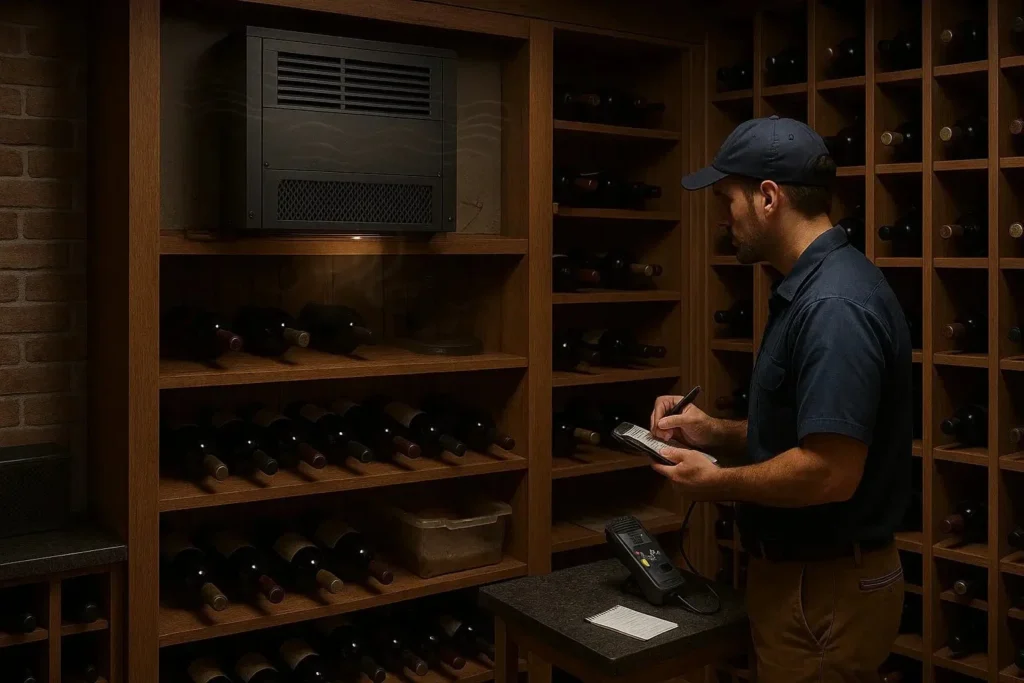
The quietest wine cellar is one where the noisy parts of the cooling system aren’t near anyone’s ears. Every refrigeration-based wine cooling unit has a compressor and fans, and both make sound. When the cellar shares a wall with a living room, bedroom, or home office, that hum and vibration can become the thing you notice most about your cellar.
The good news: noise is very solvable. Most problems come down to three decisions — which type of system you choose, where you put the loud components, and how carefully the unit is installed. This guide walks through each, from the biggest wins to the small fixes you can make today.
Before you fix noise, identify which kind you’re hearing. Each source travels differently and needs a different fix.
| Source | What it sounds like | How it travels |
|---|---|---|
| Compressor | Low hum or drone, cycling on and off | Through the air and through the structure |
| Condenser fan | Steady whoosh on the hot side | Mostly airborne |
| Evaporator fan | Softer whoosh inside the cellar | Airborne, through ducts and gaps |
| Vibration | Buzz, rattle, or a hum you feel in the wall | Structure-borne: studs, joists, framing |
| Airflow | Whistle or rush at grilles and duct turns | Airborne, amplified by restrictions |
The distinction that matters most is airborne versus structure-borne. Airborne sound is blocked with mass and sealed gaps. Structure-borne sound — vibration carried through framing — is stopped with decoupling and isolation. Many “noisy unit” complaints are really vibration problems, which is why a unit can seem loud in a bedroom two rooms away.
The single most effective noise reduction is choosing a system that puts the compressor somewhere you don’t live. No amount of insulation beats distance.
| System type | Where the compressor sits | Noise in living areas | Best for |
|---|---|---|---|
| Through-the-wall (self-contained) | In the unit, mounted in the cellar wall | Highest — the hot side vents into the adjacent room | Cellars next to garages, utility rooms, or basements |
| Ducted self-contained | In the unit, placed in a remote room and ducted to the cellar | Low to moderate, depending on where the unit sits | Cellars where a nearby closet, attic, or mechanical room is available |
| Ducted split | Outdoors or in a remote space; air handler ducted in | Very low | Cellars inside the main living space |
| Ductless split | Outdoors; only a quiet evaporator in the cellar | Low — only a soft fan inside | Cellars where ducting is impractical |
Rule of thumb: if your cellar shares a wall with a bedroom, living room, or office, avoid a through-the-wall unit that exhausts into that room. A split system with the condenser outside — or a ducted unit in a mechanical space — removes the compressor from the equation.
When placing a remote condenser or ducted unit:
A well-chosen system can still be noisy if it’s installed carelessly. These details cost little during installation and are much harder to add later.
Isolate the unit from the structure
Get the ducting right
Handle line sets and drains
If the noise source has to stay close, treat the barrier between it and your living space. Sound control rests on three principles: add mass, decouple the layers, and seal every gap.
Walls and ceilings
Doors and openings
Inside the cellar
One caution: never box in or cover a unit’s intake or exhaust to muffle it. Restricting airflow makes the compressor run hotter and longer, which is louder and shortens its life.
If your unit got louder over time, the cause is often maintenance, not design. Work through this checklist before planning a renovation.
When the hum is constant rather than cycling, the unit may be undersized for the room. A correctly sized system runs in shorter cycles and spends more time off.
What is the quietest type of wine cooling unit?
A split system with the condenser outdoors or in a remote mechanical space. Only the evaporator or air handler is near the cellar, and its fan is far quieter than a compressor.
Can I put a through-the-wall unit next to a bedroom?
It’s not recommended. The unit’s hot side, including the compressor and condenser fan, exhausts into the adjacent room. Choose a ducted or split system instead.
Will insulation alone fix a noisy cellar?
It helps with airborne noise but does little for vibration. Pair insulation with isolation mounts and decoupled drywall for the best result.
Can I enclose the unit in a cabinet to muffle it?
Only if the enclosure is designed for it, with ducted airflow that meets the manufacturer’s clearances. A sealed box will overheat the unit.
Is some noise normal?
Yes. Every refrigeration system makes some sound. The goal is to keep that sound out of the rooms where you live and sleep.
Reducing wine cooling noise works best in this order: move the compressor away from living areas, isolate the unit from the structure, then build a solid, sealed barrier between the cellar and your home. If you’re planning a new cellar, make noise part of the design conversation from day one — it’s far cheaper than retrofitting.
Not sure which system fits your space? Talk to our cellar design team. We’ll help you choose and place a cooling unit that protects your wine and keeps your home quiet.