
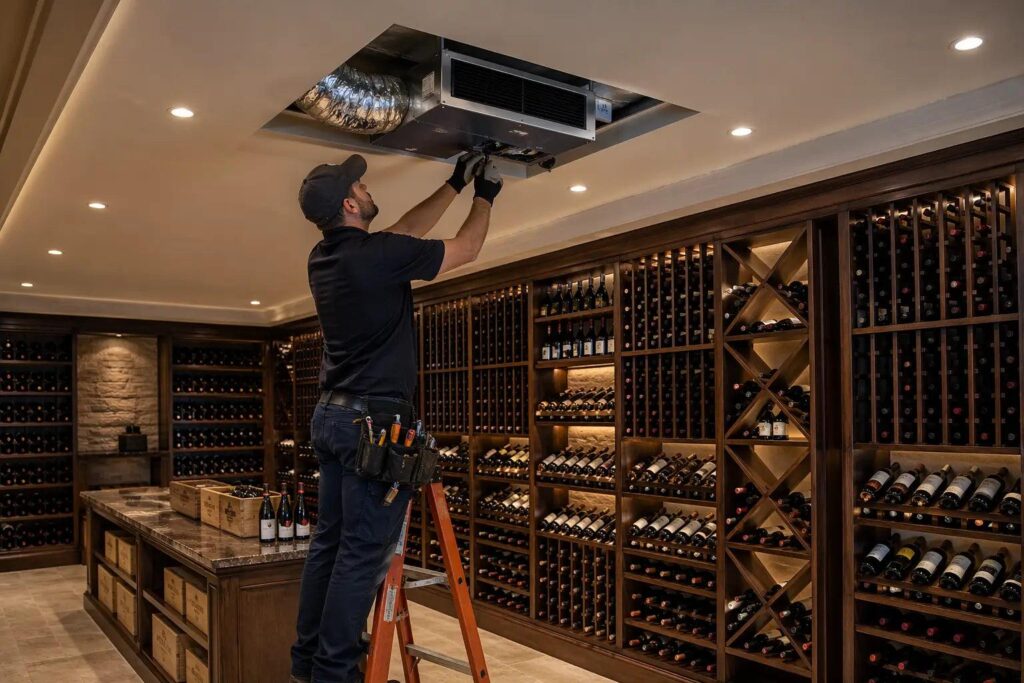
Designing a wine cellar involves more than selecting beautiful wine racks and glass doors. The cooling system is one of the most important decisions because it helps protect your collection while influencing the room’s appearance, available storage space, noise levels, and installation costs.
For many homeowners, designers, and contractors, a ceiling-mounted wine cooling system offers an appealing alternative to a traditional through-the-wall unit or a split system.
Wine Guardian manufactures cooling solutions for residential and commercial wine cellars, including ceiling-mounted configurations designed for projects where floor space, wall space, or equipment placement is a concern.
But when does a ceiling mount system make more sense than a wall-mounted or split system? And what should you consider before choosing one?
In this guide, we’ll explain how Wine Guardian ceiling-mounted systems work, compare their advantages and limitations, and help you determine which configuration may be the best fit for your wine cellar.
A ceiling-mounted wine cellar cooling system is installed at or above the ceiling, rather than occupying a visible section of wall inside the cellar. Depending on the model and installation configuration, the unit may be partially concealed or integrated into the room’s architectural design.
This arrangement can be particularly useful in contemporary wine rooms with glass enclosures, floating wine racks, or carefully planned lighting.
The main appeal of a ceiling-mounted solution is straightforward: it can preserve valuable wall space while keeping the cooling equipment out of the main visual focus.
However, a ceiling unit is not automatically the best choice for every cellar. Ceiling structure, service access, heat rejection, drainage, and cooling capacity must all be evaluated before installation.
A through-the-wall cooling unit is often a practical choice for a wine cellar with a suitable wall and an adjacent area where the unit can discharge heat. It is generally easier to understand and plan for than some more concealed installations.
However, wall-mounted systems occupy physical space and can become a noticeable part of the cellar design.
A ceiling-mounted system may be the better option in the following situations.
You want uninterrupted wine rack walls
If your wine cellar uses floor-to-ceiling wood wine racks, metal wine racks, or contemporary cable wine racks, every section of wall may be valuable.
A wall-mounted cooling unit can interrupt a symmetrical layout or take up space that could otherwise accommodate bottle storage.
By moving the equipment to the ceiling, you may be able to maintain a cleaner arrangement and use more of the available wall area for wine display.
Your cellar features glass walls
Glass-enclosed wine cellars often prioritize transparency and visual impact. A cooling unit mounted prominently on a wall can distract from the bottles and the architectural design.
A suitable ceiling-mounted configuration can help preserve the clean appearance of the enclosure.
However, glass wine rooms can have a substantial heat load. The system must be selected based on the glass specifications, room dimensions, surrounding temperatures, solar exposure, and insulation—not just the cubic footage.
You have limited suitable wall space
A cellar surrounded by doorways, glass panels, cabinetry, or structural features may not have an appropriate wall for a through-the-wall unit.
A ceiling installation can provide another placement option when the ceiling structure and equipment requirements permit it.
Best takeaway: A ceiling mount system is worth considering when preserving wall space and maintaining the visual design are major priorities.
This comparison requires one important distinction: Wine Guardian ceiling-mounted systems are themselves split systems in the sense that the indoor evaporator and remote condensing unit are separate. They are not the same as a conventional through-the-wall unit, and they should not be confused with every type of ducted split system.
Wine Guardian’s CS025 and CS050 ceiling-mounted models are examples of this configuration. The manufacturer also offers other ceiling-mounted models, including the WGC75 series. Exact specifications and installation requirements vary by model.
So, why choose a ceiling-mounted split configuration instead of another split system?
You want to avoid visible wall-mounted equipment
A conventional ductless split system places an indoor cooling unit on a wall. Although the condenser is located remotely, the indoor unit remains visible.
A ceiling-mounted evaporator can provide a different aesthetic, making it attractive for wine rooms with floating displays, contemporary metal racks, or minimalist interiors.
You want to preserve a particular wall layout
Some custom wine cellars are designed around a central display wall, a tasting area, or a symmetrical arrangement of wine racks. A ceiling-mounted unit can help preserve these design elements.
You have a suitable ceiling cavity or installation location
Ceiling-mounted systems can work well when the structure provides the required clearance, mounting support, electrical access, and space for servicing.
However, a ceiling installation should be planned early. Retrofitting equipment into a finished ceiling may require additional carpentry, access panels, or other modifications.
When a different split system may be better
A wall-mounted split system may be easier to access for maintenance and may suit a room with limited ceiling space. A ducted split system may be preferable when you want the equipment hidden outside the wine room and need greater flexibility in supply and return air placement.
The deciding factor: Choose the configuration that fits the building, cooling load, and design—not simply the one that looks most discreet.
Feature | |||
|---|---|---|---|
Indoor equipment location | Ceiling | Through an interior wall | Wall inside the cellar |
Wall space | Preserved | Partly occupied | Preserved except for indoor unit placement |
Visible equipment | Ceiling grille or unit, depending on installation | Usually visible on the wall | Indoor unit visible |
Remote condenser | Yes, for the ceiling-mounted split configuration | No separate condenser | Yes |
Installation complexity | Requires ceiling planning and support | Often simpler, if the wall and adjacent space are suitable | Requires indoor mounting and refrigerant line routing |
Maintenance access | Must be planned at the ceiling | Generally accessible at wall level | Generally accessible at wall level |
Best use case | Clean design with limited wall space | Practical, straightforward installation | Remote heat rejection with wall-mounted indoor equipment |
A fully ducted split system is another option if you want the indoor cooling equipment concealed outside the cellar. It can be particularly useful for projects where even a ceiling grille or visible indoor unit is undesirable.
Wine Guardian’s ceiling-mounted product range includes several configurations. Two models worth considering are the CS025 and CS050.
A ceiling-mounted option for projects where the calculated cooling load is within the model’s capacity.
The CS025 is designed for ceiling-mounted installation with a separate condenser. Review the current manufacturer specification sheet for its cooling capacity, electrical requirements, and installation clearances.
The published 60 Hz CS050 specifications list a capacity of 4,050 BTU/h and a nominal application volume range of 250–2,200 cubic feet. These figures are a starting point for evaluation, not a substitute for a project-specific heat-load calculation.
Why shouldn’t you select a model by cubic footage alone?
Two wine rooms with identical dimensions can have very different cooling requirements.
Consider these factors:
Number and type of glass walls and doors.
Insulation levels and vapor barrier quality.
Indoor and outdoor ambient temperatures.
Direct sunlight and nearby heat sources.
Door openings and air leakage.
Lighting and other electrical equipment inside the cellar.
A glass wine room in South Florida, for example, may need substantially more cooling capacity than a well-insulated cellar of the same volume in a cooler climate.
For this reason, request a heat-load calculation before deciding whether the CS025, CS050, or another system is suitable.
A ceiling-mounted cooling system can deliver a clean finish, but the installation needs to be planned carefully.
Ceiling structure and support
The ceiling must provide suitable structural support for the equipment. Your contractor should verify the mounting requirements, framing, clearances, and access needs using the installation manual for the exact model.
Do not assume standard drywall alone can support the unit.
Condenser location and ventilation
The remote condenser must have an appropriate location with the required airflow and operating conditions. Consider where the condenser will discharge heat and whether the surrounding space can accommodate that heat without causing the system to operate outside its intended conditions.
Electrical requirements
Confirm the voltage, circuit requirements, and electrical connections before installation. For example, the published CS025 specifications list 115V/1-phase/60Hz for the evaporator and 208–230V/1-phase/60Hz for the condenser. Verify the requirements for the exact model you select.
Condensate drainage and service access
Plan for condensate management as specified by the manufacturer. Also ensure the unit can be accessed for cleaning, inspection, and service without major disruption to the finished ceiling or wine racks.
Wine Guardian provides model-specific installation manuals, quick-start guides, specification sheets, and CAD drawings through its official Resources and Owner Manuals page.
Yes, a ceiling-mounted system can be an excellent design option for a glass-enclosed wine cellar, provided the equipment is properly sized and the installation conditions are suitable.
Glass wine rooms often use floor-to-ceiling glass panels, frameless doors, metal wine racks, and floating bottle displays. A ceiling-mounted system can help preserve the appearance of the enclosure without placing a large cooling unit on a prominent wall.
However, the most important challenge is often the cooling load, not the mounting location.
Single-pane glass, large glass doors, direct sunlight, and high surrounding temperatures can substantially increase the amount of heat entering the room. In a humid climate, poor insulation and vapor-barrier installation can also contribute to condensation problems.
Before choosing a ceiling-mounted unit:
Calculate the room’s actual heat load.
Confirm the glass type, dimensions, and solar exposure.
Verify insulation, air sealing, and vapor-barrier requirements.
Check the selected unit’s capacity under the expected operating conditions.
Plan the condenser location, drainage, and maintenance access.
For a luxury glass wine room, it is often worth coordinating the cooling system with the architect, glass installer, and wine cellar designer before construction begins.
A ceiling-mounted system is not always the most economical or practical choice.
Consider a different configuration when:
You have a straightforward installation: A through-the-wall unit may be simpler if an appropriate interior wall and a suitable adjacent space are available.
Ceiling space is limited: A wall-mounted split system may be easier to accommodate.
You want all cooling equipment concealed: A ducted system may offer more flexibility for hiding the equipment and positioning the supply and return grilles.
Maintenance access is difficult: A readily accessible wall-mounted system may simplify routine service.
The project has a demanding heat load: A different model or configuration may be more appropriate after the heat-load calculation.
The best system is the one that meets the cellar’s cooling requirements while fitting the building and the desired design.
Is Wine Guardian CS050 a ceiling-mounted wine cooling unit?
Yes. The CS050 is a Wine Guardian ceiling-mounted wine cellar cooling system. Its published 60 Hz specifications list 4,050 BTU/h of cooling capacity. Confirm the current model documentation and suitability for your specific cellar before ordering.
Is a ceiling-mounted wine cooling system quieter than a wall unit?
It can offer an aesthetic advantage and may help with noise management depending on the system design, but ceiling mounting alone does not guarantee quieter operation. The condenser location, evaporator noise, airflow, vibration, and installation quality all matter.
Can a Wine Guardian ceiling mount system cool a glass wine cellar?
Yes, when the selected system has sufficient capacity for the enclosure’s calculated heat load. Glass construction can substantially increase heat gain, so the unit should be sized based on the actual room conditions rather than volume alone.
Does a ceiling-mounted wine cooling unit need a separate condenser?
Wine Guardian’s CS025 and CS050 ceiling-mounted configurations use separate evaporator and condenser components. Confirm the configuration and installation requirements for the specific model.
Is a ceiling-mounted system more expensive than a through-the-wall unit?
The total installed cost depends on the equipment, structural preparation, electrical work, condenser placement, drainage, and labor. A ceiling installation may involve additional planning, while a through-the-wall system can be simpler where the building layout is suitable. Request a complete installed-cost comparison before making your decision.
Can a ceiling-mounted unit be installed after the wine cellar is built?
It may be possible, but retrofitting can involve opening the ceiling, modifying framing, routing electrical connections, and arranging service access. Planning the cooling system before the ceiling is finished can reduce complications.
A Wine Guardian ceiling-mounted cooling system is worth considering when you want to preserve wall space, maintain a clean architectural appearance, and integrate cooling equipment into a carefully designed wine cellar.
It is particularly attractive for contemporary glass wine rooms, floor-to-ceiling wine displays, and projects where a visible wall-mounted unit would compromise the design.
A through-the-wall system may be the more practical option for a straightforward installation, while a ducted or wall-mounted split system may suit other layouts better.
Before choosing, compare the installation requirements, plan condenser placement, and calculate the cellar’s heat load. The right configuration should support both the visual design and the long-term storage conditions your wine collection requires.
Need help selecting a Wine Guardian cooling system? Explore Wine Guardian cooling units at CoolWineCellar.com and contact our team for assistance with your wine cellar design and cooling requirements.

