
Call Us 📞 800-323-3130
Mon–Fri 8am–6pm CST, Sat–Sun 9am–1pm CST
Free design consultations
Showrooms in Miami & Fort Lauderdale
A properly designed wine cellar does more than keep bottles organized. It creates a stable environment that helps protect your wine collection over time. While temperature control often receives the most attention, humidity is another important factor to consider, particularly if you store wines with natural cork closures for extended periods.
So, what are the best humidifiers for wine cellars? The answer depends on your cellar’s size, cooling system, insulation, and existing humidity levels. For many residential and commercial wine cellars, a dedicated wine cellar humidifier with automatic humidity control is a better choice than a standard household humidifier.
In this guide, we explain the best wine cellar humidifier options, compare integrated and freestanding systems, discuss important features, and share practical tips for maintaining the right environment for your collection.
Wine cellars are designed to maintain cool, stable storage temperatures. However, cooling systems can also remove moisture from the air, depending on their design and operating conditions. This can cause relative humidity to fall below the desired range.
According to Wine Guardian, a commonly recommended wine cellar humidity range is 50% to 70% relative humidity (RH), with approximately 60% as a typical target. <Cite refs={[“turn458393search3″,”turn458393search4”]}/>
Maintaining suitable humidity can help protect natural corks, preserve bottle labels, and reduce the risk of excessively dry storage conditions.
Here are the main benefits of a properly selected humidifier:
Helps protect natural corks: Extremely dry conditions may contribute to cork drying and compromise long-term storage.
Supports stable storage conditions: Automatic humidity control helps maintain a more consistent environment.
Helps preserve labels: Avoiding excessive humidity can reduce the risk of mold and label deterioration.
Complements your cooling system: A dedicated humidifier adds moisture when required, while the cooling system manages temperature.
Supports long-term wine storage: Properly balanced environmental conditions are particularly important for collectors aging valuable bottles.
A humidifier is not necessary in every wine cellar. Measure the actual humidity first, and investigate insulation, air leakage, and vapor-barrier problems before adding equipment.
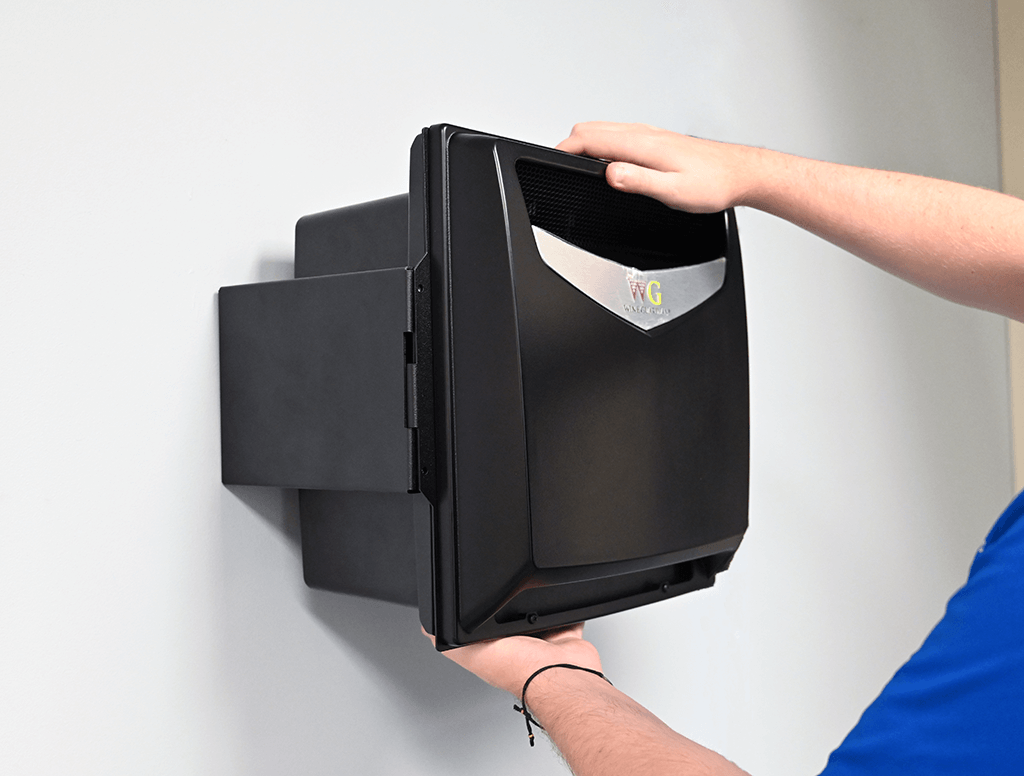
If you want a dedicated humidification system that offers flexible installation, a freestanding wine cellar humidifier is an excellent option to consider.
<AsyncImage query=”Wine Guardian freestanding wine cellar humidifier white wall mounted unit” aspectRatio=”5:4″ width=”100%”/>
The Wine Guardian Freestanding Humidifier is designed specifically for wine storage environments. It can be installed on a suitable wall or integrated into a compatible wine-racking arrangement, depending on the installation requirements.
Wine Guardian offers a freestanding version that can work with various wine cellar cooling systems, including compatible systems from other manufacturers. Confirm the exact compatibility and installation requirements before purchasing. <Cite refs={[“turn458393search0″,”turn458393search1”]}/>
Key features
Dedicated wine cellar humidity control.
Automatic humidification based on humidity sensing and control.
Evaporative drip-pad technology.
Flexible mounting options.
Maintenance access for cleaning the humidifier pad.
Options for operation alongside compatible wine cooling equipment.
Why consider it?
A freestanding unit is useful when your existing cooling system does not support a suitable integrated humidifier or when you need a separately installed humidity-control solution.
It can also be a practical choice for an existing cellar where adding a new cooling system would be unnecessary.
Best for: Residential wine cellars, existing wine rooms, and installations where flexible humidifier placement is important.
If you are installing a ducted or ducted split wine cooling system, an integrated humidifier may provide a cleaner and more convenient solution.
<AsyncImage query=”Wine Guardian integrated humidifier mounted to ducted wine cellar cooling unit mechanical room” aspectRatio=”5:4″ width=”100%”/>
The Wine Guardian Integrated Humidifier attaches directly to compatible Wine Guardian ducted or ducted split cooling equipment, typically in an adjacent mechanical space.
Instead of occupying additional display space inside the wine cellar, it introduces moisture into the cooling system’s airstream.
Key features
Integration with compatible Wine Guardian cooling units.
Space-saving installation outside the wine display area.
Humidity sensing and control through the compatible system.
No separate power source for supported integrated configurations.
Accessible components for routine maintenance.
Wine Guardian lists integrated humidifiers for compatible Sentinel ducted and ducted split models. Compatibility varies by model and system generation, so check the manufacturer’s documentation before ordering. <Cite refs={[“turn458393search1″,”turn458393search2”]}/>
Why consider it?
An integrated humidifier is particularly attractive when designing a new wine cellar. Keeping the equipment in a mechanical room can preserve the appearance of a glass-enclosed cellar and leave more room for wine racks.
Best for: New wine cellar construction, ducted cooling systems, luxury residential cellars, and commercial installations with a separate equipment area.
Not every wine cellar uses Wine Guardian equipment. Some cellars rely on through-the-wall cooling units, ductless split systems, or cooling equipment from other manufacturers.
In these situations, a compatible standalone wine cellar humidifier may be the most practical option.
Before selecting one, look for a unit that offers:
An appropriate moisture output for the cellar.
A reliable humidistat or compatible humidity controller.
Automatic operation rather than continuous manual adjustment.
Suitable mounting and ventilation requirements.
Appropriate water-supply and drainage arrangements.
Compatibility with the existing cooling equipment.
Wine Guardian’s freestanding humidifier is one product to evaluate for compatible installations, including certain systems made by other manufacturers. <Cite refs={[“turn458393search0″,”turn458393search1”]}/>
However, compatibility alone does not guarantee adequate performance. The humidifier must also be capable of maintaining the required humidity under the cellar’s actual operating conditions.
Best for: Wine cellar owners upgrading humidity control without replacing their existing cooling system.
Large wine rooms, commercial cellars, restaurants, private clubs, and wine storage facilities may require more careful humidification planning than a small residential cellar.
The amount of moisture required depends on several factors, including:
Total cellar volume.
Target temperature and relative humidity.
Insulation quality and vapor-barrier integrity.
Air leakage and door-opening frequency.
Cooling system operation.
Ambient temperature and humidity outside the cellar.
A larger cellar does not automatically need the largest available humidifier. An oversized or poorly controlled unit can create excessive humidity, while an undersized system may struggle to maintain the desired conditions.
For a large or high-value wine collection, ask a wine cellar specialist to assess the space and select equipment with appropriate moisture output and controls.
Best for: Commercial wine storage, hospitality environments, large custom cellars, and collections requiring carefully managed environmental conditions.
A household humidifier may seem like an inexpensive solution, but it is not always the best option for a dedicated wine cellar.
Most standard room humidifiers are designed to improve comfort in occupied rooms rather than provide integrated environmental control for wine storage.
Potential disadvantages include:
Limited integration with the cellar’s cooling system.
Manual adjustments or less precise humidity management.
Water reservoirs that require frequent refilling.
Additional cleaning and maintenance.
Possible condensation if moisture output is excessive.
Fine mineral particles from some ultrasonic models when ordinary tap water is used.
A household humidifier might be considered for a small, carefully monitored space, but it should not be assumed suitable for a temperature-controlled wine cellar.
For a dedicated wine room, a wine cellar humidifier with automatic controls is generally the more appropriate starting point.
| Humidifier type | Main advantage | Best application |
|---|---|---|
| Wine Guardian freestanding humidifier | Flexible placement | Existing cellars and compatible cooling systems |
| Wine Guardian integrated humidifier | Space-saving installation | Compatible ducted and ducted split systems |
| Compatible standalone wine humidifier | Can complement an existing cooling unit | Cellars using other cooling brands |
| Professionally sized humidification system | Tailored moisture output and control | Large residential and commercial cellars |
| Standard household humidifier | Simple, accessible equipment | Only where suitability and humidity control have been carefully evaluated |
The most suitable choice is the one that matches your cooling equipment and maintains the target humidity without creating condensation or excessive moisture.
For many wine cellars, a relative humidity range of approximately 50% to 70% is a practical guideline, with 60% often used as a target. <Cite refs={[“turn458393search3″,”turn458393search4”]}/>
The goal is not to keep the cellar as humid as possible. It is to maintain a stable environment without creating conditions that encourage mold, condensation, or damage to the room.
Here is a simple guide:
Below 50% RH: Investigate whether the cellar is too dry, especially if the condition persists.
Around 60% RH: A commonly recommended target for wine storage.
Between 60% and 70% RH: Generally within the commonly recommended range, provided condensation is controlled.
Above 70% RH: Investigate persistent high humidity, condensation, and potential mold risks.
Use a reliable hygrometer to measure humidity inside the cellar. If readings fluctuate significantly, check the equipment settings, door seals, room construction, and sensor placement before changing the humidifier.
Before purchasing a humidifier, evaluate the following features.
1. Automatic humidity control
Choose a unit with suitable humidity sensing and automatic operation. This allows the humidifier to add moisture when readings fall below the selected target rather than operating continuously.
2. Appropriate moisture output
Humidifier capacity should match the moisture demand of the room. Ask the supplier or installer to confirm that the equipment can maintain the target under normal operating conditions.
3. Cooling-system compatibility
Check whether the humidifier is designed to integrate with your specific cooling unit or operate independently. Some cooling systems have restrictions on compatible humidification accessories.
4. Water supply and drainage
Certain dedicated humidifiers require a water connection and drainage. Confirm these requirements before installation, particularly if the equipment will be located in a finished home or mechanical room.
5. Easy maintenance
Look for accessible components, cleanable or replaceable humidifier pads, and clear maintenance instructions. Mineral buildup and dirty components can reduce performance.
6. Condensation protection
A humidifier should not be used to compensate for poor cellar construction. Proper insulation, an appropriately positioned vapor barrier, sealed penetrations, and suitable door seals are essential parts of humidity management.
In climates such as South Florida, humidity control requires particular attention. Outdoor air may contain substantial moisture, and warm air entering a cooled wine cellar can lead to condensation on cold surfaces.
In these environments, the problem may not be insufficient humidity at all. The cellar may already have high moisture levels, especially if the enclosure is poorly sealed or the cooling system is not operating as intended.
Before installing a humidifier, consider the following:
Measure the actual cellar humidity over time.
Check insulation and vapor-barrier installation.
Inspect the door seals and glass enclosure.
Confirm that the cooling unit is appropriately sized for the cellar’s heat load.
Investigate condensation on glass, metal, and other cool surfaces.
Avoid adding moisture when humidity is already adequate or excessive.
Important: A humidifier adds moisture; it does not dehumidify a room. If your cellar has excessive humidity, the appropriate solution may involve correcting air leakage, improving the vapor barrier, or addressing the cooling and moisture-control strategy.
This is especially important for glass-enclosed wine cellars, where differences between indoor and outdoor conditions can increase condensation risks.
Regular maintenance helps keep your humidification system operating effectively.
Follow the manufacturer’s recommended maintenance schedule, including:
Monitor humidity: Check readings regularly with a reliable hygrometer.
Inspect the humidifier pad: Look for mineral deposits, dirt, or restricted airflow.
Clean components: Follow the manufacturer’s instructions for cleaning water-contact surfaces and other accessible parts.
Check water and drain lines: Look for leaks, blockages, or improper drainage.
Verify automatic controls: Confirm that the humidifier responds correctly to changes in humidity.
Watch for condensation: Inspect nearby surfaces and cellar finishes for signs of excess moisture.
Wine Guardian recommends monthly checks for mineral buildup on its humidifier drip pad, although cleaning frequency depends on water quality and operating conditions. <Cite refs={[“turn458393search4″,”turn458393search1”]}/>
Do all wine cellars need a humidifier?
No. Some wine cellars maintain suitable humidity without a separate humidifier. Measure the actual relative humidity before purchasing one. If humidity remains too low, assess the room construction and cooling system before selecting a humidification solution.
Can I use a Wine Guardian humidifier with another brand of cooling unit?
Wine Guardian offers a freestanding humidifier designed to work with various wine cellar cooling systems, including compatible equipment from other manufacturers. Confirm the specific model’s compatibility, installation requirements, power supply, and controls before purchasing.
What humidity should I set my wine cellar humidifier to?
Approximately 60% relative humidity is a commonly recommended target, within a broader guideline of 50% to 70%. Adjust the setting according to your cellar’s requirements and the manufacturer’s recommendations.
Does a wine cellar cooling unit control humidity automatically?
Not necessarily. Some systems display humidity readings, while others require an optional humidifier or additional controls to actively manage humidity. Check the specifications of your particular cooling unit.
Can too much humidity damage a wine cellar?
Yes. Persistent excessive humidity can encourage mold growth and damage labels, adhesives, and finishes. Condensation can also damage building materials. Proper insulation, vapor control, and balanced humidity management are essential.
Is an integrated or freestanding humidifier better?
An integrated humidifier can be ideal for compatible ducted systems when you want to keep equipment outside the cellar. A freestanding humidifier offers more flexibility for existing cellars and compatible cooling systems. The best choice depends on your installation and equipment.
The best wine cellar humidifier is one that maintains suitable humidity, works with your cooling system, and meets the moisture requirements of your space.
For many residential cellars, a dedicated Wine Guardian freestanding humidifier is worth considering when flexible installation is important. If you have compatible ducted cooling equipment, an integrated humidifier can provide a more discreet solution. Larger or more complex wine rooms may benefit from a professionally designed humidity-control system.
Before purchasing, measure your cellar’s humidity, inspect the room’s insulation and vapor barrier, and confirm cooling-system compatibility. These steps can help you avoid unnecessary equipment costs while protecting your wine collection.
Planning a new wine cellar or upgrading an existing one? Explore CoolWineCellar’s wine cellar cooling solutions and consider professional guidance to select a cooling and humidity-control setup that suits your room, climate, and collection.