
Call Us 📞 800-323-3130
Mon–Fri 8am–6pm CST, Sat–Sun 9am–1pm CST
Free design consultations
Showrooms in Miami & Fort Lauderdale
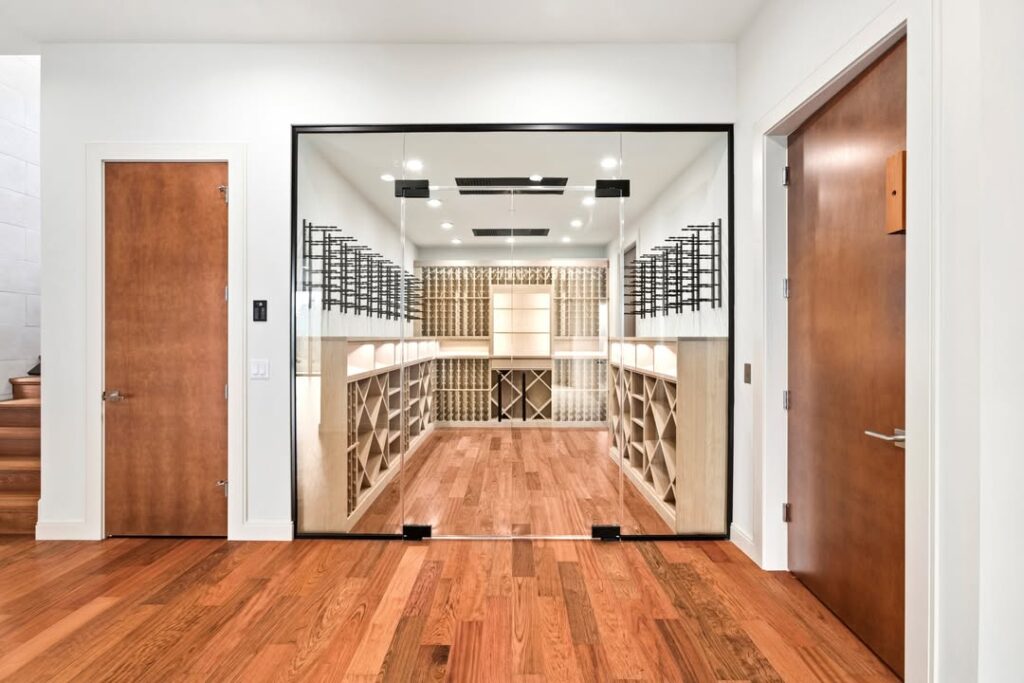
A beautiful wine cellar is only as good as its climate-control system.
Wine requires a stable environment for long-term storage, and maintaining the right temperature and humidity becomes even more important as the value of a wine collection increases. While there are several types of wine cooling systems available, ducted wine cellar cooling units are one of the most popular solutions for custom residential and commercial wine cellars.
Unlike through-the-wall or visible self-contained systems, ducted cooling units can be installed outside the wine cellar and connected through insulated ductwork. This keeps the equipment out of sight while allowing conditioned air to enter the cellar through discreet supply and return grilles.
For homeowners who want a quiet, clean, luxury wine room without visible cooling equipment, a ducted system can be an excellent solution.
In this guide, we’ll explain how ducted wine cooling works, its benefits and limitations, the difference between ducted self-contained and ducted split systems, sizing considerations, installation requirements, and how to shop for a ducted wine cooling unit online.
A ducted wine cooling unit is a specialized climate-control system designed to maintain the temperature and, depending on the system, humidity conditions inside a wine cellar.
Instead of installing the cooling equipment directly through the wine cellar wall, the unit is located remotely—such as in a mechanical room, utility room, attic, garage, or another suitable location.
Insulated ductwork connects the cooling system to the wine cellar.
The basic process is:
Cooling Unit → Supply Duct → Wine Cellar → Return Duct → Cooling Unit
Only the supply and return grilles are visible inside the cellar.
This approach can dramatically reduce visual clutter while allowing the cooling equipment to remain outside the wine storage area.
The biggest reason homeowners choose ducted cooling is simple:
The cooling equipment can be hidden.
A luxury wine cellar often includes custom wine racks, glass doors, architectural lighting, stone, wood, and other high-end finishes. A large cooling unit mounted on the wall can interrupt that design.
Ducted systems solve this problem by moving the equipment away from the wine room.
Key advantages include:
Equipment can be installed outside the cellar
Cleaner architectural appearance
Reduced equipment noise inside the wine room
Flexible equipment placement
Even distribution of conditioned air
Suitable for custom wine cellars
Available for residential and commercial applications
Can accommodate different duct configurations
Allows valuable wall space to remain available for wine racks
Wine Guardian specifically describes its ducted systems as quiet, out-of-sight solutions that integrate into custom cellar designs.
The system continuously circulates conditioned air between the wine cellar and the cooling unit.
Warm air from the wine room returns to the cooling system through return ductwork.
The cooling unit removes heat from the air and conditions it to the desired wine-storage temperature.
Conditioned air travels through insulated supply ductwork and enters the wine room through a supply grille.
The system repeats this process to maintain the desired cellar environment.
Proper duct design and airflow distribution are important because the goal is not simply to make the air cold—it is to maintain a stable environment throughout the wine room.
One of the most common decisions when designing a wine cellar is whether to use a visible through-the-wall cooling unit or a ducted system.
A through-the-wall unit is installed directly into a wall separating the wine cellar from an appropriate adjacent space.
Advantages:
Relatively straightforward installation
Compact design
No extensive ductwork
Often suitable for smaller wine rooms
Easy access to the equipment
Potential disadvantages:
Cooling unit remains visible
Fan and compressor noise can be noticeable
Requires suitable wall placement
Can consume valuable wine-racking space
A ducted system moves the cooling equipment away from the cellar.
Equipment can be hidden
Quieter wine room
Cleaner appearance
Flexible installation
Better suited to luxury architectural designs
Equipment does not occupy wine-racking wall space
For a high-end wine room where aesthetics and quiet operation are priorities, ducted cooling can provide a more seamless solution.
Not every ducted system is built the same way.
There are two major configurations:
and
Understanding the difference is important before purchasing.
A ducted self-contained system houses the major refrigeration components—including the compressor, condenser, evaporator, fans, and controls—in one unit.
The unit is installed outside the wine cellar and connected to the room through ductwork.
Wine Guardian’s ducted self-contained systems include models such as the D025, D050, D088, and D200, along with Pro configurations for larger or more demanding applications.
Benefits of Self-Contained Ducted Systems
Single packaged system
No separate refrigeration lines between evaporator and condenser
Relatively straightforward duct connection
Equipment can be installed outside the wine cellar
Field serviceability
Clean cellar appearance
Wine Guardian notes that its self-contained ducted systems house the major refrigeration components within one enclosure and use ductwork to deliver conditioned air into the cellar.
A ducted split system separates the refrigeration components into two primary sections:
Evaporator
and
Condenser
The evaporator is generally positioned near the wine cellar and connected to the cellar’s ductwork, while the condenser can be located in another suitable mechanical or outdoor location.
Wine Guardian’s ducted split lineup includes models such as the DS025, DS050, DS088, and DS200, as well as Pro ducted split systems.
Advantages of Ducted Split Systems
Greater installation flexibility
Condenser can be positioned separately
Useful where heat rejection is challenging
Suitable for larger or more complex projects
Keeps compressor and condenser heat away from the wine room
Can accommodate challenging mechanical layouts
Because split systems involve separate components and refrigeration connections, professional installation is generally appropriate.
The answer depends on your project.
| Feature | Ducted Self-Contained | Ducted Split |
|---|---|---|
| Equipment configuration | One unit | Separate evaporator & condenser |
| Ducted | Yes | Yes |
| Equipment hidden | Yes | Yes |
| Installation flexibility | High | Very high |
| Refrigeration lines | No separate field refrigeration connection | Required |
| Suitable for custom cellars | Yes | Yes |
| Complex installations | Good | Excellent |
| Professional installation | Project dependent | Generally recommended |
The physical layout of the property often determines which system makes the most sense.
Noise is a major consideration for residential wine rooms.
A cooling unit installed directly inside the wine cellar can introduce fan and compressor noise into the space.
With a ducted system, the main equipment can be positioned outside the wine room.
The cellar itself only needs discreet supply and return grilles.
Wine Guardian specifically markets its ducted systems as quiet and out-of-sight solutions.
However, the final noise level depends on:
Equipment location
Duct design
Airflow velocity
Duct insulation
Grille selection
Mechanical-room construction
Installation quality
Proper duct design is therefore just as important as selecting a quality cooling unit.
The equipment can potentially be installed in several locations depending on the system and site conditions.
Common locations include:
One of the best options when available.
A convenient choice for many residential installations.
Can work when temperature and environmental conditions are suitable for the equipment.
Possible for certain systems, but accessibility, temperature, drainage, and service requirements must be carefully considered.
A nearby room can provide a convenient location while keeping equipment outside the wine cellar.
The installation location should always comply with the manufacturer’s requirements for ambient temperature, airflow, drainage, service clearance, and duct length.
The answer depends on the cooling unit and the layout.
Some systems support relatively short duct runs, while others are specifically designed for longer duct configurations.
For example, CoolWineCellar currently lists WhisperKOOL ducted systems capable of being ducted up to 25 feet away from the cellar, depending on the specific model.
Wine Guardian also offers multiple ducted configurations designed for different installation requirements.
The maximum allowable duct length should never be assumed from one model to another.
Always verify:
Maximum duct length
Duct diameter
Number of bends
Static pressure limitations
Supply and return configuration
Insulation requirements
with the manufacturer’s specifications for the exact model.
A high-quality cooling unit cannot compensate for poorly designed ductwork.
Improper ductwork can result in:
Reduced airflow
Uneven cooling
Excessive noise
Poor temperature distribution
Reduced system performance
Higher operating costs
Premature equipment problems
Ducts should be properly insulated and sized according to the cooling system manufacturer’s specifications.
The supply and return locations should also be positioned strategically.
For larger cellars, multiple supply and return grilles may be required to create balanced airflow.
One of the biggest mistakes people make is choosing a wine cooling unit based solely on the cubic footage of the cellar.
Wine cellar cooling should be sized according to the actual heat load.
The cooling requirement can be affected by:
Cellar volume
Wall insulation
Ceiling insulation
Floor construction
Glass walls
Glass doors
Exterior walls
Sun exposure
Ambient temperature
Location
Door openings
Lighting
Adjacent rooms
Number of people entering the cellar
Desired wine-storage temperature
A small room with several large glass walls may require substantially more cooling capacity than a larger room with excellent insulation and no glass.
CoolWineCellar’s current website emphasizes heat-load calculations as part of its wine cooling consultation process.
Glass is one of the most important considerations when sizing a wine cooling system.
A wine room with:
Three glass walls
Large glass doors
Full-height glazing
Direct sunlight
can have significantly different cooling requirements from a traditional insulated room.
This is particularly important in warm climates.
For a glass-enclosed wine room, the cooling system should be selected based on the actual heat load rather than room size alone.
Wine cellar climate control becomes particularly important in regions with high outdoor temperatures and humidity.
In warm climates, the cooling system may have to work harder to maintain the desired cellar temperature.
Humidity can also create additional challenges.
The wine cellar should therefore be properly constructed with:
Appropriate insulation
Vapor barrier
Air sealing
Properly sealed doors
Suitable glass
Adequate drainage
Correctly sized cooling equipment
The cooling system and cellar construction should be treated as one integrated project.
Wine storage systems are generally designed to maintain a stable wine-cellar environment rather than simply making the room as cold as possible.
Wine Guardian’s ducted split systems, for example, can maintain wine-storage temperatures in the 55°F–58°F range, while certain configurations can be used for lower serving temperatures.
The exact temperature setting depends on the wine collection, storage objectives, and system capabilities.
For long-term storage, consistency is more important than repeatedly changing the temperature.
Temperature gets most of the attention, but humidity also matters.
Wine Guardian’s systems can incorporate humidity monitoring and optional humidification features.
A commonly referenced wine-cellar humidity range is approximately 50%–70% relative humidity, although the appropriate target depends on the specific system and cellar environment.
Excessive humidity can contribute to:
Mold
Label damage
Condensation
Deterioration of wood finishes
Very low humidity can contribute to problems with natural cork over long storage periods.
The goal is a stable, controlled environment.
Ducted systems aren’t limited to residential wine rooms.
They can also be used for:
Restaurants
Hotels
Country clubs
Wine bars
Retail stores
Commercial wine storage
Hospitality projects
Private dining rooms
Commercial applications can benefit from the ability to locate cooling equipment away from the customer-facing wine display.
Wine Guardian offers ducted systems designed for both residential and commercial applications, including its Pro range.
A major advantage of ducted cooling is that the cooling equipment doesn’t need to compete with the wine racks for wall space.
This is particularly valuable when designing:
Floor-to-ceiling wine racks
Cable wine racks
Floating wine racks
Metal wine racks
Custom wood wine racks
Glass wine walls
Instead of sacrificing a section of the wine wall to accommodate a cooling unit, the system can be located remotely.
This allows the wine rack design to remain the primary visual element.
Like any mechanical system, ducted wine cooling units require maintenance.
Typical maintenance can include:
Cleaning or replacing filters
Checking ductwork
Inspecting grilles
Checking condensate drainage
Inspecting electrical connections
Checking refrigerant-related components where applicable
Cleaning coils according to manufacturer recommendations
Verifying temperature and humidity readings
Wine Guardian notes that its self-contained ducted units are designed for field serviceability, allowing service work to be performed without returning the unit to the factory.
Routine maintenance can help maintain performance and extend equipment life.
The service life of a wine cooling system depends on:
Brand
Model
Installation quality
Operating conditions
Maintenance
Usage
Ambient temperature
Ductwork
Electrical conditions
A properly installed and maintained professional-grade wine cooling system can provide many years of service.
However, no cooling unit should be selected solely on an advertised lifespan.
Consider the manufacturer’s warranty, serviceability, replacement parts availability, and local technical support.
If you’re shopping for a ducted wine cellar cooling system, CoolWineCellar.com is a strong online destination to explore ducted wine cooling units and related wine cellar climate-control products.
Shop Ducted Wine Cooling Units at CoolWineCellar.com
CoolWineCellar currently offers ducted options from brands including Wine Guardian, WhisperKOOL, CellarPro, and Breezeaire, with categories covering ducted, ducted self-contained, Pro ducted, and other configurations.
The site also provides wine cooling consultation and heat-load calculation services, which can be useful when you’re unsure which capacity or configuration is appropriate.
For a custom wine cellar, purchasing the cooling unit should ideally be part of a larger design process rather than simply selecting a model based on room square footage.
When shopping for a ducted wine cooling system, several established brands are worth considering.
Wine Guardian offers a broad range of self-contained ducted and ducted split systems, including residential and commercial models. Its lineup includes D025, D050, D088, D200, and Pro systems.
WhisperKOOL offers ducted and ducted split wine cooling systems, including systems designed for remote installation away from the cellar. CoolWineCellar currently lists multiple WhisperKOOL ducted configurations.
CellarPro offers split wine cooling configurations, including ducted options designed for custom wine cellar applications.
The best brand and model depend on the project’s heat load, installation configuration, desired features, budget, and service requirements.
Before placing your order, ask:
1. What is the actual heat load of the wine cellar?
Don’t rely solely on cubic footage.
2. How far away can the cooling unit be installed?
Check the manufacturer’s maximum duct distance.
3. Where will the condenser reject heat?
This is particularly important for self-contained systems.
4. Is the unit self-contained or split?
Understand what equipment needs to be installed and where.
5. What duct size is required?
Incorrect duct sizing can affect performance.
6. How much glass is in the wine cellar?
Glass can significantly affect heat gain.
7. What is the ambient temperature around the cooling unit?
The installation environment matters.
8. Is humidity control required?
Consider whether a humidifier or additional humidity management is appropriate.
9. Who will install the system?
Some systems are more installation-intensive than others.
10. Is service support available?
Consider warranty coverage, parts availability, and serviceability before purchasing.
Choosing by Cubic Feet Alone
Room volume is only one part of the calculation.
Ignoring Glass
Large glass areas can substantially increase heat gain.
Installing Undersized Ductwork
Restricted airflow can compromise system performance.
Forgetting Condensate Drainage
Cooling systems may generate condensate that requires proper drainage.
Installing the Unit in an Unsuitable Location
The mechanical environment must meet the manufacturer’s requirements.
Ignoring Service Access
A hidden cooling unit still needs to be accessible for maintenance.
Treating Wine Cellar Construction as an Afterthought
Even the best cooling unit cannot compensate for poor insulation, air leakage, or an improperly designed vapor barrier.
A ducted wine cellar cooling system is more than a way to make a wine room cold.
It is a climate-control solution designed to protect the wine collection while preserving the architecture and aesthetics of the room.
By locating the cooling equipment outside the cellar and using insulated ductwork to circulate conditioned air, ducted systems can provide a quiet and visually clean solution for luxury residential and commercial wine cellars.
The key is selecting the system based on the actual heat load, room construction, glass exposure, duct requirements, installation environment, and desired climate conditions.
For homeowners and wine-cellar professionals looking to purchase online, CoolWineCellar.com offers a dedicated selection of ducted wine cooling units from major wine-cooling brands, along with wine cellar cooling guidance and heat-load calculation services.