
Call Us 📞 800-323-3130
Mon–Fri 8am–6pm CST, Sat–Sun 9am–1pm CST
Free design consultations
Showrooms in Miami & Fort Lauderdale
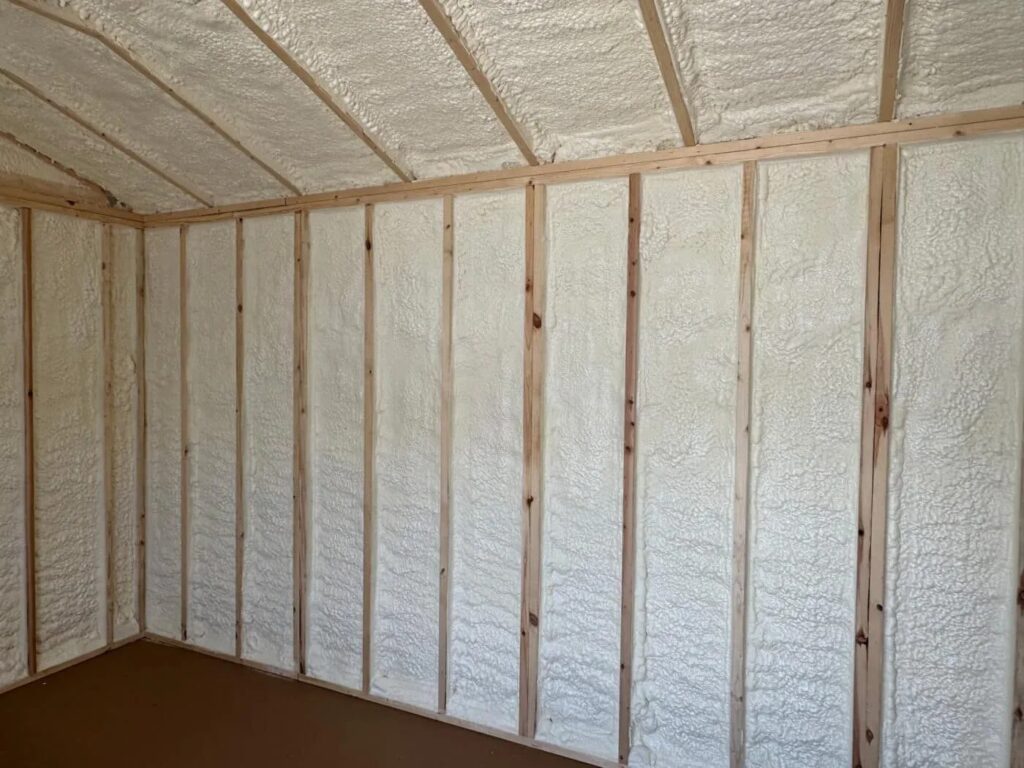
Every conversation about wine storage eventually reaches the cooling system: which unit to choose, how many BTUs, ducted or ductless, wall-mount or ceiling. These are important questions. But they’re the second conversation. The first conversation — the one that determines whether any cooling unit can succeed — is about insulation. Specifically, it’s about closed-cell spray polyurethane foam, and why no other insulation material can match what a wine cellar demands.
This guide walks through exactly what closed-cell spray foam is, the physics of why it outperforms every alternative, how it interacts with your refrigeration system, and what proper installation looks like. Whether you’re planning a new build or retrofitting an existing space, understanding this material will change how you think about every other decision in the project.
Wine storage is a climate control problem. The goal is a consistent environment: 55°F to 58°F and 60–70% relative humidity, maintained year-round regardless of what’s happening outside the cellar walls. Fluctuations in temperature accelerate aging unpredictably and can push corks out of bottles. Humidity extremes dry out corks or cause label damage and mold. Your cooling system exists to hold these conditions stable.
But a cooling system can only control what’s inside the space it’s conditioning. Every time heat passes through a wall, every time warm outdoor air seeps through a gap, every time moisture migrates through an inadequately sealed surface — the cooling unit has to compensate. The harder a cooling system works, the less efficient it is, the shorter its lifespan, and the more it costs to operate. In extreme cases, an undersized unit in a poorly insulated room simply cannot maintain temperature, regardless of tuning.
Insulation is the first line of defense. It slows heat transfer, stops air movement, and manages moisture migration. Choose the wrong material and every other investment in your cellar — the cooling unit, the racking, the wine itself — is working against compromised fundamentals.
| R-6.5 per inch of thermal resistance | 99% air infiltration eliminated | 2x cooling efficiency vs. batt insulation |
Spray polyurethane foam (SPF) comes in two forms: open-cell and closed-cell. Both start as two liquid components — an isocyanate and a polyol resin — that combine at the spray gun and expand dramatically on contact with a surface. But the cell structure that results is entirely different, and that difference is everything.
In open-cell foam, the cells that form during expansion rupture and interconnect. The result is a soft, spongy material — think of it like a flexible foam sponge. It achieves roughly R-3.5 per inch and has a porous structure that allows both air and moisture to pass through.
In closed-cell foam, the cells remain intact and sealed after expansion. Each cell is a discrete, sealed unit filled with a low-conductivity blowing agent. The resulting material is rigid, dense (approximately 2 lbs per cubic foot), and structurally impermeable. It achieves R-6 to R-6.5 per inch, bonds powerfully to almost any substrate, and acts as its own vapor retarder.
| THE SCIENCE IN 30 SECONDS |
Why “closed” matters so much. Heat moves through materials via conduction, convection, and radiation. Insulation interrupts all three — but the biggest thermal culprit in most buildings isn’t conduction through solid walls, it’s air movement. Warm air carries heat and humidity into a space far more effectively than conduction through a wall cavity. Open-cell foam, batts, and even rigid board all leave pathways for air. Closed-cell foam doesn’t. It forms a continuous solid barrier that air physically cannot penetrate. At 2 inches of thickness, closed-cell spray foam achieves a vapor permeability below 1 perm — the threshold for a Class II vapor retarder under building codes. At 3–4 inches, it reaches well below 0.1 perm. No batt, blown, or board insulation can match this without a separate vapor barrier membrane added to the assembly. |
Moisture management is where most DIY and contractor-installed wine cellars fail, and it’s where closed-cell foam earns its cost premium most clearly.
Wine cellars are intentionally kept cold. The air outside them, whether it’s a climate-controlled home interior, a garage, or an exterior wall, is almost always warmer and contains more moisture. When warm, moisture-laden air meets a cold surface, it deposits that moisture as condensation. In a wall assembly, this means water collects inside the cavity, on the sheathing, on the studs, in the batt insulation. The results are structural: rot, mold, degraded insulation performance, and eventually, compromised structural integrity.
The conventional solution is a separate vapor barrier — a polyethylene membrane or vapor-retarding paint applied to the warm side of the wall assembly. This works when installed perfectly. In practice, every penetration, every seam, every electrical outlet becomes a moisture pathway.
| Closed-cell spray foam doesn’t just slow moisture, it makes the question of a separate vapor barrier irrelevant. |
With closed-cell foam applied at 2 inches or more to the interior face of the framing, the foam itself is the vapor control layer. It’s seamless. It covers the framing members as well as the cavity, eliminating thermal bridging through the wood. It wraps around penetrations and irregular surfaces. There are no seams to fail because it’s a single continuous material.
For wine cellars in particular — where the temperature differential between the inside and outside air is greater than almost any other application in residential construction — this continuity is not a nicety. It’s a requirement.
A wine cellar cooling system’s BTU rating defines its size. The amount of heat it can remove from the space per hour. Expected heat gain dictates that number: how much heat will flow into the cellar through its surfaces, and how quickly.
The better the insulation, the lower the heat gain, and the smaller (and cheaper) the cooling unit that can adequately serve the space. But the relationship runs deeper than initial sizing.
When a cooling unit in a poorly insulated room reaches setpoint and shuts off, heat immediately begins flooding back in through walls, gaps, and air infiltration. The unit turns on again within minutes. This pattern — called short-cycling — is one of the primary causes of premature compressor failure. The startup phase of a refrigeration cycle is its most electrically demanding and mechanically stressful moment. A unit designed to run in 20–40 minute cycles that’s short-cycling every 5–8 minutes will fail years before it should.
With properly installed closed-cell foam, the thermal envelope holds so effectively that once the cooling unit brings the cellar to temperature, it runs in long, stable, efficient cycles. The system operates as designed, uses less energy, and reaches a significantly longer service life.
Air infiltration doesn’t just strain the cooling system — it creates thermal stratification inside the cellar. Pockets of warmer air near gaps or poorly insulated sections become microclimates. Wine stored near those zones ages differently than wine stored in the thermally stable core of the room. Closed-cell foam’s complete air sealing eliminates the infiltration that drives this stratification, giving you uniform conditions throughout the entire volume of the cellar.
R-value measures thermal resistance: the higher the value, the slower heat moves through a material. Wine cellars typically target a minimum of R-19 to R-21 for walls and R-25 to R-30 for the ceiling. These targets exist for good reason — the ceiling is where the greatest heat gain occurs, since heat rises and the ceiling surface is often in contact with conditioned living space above.
| INSULATION TYPE | R-VALUE/INCH | BUILT-IN VAPOR BARRIER | AIR SEALING | WINE CELLAR SUITABILITY |
| Closed-Cell Spray Foam | R-6 to R-6.5 | ✓ Yes (≥2″) | ✓ Complete | ✓ Best Choice |
| Open-Cell Spray Foam | R-3.5 | ✗ No | ~ Partial | ✗ Not Recommended |
| Fiberglass Batt | R-3 to R-4 | ✗ Separate required | ✗ None | ✗ Inadequate alone |
| Rigid Foam Board (XPS) | R-5 | ~ At thickness | ~ Taped seams only | ~ Adequate with care |
| Mineral Wool Batt | R-3.7 to R-42 | ✗ No | ✗ None | ✗ Inadequate alone |
To achieve R-21 in a wall assembly, closed-cell foam requires approximately 3.25 inches. Fiberglass batt requires a full 6-inch stud cavity — and still doesn’t address air sealing or vapor control. Rigid foam board can be stacked to achieve the target, but every seam is a potential failure point, and the material doesn’t conform to irregular framing, electrical boxes, or penetrations without meticulous effort.
In renovation projects — where the existing wall framing determines how much depth is available — closed-cell foam’s higher R-value per inch is frequently the deciding factor that makes a viable thermal envelope possible without rebuilding the wall assembly from scratch.
A wine cellar is an envelope — every surface that separates the conditioned interior from an unconditioned space must be treated. Missing any surface compromises the entire system.
Even with the right material specified, execution errors can substantially degrade performance. These are the most common problems encountered in wine cellar insulation work.
| CRITICAL MISTAKE Using open-cell foam instead of closed-cell. Open-cell foam is significantly cheaper and faster to apply. Some contractors — particularly those without specific wine cellar experience — will substitute it without disclosing the critical differences. Open-cell foam absorbs moisture, has roughly half the R-value per inch, and provides no vapor control. In a wine cellar, it will fail. |
| COMMON ERROR Underestimating ceiling insulation. Wall R-values are treated carefully while the ceiling receives the same depth as the walls. Given that heat gain through the ceiling is typically the largest single thermal load in a wine cellar, this imbalance will be apparent in the cooling system’s performance — and in your energy bill. |
| COMMON ERROR Skipping the floor entirely. Floors are visually invisible once finished and are frequently left untreated. A concrete slab without thermal separation is a direct conductive path between the ground and your cellar environment, and a persistent source of moisture vapor entering from the slab’s underside. |
| INSTALLATION ERROR Insufficient thickness in a single pass. Closed-cell foam generates substantial exothermic heat during curing. Applying too thick a layer in a single pass can cause charring, cracking, or compromised cell structure in the interior of the foam mass. Proper installation builds thickness in multiple passes of 1.5 to 2 inches each, allowing each layer to cure before the next is applied. |
| PLANNING ERROR Sizing the cooling unit before the insulation is finalized. The BTU load calculation that determines your cooling unit size depends entirely on your insulation’s R-values and air sealing performance. Purchasing equipment before the insulation specification is confirmed often results in an oversized unit that short-cycles or an undersized one that can’t keep up. |
Closed-cell spray foam is a professional-grade material. The equipment required — a proportioner, heated hose, and spray gun — represents a significant capital investment, and the chemistry is sensitive to temperature and humidity conditions at the time of application. Surfaces must be between 50°F and 90°F; ambient humidity must be controlled; and the mix ratio at the gun must be precisely calibrated. Deviations from these parameters produce foam with compromised physical and thermal properties that may not be visible until performance degrades.
A trained applicator will verify substrate conditions before spraying, use depth pins or a calibrated gun to confirm consistent thickness across every surface, and conduct an inspection of penetrations and transitions before deeming the installation complete. For wine cellar applications specifically, look for installers familiar with cold-room construction — the sequencing of insulation relative to framing, electrical rough-in, and the cooling unit is different from standard residential application.
At Cable Wine Cellars, every project begins with a full thermal envelope assessment before any materials are specified. We calculate the expected BTU load based on the room’s dimensions, orientation, adjacent conditions, and the target R-values for each surface — and we don’t size the cooling system until that envelope is defined and committed to. The result is a cellar where the insulation, the refrigeration, and the racking all work as a single integrated system rather than independent components that happen to share a room.
Your wine collection deserves a space built to the same standard of care that went into acquiring it. That standard starts with closed-cell spray foam — and everything else follows.
Ready to Plan Your Wine Cellar?
Every Cable Wine Cellars project begins with a complimentary thermal envelope assessment. We’ll evaluate your space, define the right insulation strategy, and size your cooling system around a properly built envelope and not the other way around.