
Call Us 📞 800-323-3130
Mon–Fri 8am–6pm CST, Sat–Sun 9am–1pm CST
Free design consultations
Showrooms in Miami & Fort Lauderdale
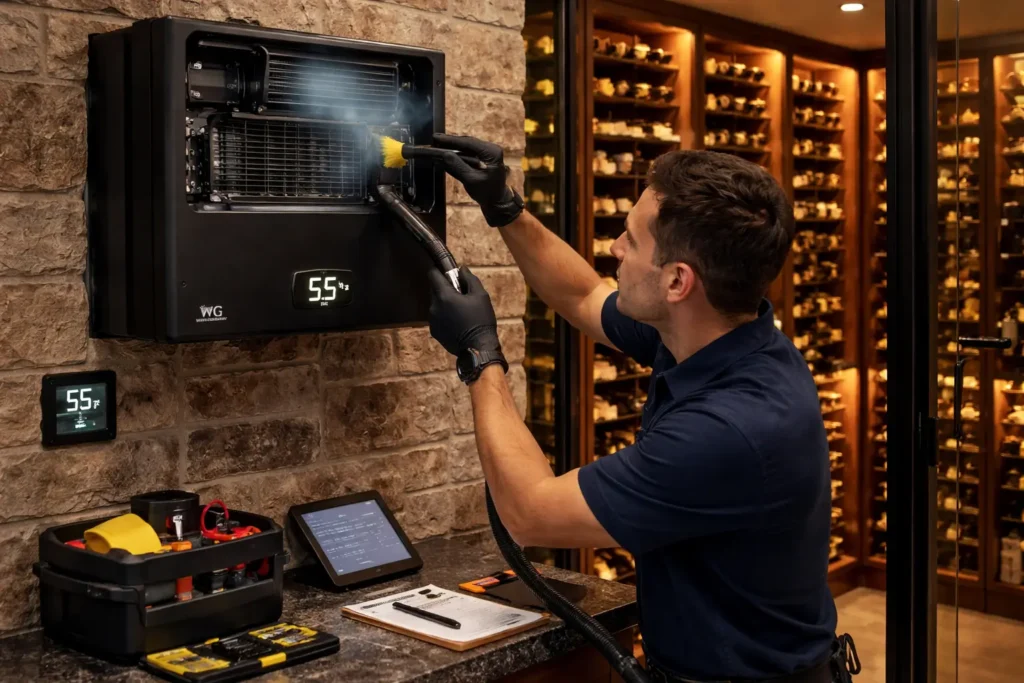
A wine cooling system is one of the most important components of a climate-controlled wine cellar. While a quality cooling unit can provide years of reliable service, it should not be installed and forgotten. Annual maintenance helps protect performance, efficiency, temperature stability, and the wine collection itself.
Whether your cellar uses a self-contained, through-the-wall, ducted, split, or ceiling-mounted system, routine inspection can identify small problems before they become expensive failures.
Here is what homeowners should know about annual wine cooling system maintenance.
Wine cooling systems typically operate differently from conventional residential air conditioners. They are designed to maintain relatively stable cellar temperatures for extended periods, which means the equipment may run for long cycles—especially in warm climates.
Regular maintenance can help:
A maintenance program is particularly important for cellars containing expensive or irreplaceable bottles.
The condenser coil is one of the most important components to inspect.
The condenser removes heat from the refrigeration system. Dust, dirt, pet hair, and debris can accumulate on the coil and restrict heat transfer.
A dirty condenser can cause:
The condenser should be inspected and cleaned according to the manufacturer’s recommendations.
If the condenser is located in an attic, garage, mechanical room, or other dusty environment, it may require more frequent attention.
The evaporator coil is responsible for absorbing heat from the wine cellar.
Dust buildup can restrict airflow across the coil and reduce the system’s ability to cool the room.
During annual service, a technician should inspect the evaporator for:
An iced evaporator can indicate an airflow restriction, refrigeration problem, incorrect operating conditions, or another issue that should be diagnosed rather than simply removing the ice.
If your wine cooling system uses an air filter, it should be inspected regularly.
A clogged filter restricts airflow and can cause the system to work harder.
The maintenance interval depends on the environment. A clean residential environment may require less frequent replacement than a dusty garage or mechanical room.
Always follow the cooling unit manufacturer’s recommendations for the appropriate filter type and replacement schedule.
Proper airflow is essential to wine cellar cooling.
During maintenance, check that:
For ducted wine cooling systems, airflow problems can occur even when the cooling unit itself is functioning correctly.
A restricted duct can reduce the amount of conditioned air reaching the cellar.
Temperature measurements are an excellent diagnostic tool.
A technician can record:
Return-air temperature → Supply-air temperature
The difference between these readings is commonly referred to as Delta T.
Monitoring Delta T from year to year can help identify changes in system performance.
If the temperature difference becomes significantly smaller than expected, it may indicate an airflow, refrigeration, coil, compressor, or other system problem.
The exact expected Delta T varies by equipment and operating conditions, so measurements should be compared with the specific manufacturer’s specifications.
The thermostat controls the operating cycle of the wine cooling system.
During annual maintenance, verify:
Many wine cooling systems use a temperature probe positioned in or near a wine bottle to better represent the temperature of the collection.
The probe should be correctly positioned and functioning properly.
Refrigerant should not normally need to be “topped off” as part of routine annual maintenance.
A properly sealed refrigeration system should retain its refrigerant.
If refrigerant levels or pressures are abnormal, the technician should investigate the cause rather than simply adding refrigerant.
Potential issues can include:
Refrigeration work should be performed by an appropriately qualified HVAC technician.
Fans are critical to maintaining proper heat transfer and airflow.
The technician should verify that both the evaporator and condenser fans:
A weak or failing fan can reduce cooling performance even if the compressor appears to be operating normally.
The compressor is essentially the heart of the refrigeration system.
During maintenance, a technician can check for:
A compressor that runs continuously may indicate either a high cellar heat load or a cooling-system problem.
This is why continuous operation should be evaluated rather than automatically considered normal.
Some wine cooling systems produce condensation that must be properly drained.
The condensate drain should be checked for:
A blocked drain can result in water accumulating inside or around the wine cellar.
This is especially important in humid climates where condensation can be more significant.
Ice on the evaporator coil is not something to ignore.
Possible causes include:
The correct response is to determine why the coil is freezing rather than simply defrosting it.
Annual maintenance should include a basic inspection of electrical components and connections.
A technician may check:
Any loose or damaged electrical connections should be addressed promptly.
Maintaining the cooling system doesn’t mean ignoring the wine room itself.
A poorly sealed wine cellar can dramatically increase the workload on the cooling unit.
Inspect:
If warm, humid air is constantly entering the cellar, the cooling unit may run continuously even though the equipment itself is operating properly.
Temperature and humidity should both be monitored.
Excessive humidity can contribute to:
On the other hand, extremely dry conditions can affect natural corks over long periods.
A good monitoring system can provide historical temperature and humidity data and alert you when conditions move outside the desired range.
Insulation isn’t normally something that requires annual replacement, but it should be evaluated if the cellar suddenly begins struggling to maintain temperature.
Look for signs such as:
If the cellar has recently been renovated, new lighting, electrical work, plumbing, or cabinetry may have unintentionally compromised the thermal envelope.
Keep the area around the cooling system clear.
Avoid storing:
directly around air intakes or exhaust areas.
The system needs adequate airflow to operate efficiently.
A wine cellar alarm can be extremely valuable.
During annual maintenance, verify that temperature and system alarms are working correctly.
Depending on the system, alarms may notify you of:
An alarm is only useful if it actually works when you need it.
Maintain a simple record of annual service.
Document:
Keeping these records makes it easier to identify gradual performance changes.
For example, if your system previously maintained a 12°F Delta T but gradually drops to 6°F, that change may indicate a developing problem.
For many residential wine cellars, an annual professional inspection is a good baseline.
However, more frequent maintenance may be appropriate if:
Filters and accessible components may need to be checked more frequently than once a year.
Always follow the specific cooling-unit manufacturer’s maintenance recommendations.
Homeowners can usually perform basic tasks such as keeping the area around the unit clean and checking accessible filters, provided the manufacturer allows it.
However, refrigeration diagnostics should be left to a qualified HVAC professional.
Tasks involving refrigerant, electrical components, operating pressures, compressors, or sealed refrigeration circuits should not be treated as DIY maintenance.
Maintenance requirements can vary depending on the system.
These generally require attention to the evaporator, condenser, airflow, filters, drainage, and surrounding clearance.
In addition to the cooling unit, inspect the ductwork, grilles, connections, insulation, and airflow.
Both the evaporator and remotely located condenser require inspection. Refrigeration connections should also be checked by a qualified technician.
These require particular attention to condenser airflow and the conditions on the warm side of the unit.
Inspect airflow, filters, drainage, coil condition, and service access.
A professional wine cooling system inspection should generally consider:
Annual wine cooling system maintenance is a relatively small investment compared with the value of the wine it protects.
The most important goal isn’t simply keeping the equipment clean. It is verifying that the entire wine-storage environment is operating as designed.
A properly maintained cooling system should work together with adequate insulation, a sealed wine cellar door, appropriate airflow, moisture control, and reliable temperature monitoring.
If your wine cellar begins running continuously, struggles to reach its set point, develops condensation or ice, produces unusual noises, or experiences temperature alarms, don’t wait for the annual service appointment. Those symptoms should be investigated promptly.
For collectors investing in a custom wine cellar, preventive maintenance is one of the simplest ways to protect both the cooling equipment and the collection for years to come.