
Call Us 📞 800-323-3130
Mon–Fri 8am–6pm CST, Sat–Sun 9am–1pm CST
Free design consultations
Showrooms in Miami & Fort Lauderdale
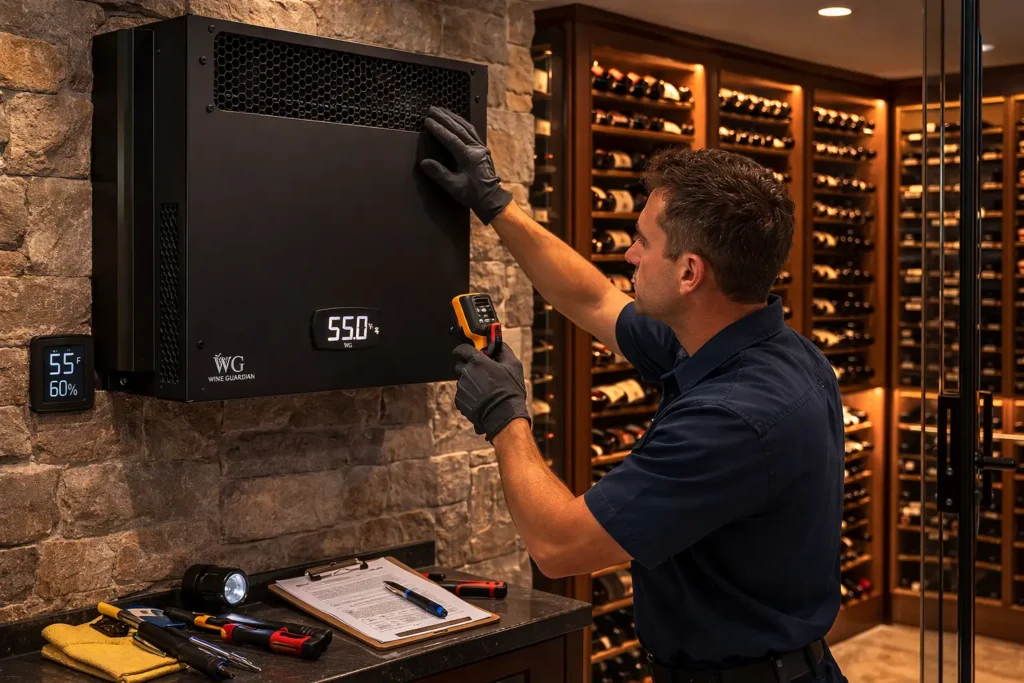
A temperature-controlled wine cellar is designed to provide a stable environment for your collection, but what happens when the electricity goes out?
Power outages can be especially concerning for serious wine collectors because a dedicated wine cellar cooling system depends on electricity to maintain its controlled environment. A short outage may not immediately create a problem, but extended outages during hot weather can cause the temperature inside the cellar to rise.
The good news is that homeowners can plan ahead with backup power solutions that keep the cooling system operating and provide greater protection for valuable wine collections.
From standby generators to battery backup systems, the right solution depends on your cellar size, cooling equipment, climate, and expected outage duration.
Wine generally benefits from a stable storage environment rather than frequent temperature fluctuations.
When the cooling system loses power, the temperature inside the wine room doesn’t immediately rise to outdoor temperature. The insulated walls, wine bottles, racks, and room construction provide some thermal buffering.
However, the longer the outage continues—and the hotter the surrounding environment—the greater the risk of the cellar moving outside its desired storage conditions.
This is particularly important in warm climates such as Miami, Fort Lauderdale, and South Florida, where outdoor temperatures can remain high for extended periods.
A backup power plan can help keep the wine cellar cooling system running when the primary electrical supply is unavailable.
There is no single answer because every wine cellar behaves differently.
The rate at which temperature changes depends on:
Room insulation
Vapor barrier
Cellar size
Ambient temperature
Glass area
Door openings
Number of wine bottles
Cooling system
Duration of the outage
A well-insulated wine room can retain its temperature for some time after the cooling system stops.
However, relying solely on insulation isn’t a good long-term outage strategy.
The safest approach for a valuable collection is to have a backup power source that can restore cooling rather than waiting to see how long the room remains within its desired temperature range.
Before selecting a generator or battery, determine exactly what needs to be powered.
Your wine cellar may have:
Remote condenser
Thermostat
Condensate pump
Circulation fans
Auxiliary ventilation equipment
Don’t assume that the cooling unit’s advertised BTU capacity tells you how much backup power it requires.
The electrical requirements of the equipment are what matter when sizing backup power.
Check the manufacturer’s specifications for:
Voltage
Amperage
Running watts
Starting requirements
Dedicated circuit requirements
For example, a refrigeration compressor can have a higher startup demand than its normal running consumption.
For homeowners who want long-duration protection, a standby generator is one of the most comprehensive solutions.
A permanently installed standby generator can automatically start when the home’s utility power fails.
Depending on the generator and electrical configuration, it can potentially power:
Wine cellar cooling
Refrigerators
Freezers
Security systems
Internet equipment
Lighting
HVAC
Other essential circuits
This can be especially valuable for homeowners in regions where outages may occur during severe storms.
Advantages of Standby Generators
Automatic operation
Long runtime when properly fueled
Can support multiple household systems
Suitable for extended outages
No need to manually connect equipment during an emergency
The generator should be professionally sized and installed according to the home’s electrical requirements and local regulations.
A portable generator can provide another backup option.
Portable generators can be less expensive than permanently installed standby systems and may be useful for occasional outages.
However, they require more involvement from the homeowner.
Important considerations include:
Generator capacity
Safe outdoor placement
Fuel availability
Proper electrical connection
Transfer equipment
Manual startup
Noise
Weather conditions
Never operate a fuel-burning generator inside a home, garage, basement, or enclosed space.
Carbon monoxide can build up quickly and create a serious safety hazard.
A qualified electrician should determine the appropriate method for connecting a generator to the home’s electrical system.
Battery energy storage systems are becoming another option for residential backup power.
A battery system can automatically supply electricity to selected circuits when utility power fails.
For a wine cellar, this can be particularly useful when the objective is to keep a cooling unit operating during shorter outages.
Benefits of Battery Backup
Automatic switchover
Quiet operation
No combustion
Can support essential circuits
Can be integrated with some residential energy systems
Useful for short-duration outages
The limitation is runtime.
A battery has a finite amount of stored energy. The amount of time it can operate a wine cooling system depends on the battery capacity and the actual electrical consumption of the equipment.
For long outages, a generator or larger energy-storage system may be more appropriate.
Homeowners with solar energy systems may consider combining solar panels with battery storage.
During an outage, the solar system and battery can potentially provide continued power to selected household circuits, depending on the system’s design and its ability to operate during grid outages.
For a wine cellar, this can provide an additional layer of resilience.
However, solar panels alone do not necessarily provide backup power when the grid goes down. The system needs to be specifically designed for backup operation, typically with appropriate energy storage and control equipment.
You don’t necessarily need to power the entire house to protect your wine collection.
If backup capacity is limited, the cooling system can be placed on an essential-load circuit.
Other systems might include:
Wine cellar cooling
Refrigerator
Freezer
Security system
Internet
Selected lighting
This approach can reduce the size of the backup power system required.
For example, if a battery backup is intended primarily to keep the wine cellar cooling system operational, there may be little reason to use the same battery to power every appliance in the home.
One of the most important questions is:
How long do you want the backup system to keep the wine cellar operating?
Consider whether your typical concern is:
1–2 hour outages
4–6 hour outages
Overnight outages
24-hour outages
Multi-day outages
Short outages may be manageable with a relatively small battery system.
Longer outages may require a generator or a larger battery-plus-solar solution.
Runtime should be calculated using the cooling system’s actual electrical consumption rather than relying on a generic estimate.
Cooling systems contain compressors and other electrical components that may require additional power when starting.
This means a backup system shouldn’t be selected based solely on the cooling unit’s normal running wattage.
The backup power equipment needs to accommodate the system’s startup characteristics.
A qualified electrician or generator professional can evaluate the cooling unit’s electrical specifications and determine the appropriate capacity.
Backup power planning starts before the generator or battery is purchased.
A properly constructed wine cellar can reduce the rate at which temperature changes during an outage.
Important components include:
Proper insulation
Vapor barrier
Sealed doors
Properly sealed glass
Insulated ceiling
Minimal air leakage
The better the wine room is insulated and sealed, the less frequently the cooling system needs to operate under normal conditions—and the more thermal protection the room may provide during a temporary outage.
During a power outage, treat the wine cellar like a refrigerator.
Avoid opening the wine cellar door unnecessarily.
Every time the door opens, warm air can enter the room and conditioned air can escape.
If the cooling system is temporarily offline, keeping the door closed helps preserve the existing conditions inside the cellar.
If you have a glass wine room, resist the temptation to repeatedly open the door to check the temperature.
Instead, use a remote temperature monitoring system.
A temperature-monitoring system can provide valuable information during a power outage.
Depending on the system, you may be able to receive alerts when:
Power is lost
Temperature rises above a set point
Cooling equipment stops operating
Temperature returns to normal
This allows you to respond before the wine room reaches an undesirable temperature.
For serious collectors, remote monitoring can be just as important as the backup power itself.
A generator may be operating, but if the cooling system has a separate electrical problem, a temperature alert can reveal the issue.
Power outages aren’t the only concern.
When electricity returns, voltage fluctuations, surges, or other electrical irregularities can potentially affect sensitive equipment.
Depending on the system and manufacturer’s recommendations, homeowners may consider appropriate electrical protection such as:
Surge protection
Proper circuit protection
Whole-home surge protection
Dedicated circuits
Correct disconnects
Transfer equipment
Any electrical protection should be selected and installed by a qualified professional and should comply with the cooling equipment manufacturer’s requirements.
If you have a split wine cellar cooling system, remember that the evaporator and condenser are separate components.
Both may require electrical power.
If your backup power system only powers the evaporator but not the condenser, the cooling system may not be able to operate normally.
The same principle applies to ducted systems and other configurations with separate components.
When designing backup power, identify every electrical component required for the cooling system to operate.
Backup power is especially valuable for wine collectors in areas where severe weather can cause extended electrical outages.
In South Florida, intense storms, hurricanes, high winds, and other weather events can disrupt electrical service.
A wine cellar exposed to high outdoor temperatures can warm more quickly if the cooling system remains offline.
For homeowners with valuable collections, a comprehensive plan can include:
Proper insulation + reliable cooling + temperature monitoring + automatic backup power.
This combination provides significantly more protection than relying on any single component.
The backup power system should be properly matched to the actual electrical load.
An undersized system may fail to start the compressor.
An unnecessarily oversized system can increase installation and equipment costs.
Start by listing the essential equipment and determining:
Running power requirements
Startup requirements
Desired runtime
Available fuel or battery capacity
Other household loads that must operate simultaneously
Then have the backup system professionally sized.
For a valuable residential wine collection, a layered approach can provide excellent protection.
Layer 1: Proper Wine Cellar Construction
Insulate the room and install an appropriate vapor barrier.
Layer 2: Dedicated Wine Cooling
Select a cooling system based on the actual heat load.
Layer 3: Temperature Monitoring
Install a monitor capable of alerting you when temperature or power conditions change.
Layer 4: Backup Power
Use a battery, generator, or combination system appropriate for the expected outage duration.
Layer 5: Electrical Protection
Use appropriate surge and circuit protection.
Together, these measures create a more resilient wine storage environment.
Determine the cooling system’s electrical requirements.
Identify all components that need power.
Check compressor startup requirements.
Decide how long the backup system should operate.
Determine which household circuits are essential.
Consider a standby generator for long outages.
Consider battery backup for short outages.
Explore solar + battery options where appropriate.
Install remote temperature monitoring.
Keep the wine cellar properly insulated and sealed.
Minimize door openings during outages.
Consider electrical surge protection.
Test the backup system periodically.
Have electrical and generator equipment professionally installed.
A backup system is only useful if it works when you need it.
Homeowners should follow the manufacturer’s recommended maintenance and testing schedule for their generator, battery system, transfer equipment, and other components.
Testing should confirm that:
The backup system starts correctly.
The appropriate circuits transfer to backup power.
The wine cellar cooling system restarts properly.
The thermostat remains operational.
Temperature monitoring continues to work.
Alerts are being received.
Fuel or battery capacity is adequate.
A planned test is much better than discovering a problem during a storm.
The best time to plan backup power is when the wine cellar is being designed.
If you’re building a new wine room, discuss the cooling system, electrical requirements, and backup power strategy before construction is complete.
This makes it easier to provide:
Dedicated circuits
Proper electrical capacity
Generator connections
Battery backup circuits
Remote monitoring
Equipment access
Retrofitting these systems later can be more complicated and expensive.
Protecting a wine collection during a power outage requires more than simply buying a generator.
The best strategy starts with a properly insulated and sealed wine room, followed by an appropriately sized wine cellar cooling system, reliable temperature monitoring, and backup power capable of supporting the equipment for the desired duration.
For short outages, a battery backup system may provide useful protection. For extended outages, a standby generator can offer much longer operating capability. Solar and battery systems can provide another layer of resilience for homeowners looking for an integrated energy solution.
Most importantly, determine the actual electrical requirements of your wine cooling system before selecting backup equipment.
At CoolWineCellar.com, you can explore wine cellar cooling systems and custom wine cellar solutions designed around your collection and space. A properly planned cellar can incorporate the cooling, insulation, racking, glass enclosure, electrical requirements, and monitoring from the beginning.
Because when your wine collection represents years of collecting—and potentially thousands of dollars in wine—planning for the unexpected is part of protecting the investment.