
Call Us 📞 800-323-3130
Mon–Fri 8am–6pm CST, Sat–Sun 9am–1pm CST
Free design consultations
Showrooms in Miami & Fort Lauderdale
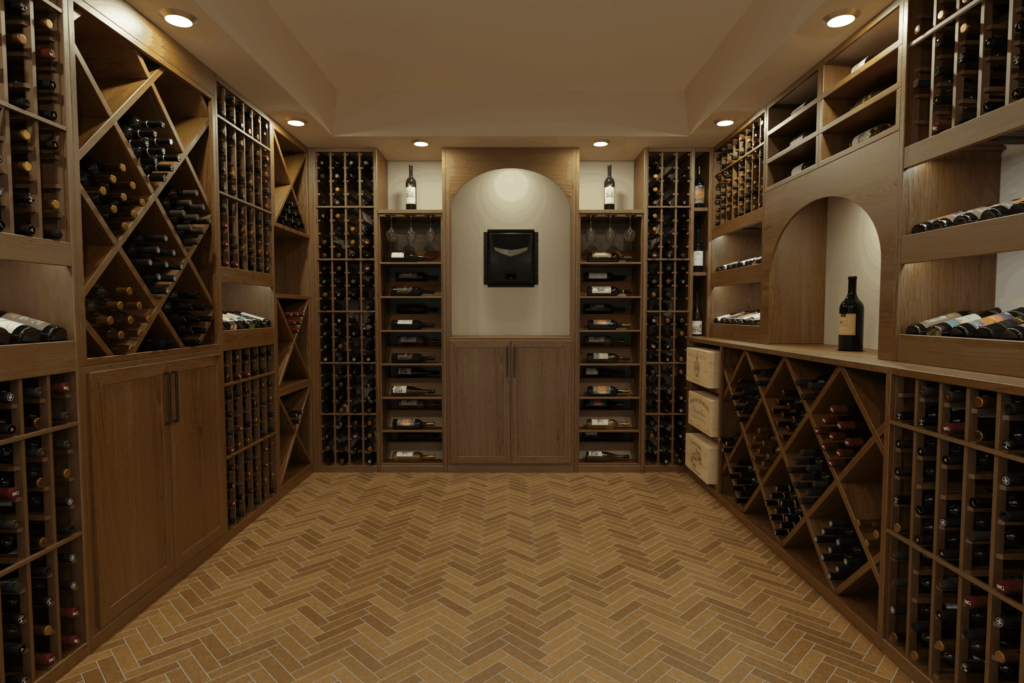
Choosing the right wine cellar cooling system is about more than selecting a unit with enough BTUs. The way a cooling system rejects heat can have a major impact on installation, noise, ventilation, energy use, and long-term performance.
For many wine cellars, an air-cooled Wine Guardian system is the practical choice. But when ventilation is limited, ambient temperatures are high, or a suitable year-round water source is already available, a water-cooled Wine Guardian system can provide an excellent alternative.
So, which one is right for your wine cellar?
The answer depends on the room’s heat load, location, installation conditions, and available infrastructure.
Both air-cooled and water-cooled systems use refrigeration to remove heat from the wine cellar. The important difference is what happens to that heat after it is removed.
An air-cooled system uses air to absorb and reject condenser heat, while a water-cooled system transfers that heat into water.
Wine Guardian offers both configurations for several of its ducted wine cellar cooling systems. Its water-cooled models are specifically designed for applications involving geothermal systems, cooling towers, lakes, wells, or other suitable year-round water sources.
Air-cooled systems are the more conventional approach to wine cellar cooling. The condenser uses surrounding air to remove the heat generated by the refrigeration process.
The major advantage is flexibility. Depending on the system, condenser air can often be taken from another area or ducted outside, while warm condenser air can be directed away from the installation space.
This can make air-cooled systems suitable for many residential wine cellars where appropriate ventilation or ducting can be provided.
1. Easier access to the heat-rejection medium
Air is readily available, so there is no need for a dedicated water supply.
2. Flexible installation
Ductable air-cooled systems can provide options for bringing in cooler air or exhausting warm condenser air away from the unit. Wine Guardian specifically notes that ducted condenser configurations can be useful when the installation area cannot comfortably accept the additional heat.
3. No ongoing water requirement
Unlike a water-cooled system, an air-cooled system doesn’t require a year-round water source.
4. Good fit for typical residential wine cellars
If the mechanical room, garage, utility area, attic, or other installation location can properly handle condenser heat, an air-cooled system is often the straightforward solution.
Air-cooled systems need somewhere for the condenser heat to go.
This becomes especially important in warm climates. Installing an air-cooled unit in a small enclosed mechanical room without adequate ventilation can cause the surrounding temperature to rise and make it harder for the system to operate efficiently.
Wine Guardian notes that air-cooled systems have allowable condenser intake temperature ranges, and special options may be needed for unusually high or low ambient conditions.
For a South Florida wine cellar, for example, the location of the condenser and the way hot air is exhausted should be considered during the design stage.
A water-cooled system uses water instead of ambient air to reject heat from the condenser.
This changes the installation equation considerably.
Rather than exhausting warm condenser air into a mechanical space or ducting it outside, the system transfers heat into the water loop.
Wine Guardian’s water-cooled ducted systems are designed for applications with suitable year-round water sources, including geothermal systems, cooling towers, and lake water applications.
1. No warm condenser-air exhaust
One of the biggest benefits is that a water-cooled system does not require warm condenser air connections. This can solve a major installation challenge when there is nowhere convenient to exhaust hot air.
2. Excellent for difficult mechanical spaces
If a wine cellar is surrounded by finished rooms and there is no practical path for condenser-air ductwork, water cooling can provide another option.
3. Quiet operation potential
Because heat rejection does not rely on an air-cooled condenser fan in the same way, water-cooled systems can be attractive for applications where condenser noise is a concern.
4. Well suited to geothermal applications
A geothermal water source can provide an effective heat-rejection method, making water-cooled systems particularly interesting for specialized residential and commercial installations.
5. Useful in high-ambient environments
When outside or mechanical-room air temperatures are very high, using an appropriate water source for heat rejection can eliminate some of the challenges associated with hot condenser air.
| Feature | Air-Cooled | Water-Cooled |
|---|---|---|
| Heat rejection | Ambient air | Water |
| Warm-air exhaust required | Yes, depending on installation | No |
| Year-round water source | Not required | Required |
| Installation flexibility | High with proper ducting | Very high where water is available |
| Geothermal applications | Not the primary choice | Excellent |
| Cooling tower applications | Not applicable | Excellent |
| Lake/well water applications | Not applicable | Excellent |
| Ideal for typical residential cellars | Yes | Sometimes |
| Best for limited ventilation | May require ducting | Excellent option |
| Water consumption | None | Depends on system/application |
| Noise considerations | Condenser airflow/fan must be considered | Attractive where condenser fan noise is undesirable |
The key point is that water-cooled does not automatically mean better. It means the system is better suited to certain installation conditions.
Wine Guardian provides water-cooled configurations across a range of its ducted systems.
For example, the D025WC, D050WC, D088WC, and D200WC are available as 60Hz water-cooled ducted systems.
The D025, for example, is a self-contained ducted system intended for small residential and commercial wine cellars. Its water-cooled D025WC configuration is designed for applications with a year-round water source and has a published capacity of up to 3,760 BTU/h.
The important point is that system capacity should be selected based on the actual wine cellar heat load—not simply the room’s cubic footage.
Glass walls, exterior walls, insulation, ceiling exposure, doors, lighting, surrounding temperatures, and other heat sources can significantly affect the required cooling capacity.
An air-cooled system is generally the better starting point when:
You don’t have a suitable year-round water source.
There is adequate space for condenser ventilation.
Condenser air can be ducted to an appropriate location.
You want a relatively straightforward installation.
Your mechanical room can safely handle the heat produced by the condenser.
Your project doesn’t require geothermal or cooling-tower integration.
For many residential wine cellars, this makes air-cooled systems the logical choice.
Wine Guardian offers ducted, through-the-wall, and split configurations, allowing designers to select a system based on the cellar’s size and installation requirements.
A water-cooled Wine Guardian system deserves serious consideration when:
This is one of the strongest reasons to choose water cooling.
If the cooling unit must be installed in an interior mechanical space where hot condenser air cannot be effectively exhausted, water cooling eliminates the need for warm-air duct connections.
Water-cooled Wine Guardian systems are particularly well suited to geothermal applications.
Commercial buildings and larger properties may already have water-based heat-rejection infrastructure. In those situations, integrating a water-cooled wine cellar system can be practical.
Wine Guardian identifies lake and well-type water sources as potential applications, provided the water meets the system’s requirements and is available year-round.
If the wine cellar is located near living areas, bedrooms, entertainment spaces, or other noise-sensitive areas, eliminating the need for conventional warm-air condenser ventilation can be an attractive design advantage.
Water temperature is an important part of the installation.
Wine Guardian states that its water-cooled systems can accept inlet water temperatures from approximately 45°F to 85°F (7°C to 29–30°C), depending on the system.
This means you should not assume that any available water source will automatically work.
The water supply should be evaluated for:
Inlet temperature
Year-round availability
Flow requirements
Water quality
Plumbing configuration
Drainage and discharge requirements
Compatibility with geothermal or recirculating systems
A qualified installer should evaluate these conditions before selecting the equipment.
Potentially, yes—and this is an important consideration.
Wine Guardian explains that water consumption varies according to the unit’s size, capacity, and cooling-cycle frequency. Recirculating applications such as geothermal systems, cooling towers, and suitable lake or pool water systems can therefore be particularly attractive.
This is why a water-cooled unit should not simply be selected because it sounds more efficient.
The water infrastructure is part of the system design.
If you already have an appropriate closed-loop geothermal or cooling-tower system, water cooling can be highly attractive. If you would need to create an entirely new water system solely for the wine cellar, the economics and installation complexity may change.
South Florida presents an interesting case.
High outdoor temperatures and humidity can make wine cellar cooling more demanding, particularly when the cellar includes large glass areas or is located near exterior walls.
For these projects, an air-cooled system can still work extremely well when the condenser is installed correctly and hot air is properly exhausted.
However, a water-cooled Wine Guardian system may become attractive when:
There is no convenient condenser-air exhaust route.
The mechanical room is small or enclosed.
The cellar is part of a luxury home where mechanical noise must be minimized.
A suitable geothermal or other water source already exists.
The project has unusual architectural constraints.
The cooling system should always be selected after calculating the cellar’s heat load and evaluating the complete installation environment.
BTU capacity is critical, but it isn’t the only consideration.
Two wine cellars with identical dimensions can require very different cooling capacities.
For example, a cellar with:
Multiple glass walls
A glass door
Exterior-facing walls
Poor insulation
High ceiling exposure
Significant lighting
Warm surrounding spaces
may have a substantially higher cooling load than a similarly sized cellar constructed inside a well-insulated interior space.
Wine Guardian recommends using a wine cellar cooling calculator to help determine whether a particular system is appropriate for the application.
At CoolWineCellar, we recommend looking at the entire heat-load calculation and installation environment before choosing the cooling technology.
There isn’t one universal winner.
You want the simplest and most flexible solution.
An air-cooled Wine Guardian system is usually the better choice when you have adequate ventilation and a practical way to exhaust condenser heat.
Your installation makes air-based heat rejection difficult.
Water cooling becomes especially compelling when you have a geothermal system, cooling tower, suitable lake/well water source, or another appropriate year-round water supply.
Air-cooled systems are generally the practical choice for conventional wine cellar installations. Water-cooled systems are specialized solutions that can be exceptionally effective when ventilation is limited or an appropriate water source is already available.
The right decision isn’t simply about choosing the more powerful or more expensive system. It is about matching the cooling technology to the architecture, heat load, climate, available utilities, and installation location.
A properly designed wine cellar cooling system should maintain stable wine-storage conditions without compromising the aesthetics or comfort of the surrounding space.
Wine Guardian’s range of air-cooled and water-cooled ducted systems gives homeowners, designers, architects, and contractors options for both conventional and highly specialized wine cellar projects. Its water-cooled systems are particularly valuable where geothermal, cooling-tower, lake, or other suitable year-round water sources are available.
If you’re designing a new wine cellar or upgrading an existing one, start with the heat-load calculation, then evaluate where the cooling unit will be installed and how condenser heat will be rejected.
That approach will help determine whether an air-cooled Wine Guardian system or a water-cooled Wine Guardian system is the better fit for your project.
For wine cellar cooling systems, racks, glass enclosures, and custom wine cellar solutions, Visit Cool Wine Cellar to explore both air cooled and water cooled wine guardian cooling systems.