
Call Us 📞 800-323-3130
Mon–Fri 8am–6pm CST, Sat–Sun 9am–1pm CST
Free design consultations
Showrooms in Miami & Fort Lauderdale
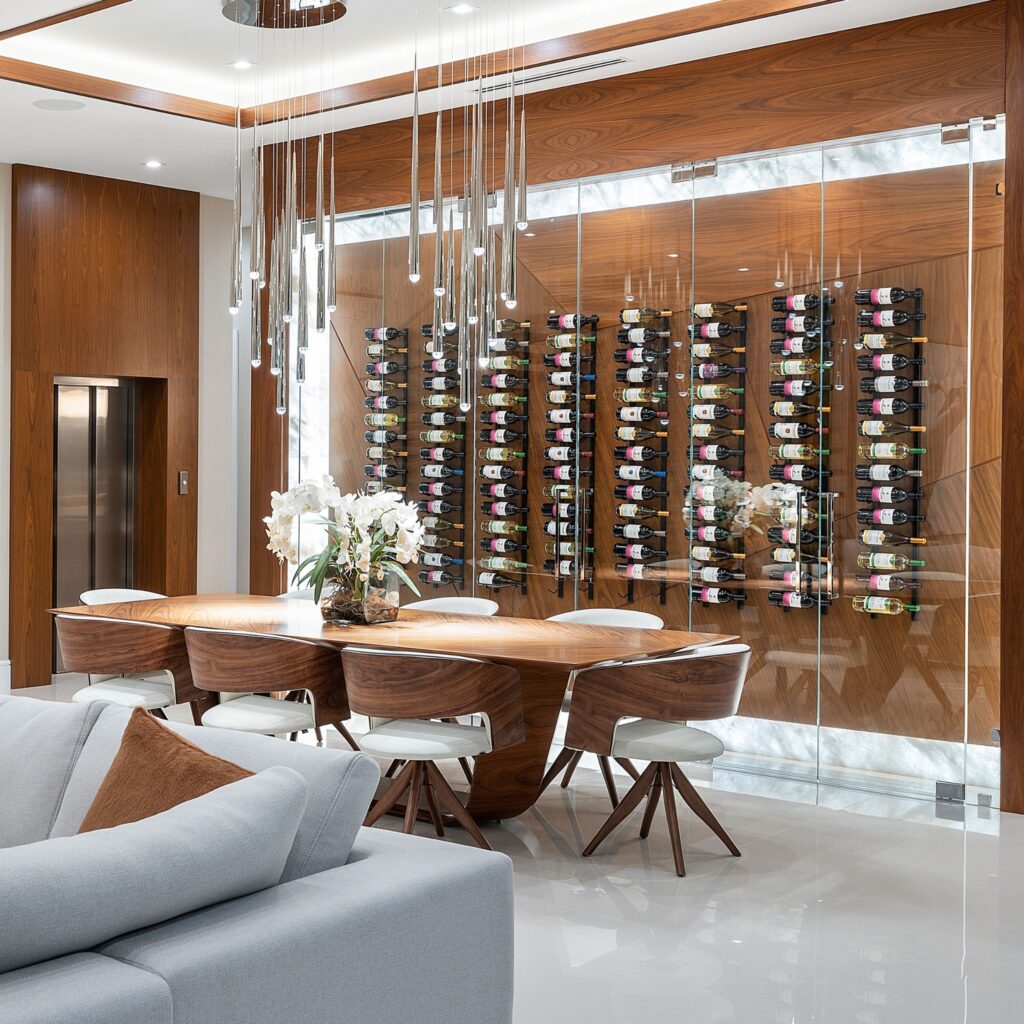
Building a custom wine cellar starts with a BTU heatload calculation, not a design sketch. That number determines which cooling system will actually hold 55–58°F and 50–70% humidity in your space, which in turn shapes the insulation, vapor barrier, door, and racking decisions that follow. Skipping this step is the single most common reason custom cellars fail to hold temperature.
Most homeowners start planning a custom wine cellar the way they’d plan a wine rack purchase — by picking a look first. That’s backwards. A wine cellar is a small, sealed refrigerated room, and refrigeration only works if the cooling unit is sized correctly for the space.
A heatload calculation measures how much heat is entering the room from every direction — walls, ceiling, floor, door, glass, ductwork, even nearby light fixtures — and expresses it in BTUs (British Thermal Units) per hour. That BTU number is what determines which cooling system can actually keep the room at wine-safe temperatures year-round.
Key factors that go into a proper heatload calculation:
Get this number wrong and one of two things happens: an undersized unit runs constantly and still can’t hold temperature, or an oversized unit short-cycles, causing temperature swings that are arguably worse for wine than a room that’s simply a few degrees warm. Bigger isn’t better — matched is better.
[We calculate heatload for free before recommending a wine cooling system — no design commitment required.]
Once the BTU number is set, the cooling system selection becomes straightforward rather than a guessing game. The main categories:
Self-contained (through-wall) units — Compact, cost-effective, and ideal for smaller cellars where the unit can vent into an adjacent space like a garage or basement.
Split systems — The compressor sits remotely (basement, garage, exterior), with only the evaporator inside the cellar. This keeps noise and vibration out of the wine room entirely — a meaningful advantage for collectors storing bottles long-term, since vibration is one of the lesser-known threats to proper aging.
Ducted systems — Best for larger cellars or rooms with unusual layouts, distributing conditioned air evenly rather than relying on a single point source.
We work primarily with WhisperKOOL and Wine Guardian systems, chosen for reliability and quiet operation — both are sized directly against your room’s heatload number, not a generic “small/medium/large” guess.
With the cooling system selected, the physical build-out follows a sequence that protects the room’s ability to hold temperature and humidity:
Wine Racking is where function and design finally meet — but it still follows practical rules:
Does a custom wine cellar increase home value? A well-built custom wine cellar is generally viewed as a premium amenity, particularly in homes positioned for entertaining or in markets where wine collecting is common. Value impact varies by market, but a properly engineered cellar (correct temperature, humidity, and build quality) adds more resale appeal than a poorly executed one.
How much does a custom wine cellar cost? Cost depends on room size, cooling system type, insulation requirements, door and glass specification, and racking materials. Because so much of the cost is driven by the heatload calculation and cooling system selection, we provide a free consultation and heatload assessment before quoting.
How long does it take to build a custom wine cellar? Timelines vary with room complexity, but the sequence is consistent: heatload calculation and design, then framing and insulation, cooling system installation and commissioning, and finally racking and finish work.
Can an existing closet or room be converted into a wine cellar? Yes — many custom cellars start as an existing closet, basement room, or under-stair space. The conversion process still requires the same heatload calculation and vapor barrier work as new construction.
Every custom wine cellar we build starts the same way — with a free heatload calculation, not a sales pitch. It’s the only way to size a cooling system that will actually protect your collection for the long term.