
Call Us 📞 800-323-3130
Mon–Fri 8am–6pm CST, Sat–Sun 9am–1pm CST
Free design consultations
Showrooms in Miami & Fort Lauderdale
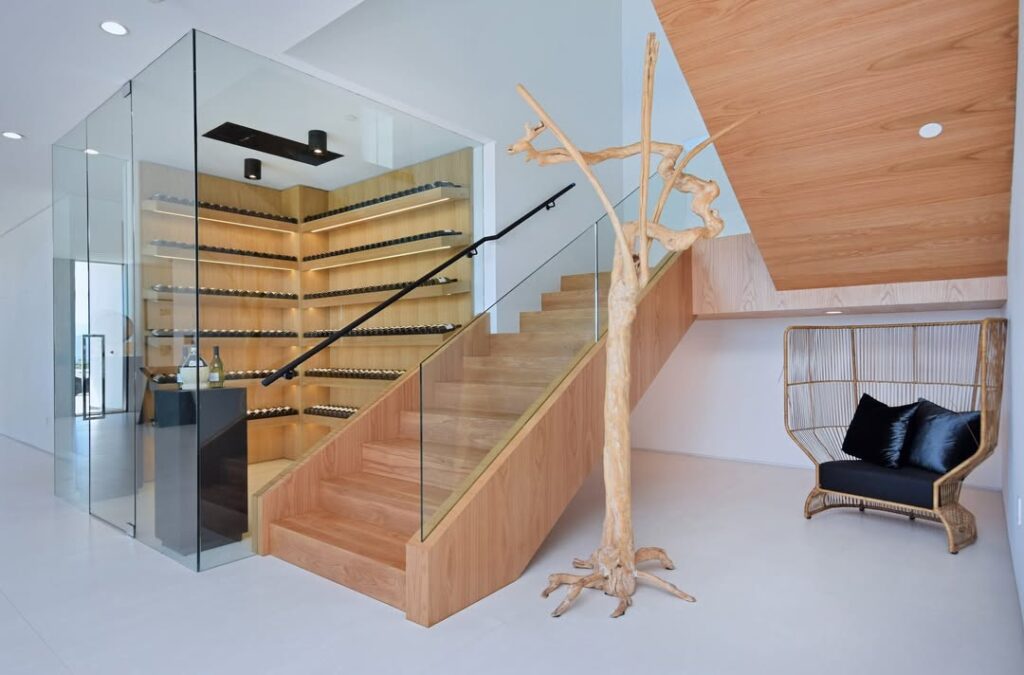
Turning the unused space under your staircase into a dedicated wine cellar is one of the most brilliant and space-efficient home upgrades a collector can make. However, this unique location presents a specific set of challenges when it comes to climate control. It’s not just a small space; it’s an irregular, usually non-rectangular space, often bordered by varying temperatures on all sides.
The success of an under-the-stairs cellar hinges entirely on selecting the right cooling unit. Get it wrong, and you risk inconsistent temperatures, damaging humidity levels, and excess noise in a central part of your home.
This guide will break down the essential considerations and review the best cooling options for this unique installation.
When designing climate control for this space, standard cellar rules often don’t apply. You must address:
1. Aggressive Space Constraints: This is the most obvious challenge. The sloped ceiling (the stairs themselves) creates varying cubic footage. You need a unit that can deliver adequate BTU (British Thermal Units) for the maximum volume of the space, but that is physically small enough to fit.
2. Challenging Airflow Patterns: In a small, irregular space, creating even, circular airflow is difficult. Dead air pockets where heat can gather are common. You need a unit that excels at circulating cold air and drawing back the warm air.
3. Condenser Heat Exhaust: A common mistake in these installations is venting the hot air exhausted by the unit into the stair cavity or an adjacent (small) hallway. This hot air will quickly warm the surrounding structure and seep back into the cellar, forcing the unit to run constantly. You must duct this exhaust away to a large, well-ventilated room or the outdoors.
4. Noise and Vibration Control: Under-the-stairs cellars are frequently near living rooms, dining rooms, or entryways. A noisy cooling system is a major deterrent. The unit must have superior vibration dampening to avoid rattling the very staircase you walk on, and quiet operation is essential.
5. Aesthetics and Integration: The cellar is often a display feature. You don’t want a bulky, industrial-looking machine dominating the view. The ideal unit is discrete or entirely hidden.
The “best” unit depends on the type of installation your home’s layout permits. Here are the three main categories and the optimal units in each class.
Through-the-wall units are the most straightforward solution, where the entire mechanical system sits on the cellar wall, venting directly to an adjacent space.
For an under-the-stairs installation, the CellarPro 1800 & WhisperKOOL SC Pro Series are a top contender.
Why it Works: It is explicitly designed for small cabinets and tight, irregular cellars. It offers incredible cooling power (up to 200 cu. ft.) in a remarkably compact chassis. It uses a top-venting system, which is ideal if you have minimal wall space near the floor.
Key Advantage: The self contained cooling unit is designed to handle higher ambient temperatures on the exhaust side (up to 95°F), meaning it can vent into a warm mechanical closet or a well-ventilated garage far better than its competitors.
Runner Up: WhisperKOOL SC Pro 2000 (Excellent reliability, but requires a lower exhaust temperature).
A fully ducted system is often the ultimate solution for a small display cellar, as it keeps all mechanical equipment entirely hidden. The unit is installed remotely (in an attic, basement, or utility closet), and cold air is supplied to the cellar via insulated ducts, with warm air returned the same way.
The ducted cooling unit is the ideal engine for this.
Why it Works: This unit is engineered for versatile installations and high-static pressure loads (which occur when pushing air through ducts). It is highly customizable, and it offers specific ducting kits tailored for tight spaces.
Key Advantage: Perfect aesthetics. The only visible element inside your cellar is a sleek, decorative grille (vent). It removes all noise and vibration from the staircase itself.
If you want the discrete aesthetics of a ducted system but cannot accommodate large ductwork (which is common under stairs), a split system is the answer. A split system separates the evaporative coil (which cools the cellar) from the condenser unit (which makes the noise and generates heat).
The WhisperKOOL Ceiling Mount series is uniquely brilliant for this application.
Why it Works: The evaporator coil is designed to recess flush into the ceiling. This utilizes the dead space at the top of your sloped staircase, where cool air naturally flows down, creating efficient, cascading airflow.
Key Advantage: It is virtually invisible and takes up zero valuable wall space for wine racking. It operates almost silently inside the cellar, making it the perfect choice for a display in a high-traffic area.
While these units represent the absolute best technology available for compact, irregular spaces, selecting the right one still requires a detailed thermal load calculation. This calculation factors in the specific insulation (R-Value) of your cellar walls, the type of glass door you install, the maximum temperature outside the cellar, and the shape of the staircase.
An under-the-stairs cellar is a precision project. Don’t leave your collection’s environment to chance. Consult a wine storage professional to ensure your chosen unit is perfectly sized for your specific, unique space.